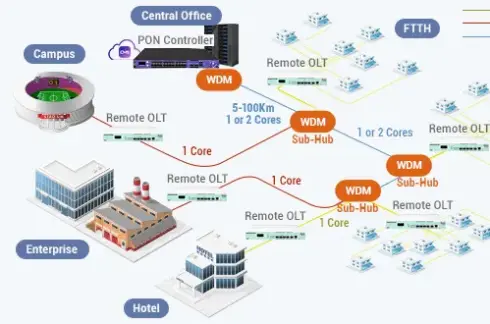
Rural broadband requires flexible OLT strategies due to scattered users, long distances, and limited facilities. Centralized, distributed, outdoor, or mini OLTs enable reliable PON coverage with remote management, suitable capacity, and support for internet, IPTV, VoIP, and future growth.
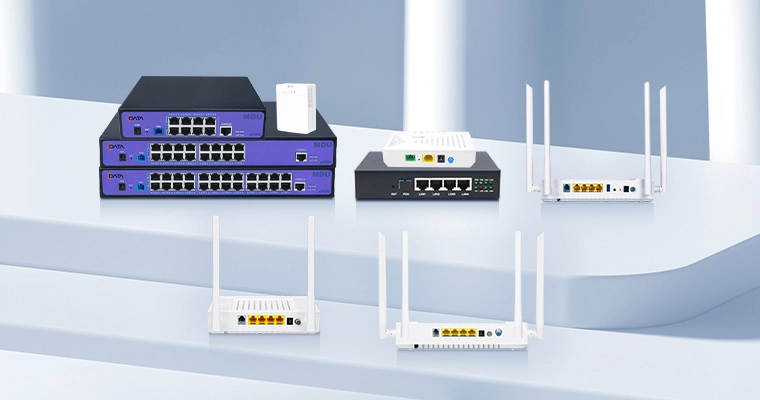
An xPON ONU receives downstream signals, completes registration and ranging, transmits upstream through scheduled windows, maps services to wired, Wi-Fi and voice interfaces, and supports centralized monitoring and management.
An OLT delivers internet, IPTV, and VoIP over one PON network using VLANs, QoS, multicast, and service profiles. It aggregates traffic from ONUs to the core, prioritizing voice and video while enabling efficient multi-service FTTH deployment with compatible ONUs.
EPON and GPON OLTs differ in standards, bandwidth, ONU compatibility and scalability. Choosing the right solution depends on existing infrastructure, subscriber capacity, management needs and future 10G migration plans.
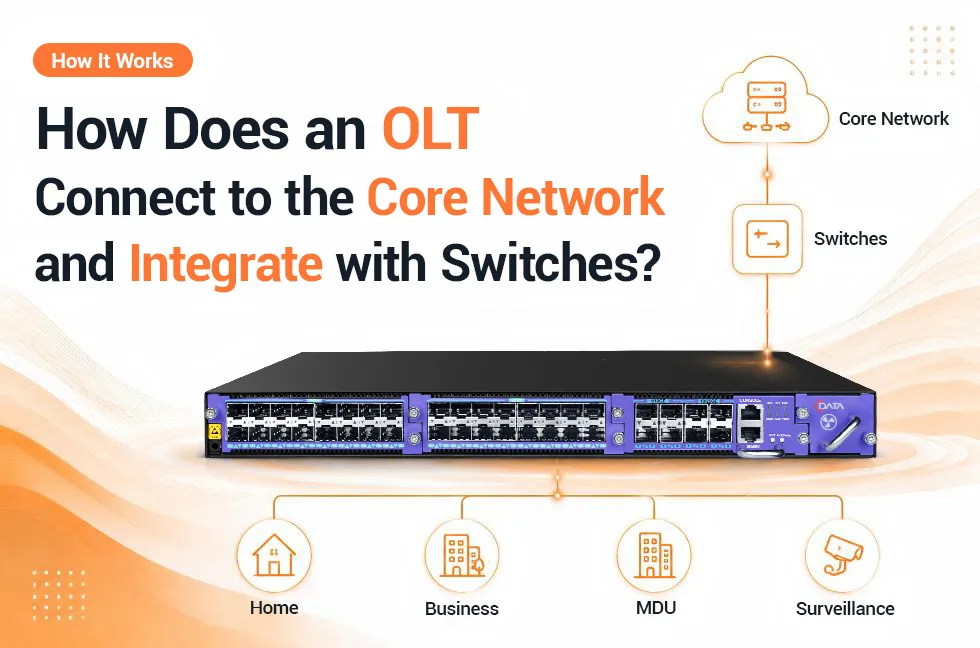
An OLT aggregates PON traffic from ONUs and forwards it via Ethernet uplink ports to aggregation switches, routers, or BNG systems toward the core network. Proper uplink bandwidth, VLAN mapping, redundancy, and switch compatibility ensure scalable, reliable carrier FTTH integration.
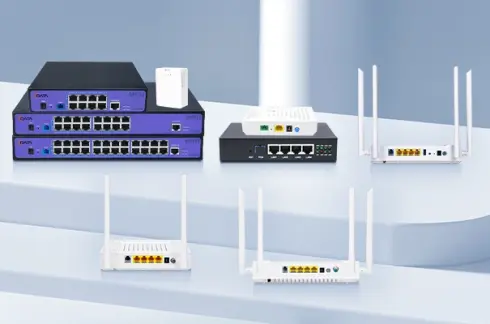
An ONU terminates PON fiber signals and converts them to user interfaces at the subscriber side. A router manages IP traffic, NAT, DHCP, and local sharing. Many devices combine both as ONU routers for simple FTTH homes; separate units suit advanced enterprise needs.
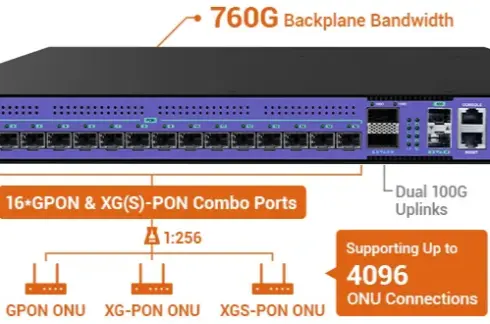
An OLT comprises PON ports (to ONUs via splitters), uplink ports (to core/aggregation), a chassis for modular housing, and service boards providing GPON/XGS-PON interfaces. These integrate for scalable PON access, balancing capacity, redundancy, and future upgrades in FTTH deployments.
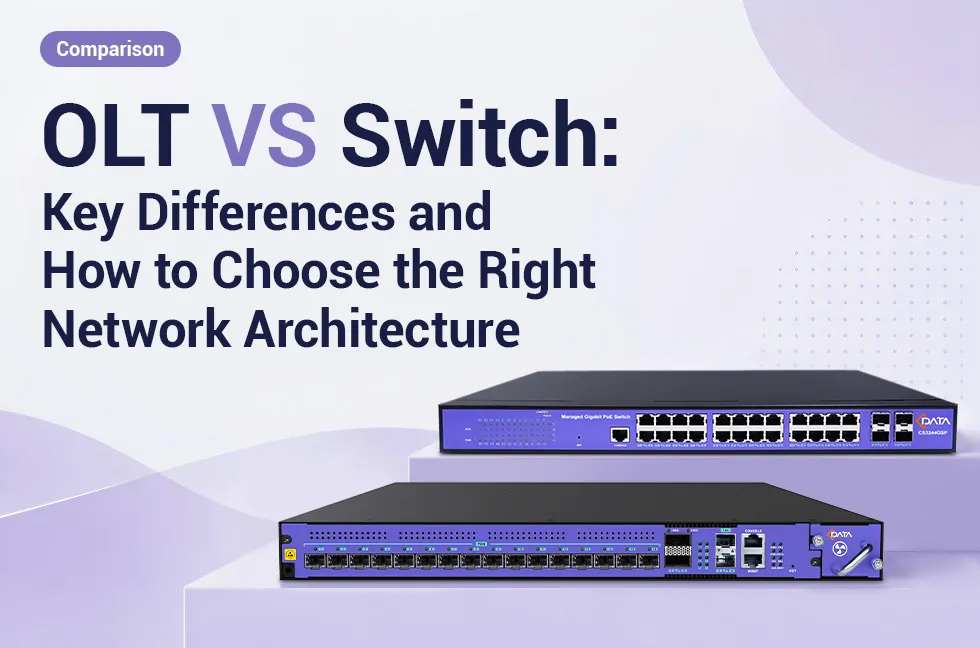
An OLT manages PON fiber access to ONUs via splitters; a switch forwards Ethernet traffic. They complement each other in FTTH networks, with OLT handling access and switches aggregating uplinks. Choose based on PON needs versus Ethernet aggregation.
This article compares GPON, Combo PON, mini, chassis, indoor, and outdoor OLTs, explaining their applications, scalability, deployment environments, upgrade paths, and selection criteria for future-ready ISP fiber networks and enterprises.
OLT selection should match deployment scenario, environment, user density, service needs, scalability and maintenance capacity, from rural and outdoor networks to enterprises, startups, ISPs and telecom operators, while enabling growth.
Subscribe to be the first to hear about news and upcoming products
+86 18138281180
+86 18138281180
This website uses cookies to ensure you get the best experience. Some cookies are essential, while others help
us improve your experience by analyzing data or showing personalized content.
For details, please see our
Privacy Policy.


 Optical Transport Networking Solution
 FTTH Solution
 Home Networking Solution
 POL Solution
 Outdoor OLT Solution
 More
More
 Brand News
 Product News
 Tech Blogs
 CMS
CMS
 Tech Support
 Document Download
 Software Download
 FAQ
FAQ
 Training Center
 About Us
 Careers
 Partners
 Quality Assurance
 Video Center