 Optical Transport Networking Solution
 FTTH Solution
 Home Networking Solution
 POL Solution
 Outdoor OLT Solution
 More
More
 Brand News
 Product News
 Tech Blogs
 CMS
CMS
 Tech Support
 Document Download
 Software Download
 FAQ
FAQ
 Training Center
 About Us
 Careers
 Partners
 Quality Assurance
 Video Center


This website uses cookies to ensure you get the best experience. Some cookies are essential, while others help
us improve your experience by analyzing data or showing personalized content.
For details, please see our
Privacy Policy.

Modern fiber access networks face a practical challenge: how to upgrade from widely deployed GPON to higher-capacity XGS-PON while preserving the existing GPON ODN and avoiding a simultaneous replacement of the installed GPON ONU base. The advanced technical answer adopted by many operators is the Combo PON OLT. This platform integrates GPON and XGS-PON (or related multi-PON) capabilities on the same hardware, allowing both generations of ONUs to coexist on the same ODN.
This article focuses exclusively on the advanced technical aspects of Combo PON OLT technology — coexistence mechanisms, high user density support, optical and bandwidth management, and operational advantages — as implemented in platforms such as the 16-port GPON XGS-PON Combo OLT FD1816S-B1 and related models from C-Data.
The global Combo PON OLT market continues to expand as operators seek practical migration paths from GPON to higher-speed services. In the Broadband Forum TR-156 architecture, the GPON OLT forms part of the access node and provides the network-facing aggregation function for PON subscribers. This architectural role becomes even more critical in Combo PON designs, where a single platform must simultaneously aggregate both GPON and XGS-PON traffic while maintaining service isolation, QoS and efficient bandwidth allocation.
A conventional GPON OLT supports only the ITU-T G.984 wavelength plan (1490 nm downstream / 1310 nm upstream). An XGS-PON OLT uses a different wavelength set (typically 1577 nm downstream / 1270 nm upstream). A Combo PON OLT embeds both optical technologies in the same line card or fixed platform and uses wavelength-division multiplexing (WDM) filters so that GPON and XGS-PON signals can share the same physical fiber and passive splitters.
This coexistence is not merely a marketing feature. It requires precise optical design, independent bandwidth scheduling engines, and careful management of power budgets so that neither technology interferes with the other. The result is a single OLT that can serve existing GPON ONUs while simultaneously supporting XGS-PON ONUs for 10G services.
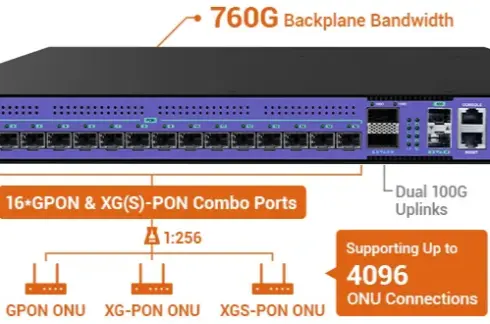
Advanced Combo platforms are engineered for high subscriber density. Models such as the 16-port Combo Pon OLT FD1816S-B1 are designed to support up to 4096 ONUs under a 1:256 split configuration when optical conditions allow. In practice, operators select split ratios according to optical budget, bandwidth packages and service mix, but the hardware capability provides significant headroom for growth.
Each PON port on a Combo OLT can independently operate in pure GPON mode, pure XGS-PON mode, or concurrent Combo mode. This flexibility lets planners migrate neighbourhood by neighbourhood or service tier by service tier rather than performing a forklift upgrade.
The technical heart of Combo PON is optical coexistence. Downstream signals at different wavelengths are combined and then separated at the ONU by wavelength-selective filters. Upstream signals from GPON and XGS-PON ONUs travel on distinct wavelengths and are demultiplexed at the OLT.
Engineers must still respect the overall optical power budget. Because both technologies share the same passive optical splitters and ODN, the design must ensure that the weakest ONU (usually the furthest or highest-split-ratio unit) remains within the receiver sensitivity window of its respective technology. Advanced Combo PON OLTs provide per-port optical monitoring and alarm thresholds so that operators can detect degrading connectors or excessive splitter loss before service is affected.
Because GPON and XGS-PON use separate transmission-convergence mechanisms, bandwidth allocation is managed independently for each PON system while the OLT can expose both through a unified management framework. This allows the platform to apply different traffic descriptors, priority queues and service profiles to GPON and XGS-PON subscribers on the same physical port.
Voice, IPTV and enterprise traffic can be protected with high-priority T-CONTs regardless of which PON generation the customer uses. Ordinary internet traffic can share remaining capacity under best-effort or non-assured rules. The result is consistent service quality during the multi-year migration period.
Advanced technical platforms are only as useful as their management systems. C-Data provides network management software CMS and OLT management software that present both GPON and XGS-PON resources in a single interface. Operators can provision ONUs, monitor optical levels, apply service profiles and perform bulk firmware upgrades without needing separate tools for each PON generation.
Centralized management is especially valuable when the same OLT serves mixed populations of residential, business and multi-dwelling users. Alarms, performance counters and configuration templates remain consistent across the Combo ports.
Urban FTTH migration An operator with a large installed base of GPON ONUs can insert Combo line cards or replace selected fixed OLTs with Combo units. Existing customers continue uninterrupted while new or premium customers receive XGS-PON services on the same ODN.
High-density multi-dwelling units Buildings that already have optical splitters can be upgraded by changing only the central OLT. A single 16-port GPON XG-PON Combo OLT FD1816S-B1 or similar high-density unit can serve thousands of apartments with a mixture of service tiers.
Greenfield projects with future growth in mind Even in new builds, many operators now prefer Combo platforms so that the initial GPON phase can later evolve to XGS-PON without another hardware replacement cycle.
Rural and distributed access Compact Combo models can be placed in outdoor cabinets or remote nodes, combining the reach advantages of GPON with the upgrade path of XGS-PON.
Aspect | Pure GPON OLT | Pure XGS-PON OLT | Combo PON OLT |
Existing GPON ONU support | Yes | No | Yes |
10G service capability | No | Yes | Yes |
GPON-to-XGS-PON migration | Requires OLT-side migration | Requires GPON users to migrate | Supports gradual coexistence |
Existing ODN reuse | Native | Requires careful planning | Possible when ODN is compatible |
Management complexity | Lower | Lower | Higher, but enables unified operation |
Typical use case | Cost-sensitive standard broadband access | Premium / greenfield 10G | Migration and mixed-service networks |
For most operators that already have GPON deployed, the Combo PON solutions can provide an effective technical and economic balance.
Successful Combo PON deployments require attention to several advanced technical details:
Accurate measurement of existing ODN loss and reflection
Confirmation that splitters and connectors support the additional wavelengths
Clear service-profile design that maps GPON and XGS-PON customers to appropriate bandwidth and QoS settings
Use of management platforms capable of handling mixed ONU populations
Pilot testing of coexistence under real traffic and optical conditions before mass rollout
C-Data, as an established OLT manufacturer, designs its Combo platforms (including the FD1816S-B1 series and related models) with these operational realities in mind. The same portfolio also includes complementary fixed and mini OLTs for pure GPON or pure XGS-PON scenarios when full coexistence is not required.
Operators evaluating high-density Combo solutions can review detailed specifications of the 16-port Combo OLT, explore the broader C-Data OLT portfolio, or start from the main C-Data site for a complete view of access platforms and management software.
Combo PON OLT technology represents one of the most practical advanced technical solutions for today’s fiber access networks. By enabling true GPON and XGS-PON coexistence on the same optical plant, it protects existing investment, supports high user densities (including configurations approaching 4096 ONUs under high split ratios), and provides a clear migration path to multi-gigabit services. Platforms such as the 100GE uplink Combo OLT for 10G broadband from C-Data combine optical coexistence, independent bandwidth engines, high port density and unified OLT NMS software into a single operational system.
For network planners facing the dual pressure of rising bandwidth demand and the need to preserve current infrastructure, Combo PON OLT technology offers a technically sound and economically rational way forward.
1. What is the core technical advantage of a Combo PON OLT?
It allows GPON and XGS-PON ONUs to share the same ODN and passive splitters through wavelength coexistence, enabling gradual migration without full network replacement.
2. How many ONUs can a high-density Combo OLT support?
Advanced models such as the 16-port GPON XGS-PON Combo OLT FD1816S-B1 are designed to support up to 4096 ONUs under a 1:256 split when optical conditions permit.
3. Does Combo PON require changes to the existing ODN?
In most cases the existing fiber and splitters can be reused. Wavelength filters at the OLT and ONU handle the separation of GPON and XGS-PON signals.
4. How is bandwidth managed when both technologies share a port?
The OLT runs independent DBA and QoS engines for each PON generation while presenting a unified management interface.
5. What management software is typically used?
C-Data provides cdata software, such as OLT management software and NMS software CMS for OLT that handle mixed GPON/XGS-PON populations from a single console.
6. Is Combo PON suitable for both migration and greenfield projects?
Yes. It is ideal for migrating existing GPON networks and is also chosen for new builds that want a built-in upgrade path to 10G services.
7. Where can operators review C-Data Combo PON OLT models?
Detailed product information is available in the C-Data OLT product section, including the FD1816S-B1 series and related platforms.