 Optical Transport Networking Solution
 FTTH Solution
 Home Networking Solution
 POL Solution
 Outdoor OLT Solution
 More
More
 Brand News
 Product News
 Tech Blogs
 CMS
CMS
 Tech Support
 Document Download
 Software Download
 FAQ
FAQ
 Training Center
 About Us
 Careers
 Partners
 Quality Assurance
 Video Center


This website uses cookies to ensure you get the best experience. Some cookies are essential, while others help
us improve your experience by analyzing data or showing personalized content.
For details, please see our
Privacy Policy.

Choosing between an EPON OLT and a GPON OLT is an important decision when designing a fiber access network. Both technologies use passive optical networks to connect multiple subscribers through optical splitters, but they differ in standards, bandwidth, transmission methods, ONU compatibility and deployment options.
For ISPs, network operators and system integrators, the right choice depends on the existing ONU/ONT base, bandwidth requirements, network size, management needs and future upgrade plans.
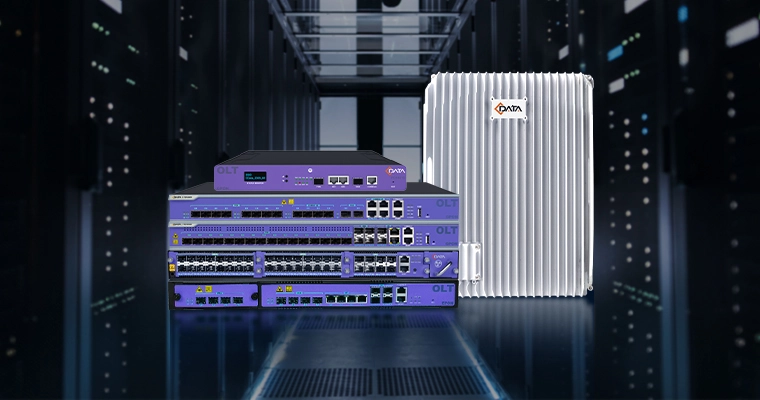
C-Data provides both C-Data EPON OLT and GPON OLT solutions, including the FD1304S, expandable EPON OLT FD1304E, Mini GPON OLT FD1601S, pizza-box GPON OLT FD1604S, FD1608S and FD1616S. and expandable GPON OLT FD1604E. Its portfolio also includes Combo PON and XG(S)-PON platforms for higher-capacity networks.
This guide compares EPON OLT and GPON OLT and explains how their differences affect network capacity, compatibility, management and equipment selection.
EPON and GPON are both passive optical access technologies, but they use different standards.
EPON is based on IEEE 802.3ah and uses Ethernet as its native transport structure. GPON is defined by the ITU-T G.984 series and uses a more flexible transport framework.
The basic architecture is:
Core Network → OLT → Optical Splitter → ONU/ONT → User Devices
The OLT manages communication between the operator's network and multiple subscriber-side ONUs or ONTs.
Feature | EPON OLT | GPON OLT |
Standard | IEEE 802.3ah | ITU-T G.984 |
Typical downstream | 1.25 Gb/s | 2.5 Gb/s |
Typical upstream | 1.25 Gb/s | 1.25 Gb/s |
Subscriber equipment | EPON ONU | GPON ONU |
Main applications | FTTH, Ethernet access | FTTH, FTTB, multi-service access |
Management | OLT/NMS/CMS | OLT/NMS/CMS |
The main difference is therefore not the fiber itself, but the transmission standard, bandwidth structure and subscriber-device compatibility.
EPON provides a 1.25 Gb/s line rate in both directions, while GPON provides approximately 2.5 Gb/s downstream and 1.25 Gb/s upstream. These rates represent the shared PON line capacity rather than the bandwidth available to an invidual subscriber.
The higher GPON downstream rate can be useful for networks with strong download traffic, including video streaming, cloud applications and large file transfers.
However, line rate does not equal individual subscriber speed. Actual performance also depends on split ratio, service profiles, uplink capacity, ONU performance and the number of active users.
Therefore, GPON is not automatically the better choice simply because its nominal downstream capacity is higher. Network architecture and existing equipment are equally important.
C-Data's EPON portfolio includes compact and expandable platforms.
The FD1304S EPON OLT provides 4 EPON ports, 4×10GE uplinks and 4×1GE interfaces. Its compact form factor makes it suitable for access networks that need substantial uplink capacity without a large chassis.
The FD1304E EPON Modular OLT provides 4 EPON ports that can be expanded to 8 ports and supports up to 512 ONUs. It also provides 4×10GE and 4×1GE uplinks.
These models demonstrate that OLT selection involves more than the PON standard. Port density, uplink bandwidth and expansion capability can significantly affect network scalability.
For operators with an existing EPON or xPON ONU base, an EPON OLT can also reduce the disruption and replacement costs associated with moving to another PON technology.
C-Data provides several GPON platforms for different network sizes.
The FD1601S is a compact 1-port GPON Mini OLT with 10GE + 2×1GE uplinks. The FD1602S provides 2 GPON ports with the same general uplink configuration.
The FD1604S provides 4 GPON ports, 2×10GE and 4×1GE uplinks, supporting up to 512 ONU connections.
The FD1608S provides 8 GPON ports and supports up to 1,024 ONUs. The FD1616S provides 16 GPON ports and supports up to 2,048 ONUs.
C-Data GPON Model | PON Ports | Uplink | Maximum ONU Capacity |
FD1601S-B1/B2/C2 | 1 GPON | 10GE + 2×1GE | 128 |
FD1602S-B1/C2 | 2 GPON | 10GE + 2×1GE | 256 |
FD1604S-B1 | 4 GPON | 2×10GE + 4×1GE | 512 |
FD1604E-C1 | 4+4 GPON | 2x10GE + 4x1GE | 1024 |
FD1604E-L1 | 4+4 GPON | 6x10GE + 4x1GE | 1024 |
FD1608S-B1/B2 | 8 GPON | 2/4×10GE + 4/2×1GE | 1,024 |
FD1616S-B2 | 16 GPON | 4×10GE + GE | 2,048 |
An EPON OLT normally works with EPON ONUs, while a GPON OLT is designed for GPON ONUs. These devices should not be assumed to be interchangeable simply because both use optical fiber.
Before replacing or purchasing an OLT, operators should verify:
PON standard and ONU compatibility
Optical wavelength
Optical budget and class
Authentication method
Management protocol
Vendor interoperability and firmware support
Optical budget
Subscriber interfaces
For an operator with thousands of existing EPON ONUs, moving to GPON may create additional equipment and installation costs. For a new FTTH deployment, however, there is usually greater freedom to select the preferred technology.
Both technologies can support FTTH, but their advantages differ.
The existing network already uses EPON.
Compatible EPON ONUs are already deployed.
Ethernet-based access is preferred.
The project requires EPON expansion.
Existing technical teams are experienced with EPON.
The network is designed around the GPON ecosystem.
Higher downstream aggregate capacity is desirable.
The network requires multiple OLT capacity options.
Multi-service broadband is planned.
A scalable GPON platform is preferred.
The best choice should be based on the complete access network rather than the PON standard alone.
The term GPON OLT switch often appears in equipment searches, but an OLT is not simply an Ethernet switch.
A conventional switch mainly forwards Ethernet traffic between network interfaces. An OLT connects the operator's network to multiple ONUs/ONTs through the passive optical distribution network and performs PON-specific access functions.
A typical structure is:
Core Router → Aggregation Switch → OLT → Splitter → ONU → User
An OLT can have 1GE, 10GE or higher-speed Ethernet uplinks, but these interfaces do not make it equivalent to a conventional Ethernet switch.
The terms "GEPON" and "GE-PON" are also used commercially, although "EPON" is the standard terminology used in IEEE specifications. Buyers should confirm the exact PON standard and ONU compatibility before purchasing.
For a broader of access technologies, see the C-Data OLT product portfolio.
As subscriber numbers increase, centralized management becomes increasingly important.
Both EPON and GPON networks may require:
ONU discovery and authorization
VLAN configuration
Bandwidth management
Optical power monitoring
Alarm management
Traffic statistics
Firmware management
Fault diagnosis
Operators evaluating OLT management software should therefore consider the management platform together with the hardware.
C-Data's CMS supports centralized management of OLTs and ONUs across multiple access sites. Operators can remotely monitor device status, optical power and alarms, manage ONU provisioning and configurations, perform upgrades and diagnose network faults. This centralized approach simplifies the operation of growing PON networks and reduces on-site maintenance.
A typical architecture is:
NMS/CMS → OLTs → PON Ports → ONUs/ONTs → Subscribers
Centralized management becomes particularly valuable for ISPs operating multiple access nodes.
Operators planning long-term network upgrades should also consider higher-speed PON technologies such as XG-PON, XGS-PON, and 10G-EPON, depending on their existing network and migration strategy.
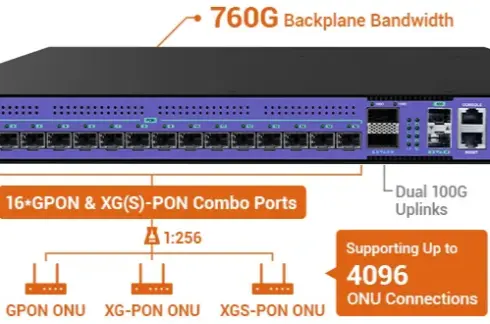
C-Data's portfolio includes XG(S)-PON and Combo PON solutions in addition to conventional EPON and GPON platforms. The FD1816S-B1 Combo PON Pizza-Box OLT supports XG(S)-PON/GPON triple mode and provides 16 PON ports with 2×100GE + 2×10GE uplinks.
This makes a 10G OLT or Combo PON platform relevant for operators preparing for higher bandwidth services.
A future-proof network strategy should consider whether the selected OLT can support an upgrade path without requiring a complete redesign of the fiber distribution network.
Optical wavelength is another factor to consider.
In conventional GPON systems, downstream transmission commonly uses 1490 nm while upstream transmission uses 1310 nm. C-Data GPON products such as the FD1604S-B1 list 1490 nm downstream and 1310 nm upstream optical specifications.
This is relevant when buyers search for 1310 optical transmitter price.
The price of an optical transmitter should not be evaluated only by wavelength. Optical power, receiver sensitivity, transmission distance, optical class and compatibility with the selected OLT are also important.
Similarly, an EPON modem should not be confused with an OLT. In technical terminology, EPON ONU is generally more accurate for the subscriber-side device.
Global Internet connectivity continues to expand, but significant gaps remain.
According to the International Telecommunication Union's Facts and Figures 2025, 2.2 billion people remained offline in 2025. The ITU also reported that 85% of urban residents used the Internet compared with 58% of rural residents.
These figures show why scalable broadband infrastructure remains important. As operators expand networks into new communities, OLT capacity, optical coverage, subscriber density and future bandwidth requirements all need to be considered.
The ITU summarizes the global connectivity challenge simply:
“2.2 billion people remain offline.”
This highlights the continued importance of expanding reliable broadband infrastructure. EPON and GPON are not solutions to the digital divide by themselves, but scalable fiber access networks can help operators extend high-speed connectivity.
The right C-Data OLT depends on the network's existing architecture, subscriber requirements and future plans.
Network Requirement | Recommended Direction |
Existing EPON ONU base | EPON OLT |
Existing GPON ONU base | GPON OLT |
Compact access node | Mini OLT |
Up to 512 GPON ONUs | FD1604S-B1 |
Up to 1,024 GPON ONUs | FD1608S-B1/B2 |
Up to 2,048 GPON ONUs | FD1616S-B2 |
EPON expansion to 8 ports | FD1304E-B1 |
GPON expansion to 8 ports | FD1604E-C1/L1 |
Future 10G PON migration | Combo PON/XG(S)-PON |
Operators should also compare uplink capacity, optical budget, form factor, management capabilities and ONU compatibility before making the final decision.
EPON OLT and GPON OLT are both effective fiber access technologies, but they are suited to different network conditions.
EPON is a practical choice for operators with existing EPON infrastructure, compatible ONUs and Ethernet-oriented access networks. GPON provides higher downstream aggregate capacity, while C-Data provides a broad range of GPON OLT platforms, from compact OLTs to high-density models, to support different network scales.
For C-Data customers, the decision can be based on PON technology, port count, uplink capacity, ONU capacity, form factor and future migration requirements.
The key point is that OLT selection should be based on the complete access network rather than the OLT alone. ONU compatibility, management software, uplink capacity, subscriber growth and future upgrade plans can have a greater impact on total network cost and performance than the initial hardware specification.
1. What is the main difference between EPON OLT and GPON OLT?
EPON is based on IEEE Ethernet PON technology, while GPON is based on the ITU-T G.984 series. They also differ in bandwidth, transmission mechanisms and ONU compatibility.
2. Is GPON faster than EPON?
Compared with conventional 1G-EPON, GPON has a higher nominal downstream line rate. GPON provides approximately 2.5 Gb/s downstream and 1.25 Gb/s upstream, while 1G-EPON provides 1.25 Gb/s in each direction.
3. Can EPON ONU work with a GPON OLT?
No. EPON ONU and GPON OLT use different PON technologies and should not be assumed to be directly interchangeable.
4. What is a GPON OLT switch?
GPON OLT switch is not a formal standards-based device category. It generally refers to a GPON OLT equipped with Ethernet uplink and switching functions. It is different from a standard Ethernet switch because it also manages PON-side ONUs/ONTs.
5. What is an EPON modem?
An EPON modem is a commercial term sometimes used for an EPON subscriber device. EPON ONU or ONT is usually the more precise technical term.
6. Does C-Data provide both EPON and GPON OLT?
Yes. C-Data provides multiple EPON and GPON OLT platforms, including compact Mini OLTs, Pizza-Box OLTs, and Expandable OLTs for different network requirements.
7. What should operators check before buying an OLT?
Check the PON standard, ONU compatibility, PON port count, uplink bandwidth, subscriber capacity, optical budget, management platform, form factor and future upgrade path.