 Optical Transport Networking Solution
 FTTH Solution
 Home Networking Solution
 POL Solution
 Outdoor OLT Solution
 More
More
 Brand News
 Product News
 Tech Blogs
 CMS
CMS
 Tech Support
 Document Download
 Software Download
 FAQ
FAQ
 Training Center
 About Us
 Careers
 Partners
 Quality Assurance
 Video Center


This website uses cookies to ensure you get the best experience. Some cookies are essential, while others help
us improve your experience by analyzing data or showing personalized content.
For details, please see our
Privacy Policy.

In a passive optical network, the Optical Line Terminal is the operator-side device that connects the operator's core network to multiple ONUs or ONTs on the user side. For ISPs, campus networks, hotels, communities and enterprise fiber access projects, understanding the structure of an OLT is essential before selecting a device.
Many users search for terms such as OLT port, OLT uplink port, OLT chassis and OLT service board separately. In fact, these terms are all part of the same topic: how an OLT is built and how it forwards traffic in a PON network. This article explains the key OLT components and how they work together in real deployment.
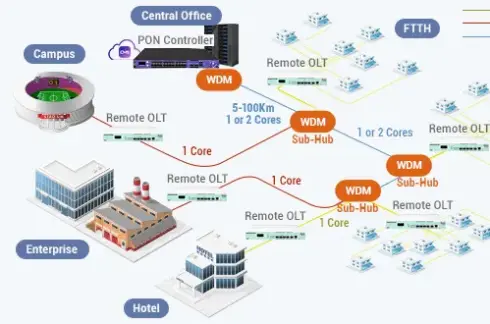
An OLT, or Optical Line Terminal, is the operator-side device in a Passive Optical Network. It connects upward to the operator's aggregation or core network and downward to multiple ONUs through passive optical splitters and optical distribution networks (ODN).
According to ITU-T G.984.1, GPON is defined as a Gigabit-capable Passive Optical Network standard, while ITU-T G.984.3 specifies the GPON transmission convergence layer. In practical deployment, GPON provides high-capacity downstream and upstream transmission between the OLT and subscriber-side ONUs.
A typical PON access path looks like this:
Core network → OLT → optical splitter → ONU / ONT → user device
For example, a GPON OLT is commonly deployed in central offices, access rooms, outdoor cabinets or enterprise network nodes to provide fiber broadband access for multiple users.
An OLT port usually refers to a physical interface on the OLT. Depending on the context, an OLT port may refer to a PON port, uplink port, management interface, or console interface. Among these, the PON port is the most important user-facing optical access interface.
A PON port connects the OLT to the passive optical distribution network. Through optical splitters, one PON port can serve multiple ONUs or ONTs. This is one of the main reasons PON networks are widely used in FTTH and FTTB deployment: operators can serve many subscribers through shared optical infrastructure.
In product selection, OLT PON port count is a key specification. For example, a 4-port OLT, 8-port OLT or 16-port OLT provides different access capacities. More PON ports usually mean the device can support more users, more splitters or larger coverage areas.
Common OLT port types include:
PON ports for connecting ONUs or ONTs
Uplink ports for connecting to aggregation switches or core routers
Console ports for local configuration
Management ports for remote operation and maintenance
Service board slots or expansion slots
When evaluating an OLT device, buyers should not only check the number of PON ports, but also confirm the supported PON standard, maximum optical split ratio, uplink capacity, redundancy design and management features.
An OLT uplink port is the interface that connects the OLT to the core network, such as an aggregation switch, metro Ethernet network, BRAS, BNG or core router. If PON ports connect downward to subscribers, uplink ports connect upward to the operator network.
In simple terms:
PON ports face users. Uplink ports face the network backbone.
OLT uplink ports are usually Ethernet interfaces. Depending on the device model and deployment scale, they may support GE, 10GE, 25GE, 40GE, 100GE or higher-speed interfaces. IEEE 802.3 defines the Ethernet standards used for local, access and metropolitan area networks.
The uplink capacity is important because it determines how much traffic the OLT can send to the core network. If the PON side has high user capacity but the uplink bandwidth is too small, congestion may occur during peak usage.
When choosing OLT uplink ports, network planners should consider:
Total number of users served by the OLT
Average and peak bandwidth per user
IPTV, VoIP, business line or enterprise service requirements
Redundant uplink design
Required interface type, such as SFP, SFP+, QSFP or QSFP28
Future bandwidth upgrade plans
For operators planning FTTH expansion, uplink capacity should be designed with future growth in mind, not only current bandwidth demand.
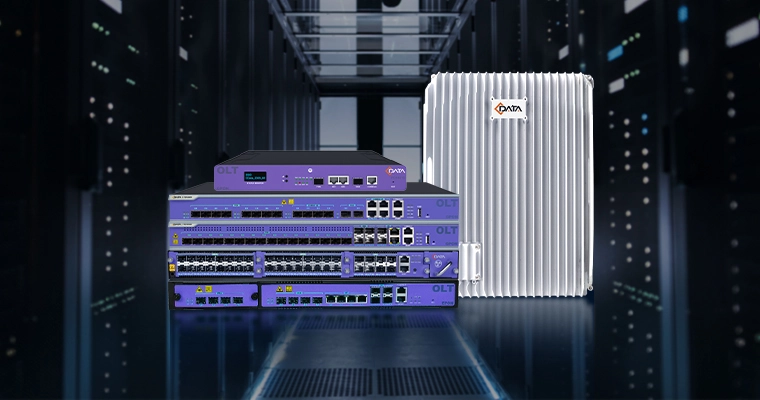
An OLT chassis is the physical frame or enclosure that houses power modules, control boards, service boards, fan modules and backplane connections. It is especially important in modular OLT systems.
A small fixed OLT may use an integrated design, where ports, power supply and switching functions are built into one compact unit. A large chassis OLT, however, usually supports multiple slots. Different boards can be inserted into the chassis according to capacity and service requirements.
An OLT chassis usually includes:
Main control board slots
Service board slots
Power module slots
Fan modules
Switching backplane
Management and alarm interfaces
Grounding and installation structure
One of the main advantages of a chassis-based OLT is scalability. Operators can start with fewer service boards and add more boards later when user demand grows, making chassis OLTs suitable for medium and large-scale FTTH networks, campus networks, smart communities and ISP access nodes.
As an example, C-Data's chassis OLT supports up to 7 service board slots, allowing flexible GPON or Combo PON service board configurations. It also provides two main control boards with dual 100GE uplink ports to ensure sufficient backhaul capacity.
A compact fixed OLT may be more suitable for small deployments, while a chassis OLT is better for projects requiring higher port density, redundancy and long-term expansion.
An OLT service board is a functional board installed in a modular OLT chassis. It provides PON service interfaces, such as GPON, EPON, XGS-PON, or Combo PON ports, depending on the board type.
Unlike the main control board, which is responsible for system control, switching, and uplink connectivity, the service board focuses on providing PON access capacity. In a modular OLT, operators can install different service boards to expand capacity without replacing the entire chassis.
Common OLT service board types include:
GPON service board
EPON service board
XGS-PON service board
Combo PON service board
Service boards are important because they affect port density, network compatibility, upgrade path and maintenance flexibility. If a network needs to migrate from GPON to 10G PON, modular service boards can make the upgrade easier than replacing the entire OLT system.
For example, networks using C-Data OLT solutions may choose different OLT models or modules based on user scale, PON technology, deployment location and bandwidth requirements.
An OLT works as an integrated system. Each component has a different role, but they must match each other.
The chassis provides the physical platform. The service board provides PON or uplink interfaces. The PON port connects to ONUs. The uplink port connects to the core network. The control and management system coordinates configuration, authentication, VLAN, bandwidth control and service delivery.
A simplified working logic is:
1. The uplink port receives traffic from the core or aggregation network.
2. The OLT control and switching system processes service rules, VLANs and bandwidth policies.
3. The service board forwards traffic to the correct PON port.
4. The PON port sends downstream optical signals through splitters.
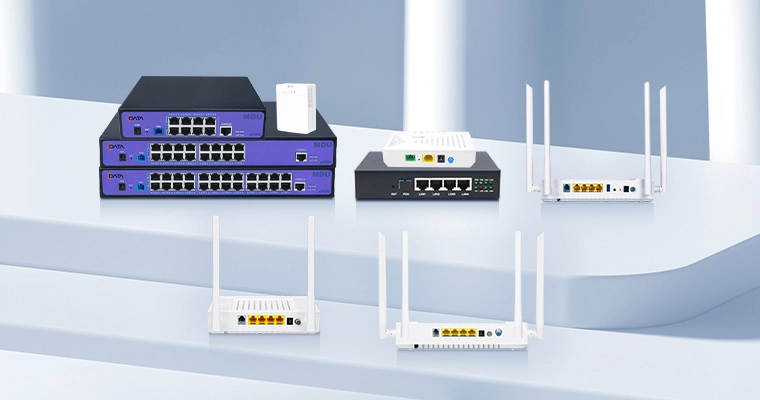
5. The ONU receives the signal and provides Ethernet, Wi-Fi, voice or CATV service to users.
The reverse process happens when users send upstream data. The ONU sends data to the OLT through the PON network, and the OLT forwards the traffic through uplink ports to the core network.
This is why OLT selection should not only focus on "how many PON ports" the device has. A good OLT configuration must balance PON access capacity, uplink bandwidth, chassis scalability, service board flexibility, power redundancy and management capability.
Choosing the right OLT configuration depends on deployment scale, user density, service type and future upgrade needs.
For small FTTH projects, a compact fixed OLT may be enough. It is easier to install, has lower initial cost and is suitable for limited user capacity. For medium or large networks, a chassis OLT may be more suitable because it supports expansion, redundancy and multiple service board options.
Key factors to check include:
Number of required PON ports
GPON, EPON, XGS-PON or Combo PON compatibility
Uplink port speed and redundancy
Maximum optical split ratio and supported users
Chassis slot capacity
Service board type and upgrade path
Power supply redundancy
EMS, web management or centralized management support
Indoor, outdoor or cabinet deployment environment
In ISP and enterprise projects, OLT configuration should be planned according to both current subscribers and future network growth. Choosing only the lowest-cost OLT may create bandwidth bottlenecks or expansion problems later.
An OLT is not just a device with PON ports. It is an integrated access platform made up of PON ports, uplink ports, chassis structure, service boards, control modules, power modules and management systems.
An OLT port usually refers to the interface used for access or network connection. A PON port connects to ONUs and end users. An uplink port connects the OLT to the core network. The OLT chassis provides the physical and electrical platform for modular expansion. The service board defines what type of PON or uplink service the OLT can support.
For network operators, system integrators and enterprise buyers, understanding these components helps avoid wrong equipment selection. The best OLT configuration should match user scale, bandwidth demand, PON standard, uplink capacity and future upgrade requirements.
An OLT port is a physical interface on an Optical Line Terminal. It may refer to a PON port, uplink port, management port or console port. In most FTTH discussions, OLT port usually refers to the PON port used to connect ONUs through optical splitters.
A PON port connects downward to ONUs or ONTs through the passive optical distribution network. An uplink port connects upward to aggregation switches, routers or the operator core network. PON ports face subscribers, while uplink ports face the backbone network.
An OLT chassis is the physical frame of a modular OLT system. It houses service boards, control boards, power modules, fans and backplane connections. Chassis OLTs are usually used for larger networks that require expansion and redundancy.
An OLT service board is a removable or pluggable board that provides PON service interfaces, such as GPON, EPON, XGS-PON, or Combo PON ports. It allows operators to expand capacity or upgrade their access network while reusing the same chassis.
The number of users depends on the PON standard, optical split ratio, bandwidth plan and operator configuration. In many FTTH networks, one PON port can connect to multiple ONUs through optical splitters, but the actual user capacity should be planned based on bandwidth demand and service quality requirements.
A fixed OLT is suitable for small or medium deployments with limited expansion needs. A chassis OLT is better for larger networks that require higher port density, service board expansion, redundancy and long-term scalability.