 Optical Transport Networking Solution
 FTTH Solution
 Home Networking Solution
 POL Solution
 Outdoor OLT Solution
 More
More
 Brand News
 Product News
 Tech Blogs
 CMS
CMS
 Tech Support
 Document Download
 Software Download
 FAQ
FAQ
 Training Center
 About Us
 Careers
 Partners
 Quality Assurance
 Video Center


This website uses cookies to ensure you get the best experience. Some cookies are essential, while others help
us improve your experience by analyzing data or showing personalized content.
For details, please see our
Privacy Policy.

In a PON access network, an OLT does more than forward data between the core network and ONUs. It also controls how bandwidth is shared, how different services are prioritized, how multicast video is delivered, and how traffic is managed across many users on the same optical access infrastructure.
For ISPs, telecom operators, smart communities, hotels, campuses and enterprise fiber access projects, understanding OLT traffic and service control is important. A network may have enough PON ports and ONUs, but if bandwidth allocation, QoS, multicast and traffic management are poorly configured, users may still experience slow internet, IPTV freezing, voice delay or unstable service.
This article explains how OLT bandwidth allocation algorithms, OLT QoS mechanisms, OLT multicast technology and OLT traffic management work together in FTTH and FTTx networks.
OLT traffic management refers to how the Optical Line Terminal controls, forwards, separates, prioritizes and monitors traffic between the PON access side and the aggregation network.
A typical traffic path is:
User device → ONU → optical splitter → OLT → aggregation switch / router / BNG → core network
In this process, the OLT must manage traffic from many ONUs at the same time. It needs to make sure that each user receives the correct service, that traffic is handled according to the configured QoS policies, and that upstream transmissions from different ONUs occur only within their assigned transmission opportunities.
A C-Data OLT can be used as the access-side control platform for broadband, IPTV, VoIP, enterprise access, surveillance and smart community applications. In these scenarios, traffic management is not optional. It is one of the core functions that keeps the access network stable.
OLT traffic management usually includes:
Bandwidth allocation
VLAN and QinQ service separation
QoS priority control
Multicast forwarding
User isolation
Traffic shaping
Storm control
ONU service profile management
Uplink traffic aggregation
Performance monitoring and alarms
OLT bandwidth management refers to the allocation and control of upstream and downstream capacity for ONUs and services. In GPON, dynamic bandwidth allocation specifically coordinates shared upstream transmission opportunities, while downstream bandwidth is controlled mainly through traffic scheduling, shaping, policing, and service profiles.
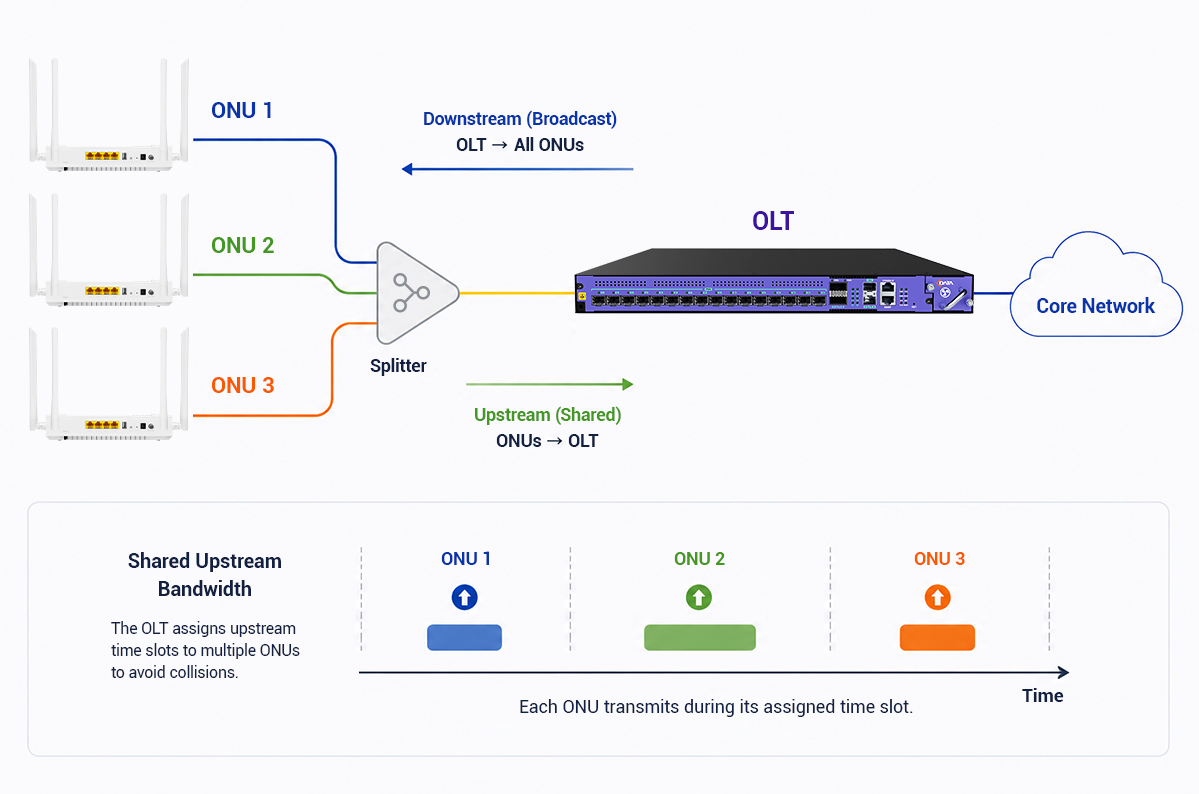
In the downstream direction, the OLT sends data to ONUs through broadcast transmission. Each ONU identifies and processes only the traffic intended for itself.
In the upstream direction, multiple ONUs share the same optical path back to the OLT. To avoid collisions, the OLT assigns transmission windows to each ONU. According to ITU-T G.984.3, GPON transmission convergence includes upstream time division multiple access and dynamic bandwidth allocation mechanisms. This is the technical foundation for how a GPON OLT controls upstream traffic from multiple ONUs.
A simplified upstream control model is:
1. ONUs generate upstream traffic.
2. The OLT collects bandwidth demand information or monitors traffic status.
3. The OLT calculates transmission opportunities.
4. Each ONU sends data only during its assigned time slot.
5. The OLT continuously adjusts bandwidth allocation according to traffic demand.
This process allows multiple ONUs to share the same upstream PON channel while preventing transmission collision and improving bandwidth utilization.
OLT bandwidth allocation algorithms are the rules or logic used by the OLT to distribute shared upstream bandwidth among ONUs. The exact implementation may vary by vendor, but the goal is usually the same: improve bandwidth efficiency while protecting service quality.
GPON upstream bandwidth profiles may contain the following bandwidth components:
Allocation Method | Description | Typical Use |
Fixed bandwidth | A fixed amount of bandwidth is reserved for a service or ONU | Voice, leased service, critical business traffic |
Assured bandwidth | A configured amount of bandwidth is guaranteed according to the traffic contract when the corresponding traffic has demand. | Broadband packages, business users |
Non-assured bandwidth | Extra bandwidth may be assigned when available | Flexible broadband traffic |
Best-effort bandwidth | Traffic uses remaining capacity without strict guarantee | Normal internet browsing, downloads |
Dynamic Bandwidth Allocation, or DBA, is the process used by the OLT to assign upstream transmission opportunities according to these configured bandwidth profiles, ONU traffic reports, service priorities, and available PON capacity. Some users may be idle while others need more capacity. DBA allows the OLT to adjust bandwidth based on actual traffic conditions.
For example, one home user may only browse web pages, while another user uploads large files or runs a cloud backup. The OLT can allocate upstream opportunities more efficiently instead of treating all ONUs as if they always need the same bandwidth.
DBA is important because FTTH users do not consume bandwidth evenly. Traffic demand changes by time, service type and user behavior. Video calls, cloud storage, remote work, gaming, surveillance and business applications can all create different upstream demand.
For operators using a GPON OLT, DBA helps improve:
Upstream bandwidth utilization
User experience during peak hours
Fairness between subscribers
Support for different bandwidth packages
Service quality for voice and video
Efficient sharing of PON capacity
Network scalability as more ONUs are added
DBA does not mean every user always receives maximum bandwidth. It means the OLT can assign bandwidth according to service rules, priority, demand and available capacity.
In practical deployment, DBA and bandwidth profiles should be planned in conjunction with the split ratio, user bandwidth package, uplink capacity and service type. A high split ratio with heavy users may still create congestion if bandwidth planning is unrealistic.
QoS, or Quality of Service, refers to the mechanisms used by the OLT to prioritize important traffic and manage different service requirements. In a multi-service PON network, not all traffic should be treated equally.
For example:
VoIP is sensitive to latency, jitter, and packet loss.
IPTV needs stable bandwidth and low packet loss.
Business services may need guaranteed bandwidth.
Internet browsing can tolerate some delay.
File downloads are usually less time-sensitive.
Bandwidth and QoS requirements in Broadband Forum TR-156 provides an architectural reference for deploying GPON access within a TR-101-based broadband network. It includes requirements related to Ethernet service delivery, VLAN handling, QoS, multicast, and subscriber isolation.
Common OLT QoS mechanisms include:
Traffic classification
Priority queues
IEEE 802.1p/PCP priority marking and mapping
DSCP priority mapping
Bandwidth profiles
Rate limiting
Traffic shaping
Policing
Scheduling
Service-level priority control
QoS allows the OLT to protect sensitive services from being affected by ordinary data traffic. Without QoS, heavy downloads or large uploads may affect IPTV, voice or business applications.
The OLT prioritizes services by classifying traffic and assigning different forwarding rules. Classification may be based on VLAN, port, service profile, traffic type, priority tag or user package.
A practical priority model may look like this:
Service Type | Sensitivity | Suggested Priority |
VoIP | Very sensitive to delay and jitter | Higher |
IPTV live video | Sensitive to packet loss and bandwidth fluctuation | High |
Enterprise private service | Requires stable quality | High or guaranteed |
Public Wi-Fi | Variable traffic demand | Medium |
Residential internet | General browsing and applications | Normal |
File download | Less time-sensitive | Lower |
Background updates | Low sensitivity | Best effort |
In an OLT configuration, voice traffic may be placed in a high-priority queue, IPTV traffic may use multicast and QoS control, and ordinary internet traffic may use best-effort forwarding.
For user-side service delivery, the optical network unit must also support the required service model. For example, some ONUs may support voice ports, IPTV port binding, VLAN mapping or Wi-Fi access, depending on the deployment scenario.
OLT multicast technology is used to deliver one stream of data to multiple users efficiently. It is especially important for IPTV and live video services.
Without multicast, if 100 users watch the same TV channel, the network may need to carry 100 separate video streams. With multicast, the network can send one stream and replicate it only where needed. This reduces bandwidth waste and improves video delivery efficiency.
For IPv4 multicast group management, IETF RFC 9776 specifies IGMPv3, which allows IPv4 hosts to report multicast group membership to neighboring multicast routers. In OLT-based access networks, IGMP-related functions help control which ONUs or user ports should receive specific multicast streams.
OLT multicast technology may include:
IGMP snooping
IGMP proxy
Multicast VLAN
Channel access control
Fast leave
Multicast user authorization
IPTV service binding
Multicast bandwidth control
Multicast traffic monitoring
For IPTV networks, multicast is one of the most important OLT service capabilities.
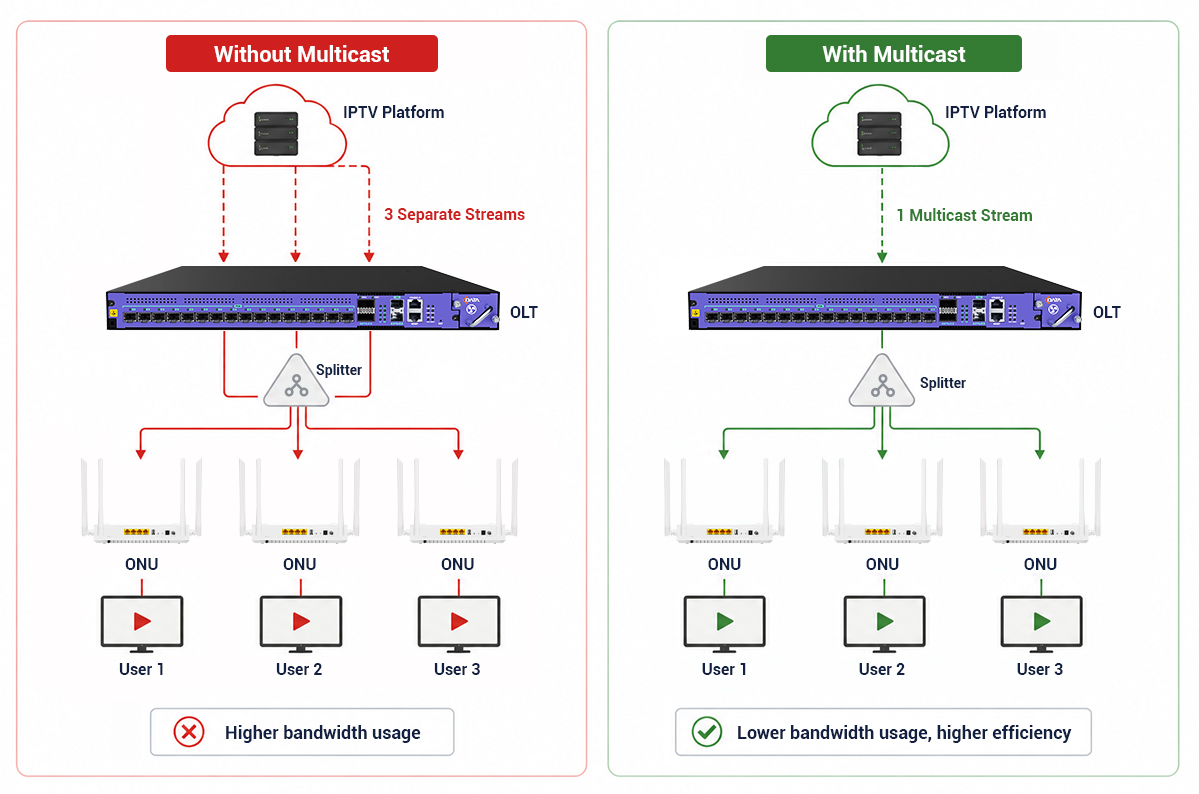
In IPTV service delivery, the OLT forwards multicast video traffic from the IPTV platform to the correct ONUs and user ports. The OLT does not need to forward every TV channel to every user all the time. Instead, it forwards multicast streams based on user join and leave behavior.
A simplified IPTV multicast flow is:
1. IPTV platform sends multicast streams into the operator network.
2. The OLT receives multicast traffic through uplink ports.
3. A user selects a TV channel on a set-top box.
4. The ONU or user-side device sends an IGMP Membership Report for the selected multicast group.
5. The OLT forwards the requested multicast stream to that user.
6. When the user changes channel or leaves the group, the access network updates forwarding status.
This process helps reduce unnecessary video traffic in the access network.
For triple-play service projects, a triple-play ONU may be used when broadband, IPTV and voice services need to be delivered through one subscriber-side device.
VLANs are one of the most important tools for OLT traffic management. They help separate users, services and management traffic.
In a PON network, the same OLT may carry residential internet, IPTV, voice, enterprise services, public Wi-Fi and device management traffic. VLANs help keep these services logically separated.
Common VLAN designs include:
VLAN Design | Typical Purpose |
Internet VLAN | Carries residential or business broadband traffic |
IPTV VLAN | Carries multicast video traffic |
Voice VLAN | Carries VoIP or POTS-related voice service |
Management VLAN | Carries OLT and ONU management traffic |
Enterprise VLAN | Separates business users or private services |
VLAN Stacking (QinQ / IEEE 802.1ad) | Supports large-scale subscriber separation |
VLAN planning should match the service model. If VLANs are poorly planned, operators may face traffic leakage between subscribers or services, difficult troubleshooting, wrong traffic forwarding or security risks.
OLT traffic management does not stop at the PON port. The OLT must also forward traffic through uplink ports to aggregation switches, routers, BNG systems or the core network.
A common topology is:
ONU → OLT → aggregation switch → router / BNG → internet or service platform
If the OLT manages PON traffic well but the available uplink capacity is insufficient, users may still experience congestion. This is why traffic management must include uplink planning.
Important uplink considerations include:
GE, 10GE, 25GE, 40GE or 100GE uplink capacity
Link aggregation
Redundant uplinks
VLAN trunking
QoS trust boundary
Multicast forwarding support
Aggregation switch capacity
Peak-hour traffic growth
Future 10G PON upgrade
A network switch can aggregate OLT uplinks, carry VLAN traffic and connect the PON access layer to the aggregation network.
Traffic management is easier when the operator can see what is happening in the network. OLT monitoring helps engineers identify congestion, ONU offline status, optical power problems, abnormal traffic and service faults.
Useful OLT monitoring data includes:
ONU online or offline status
OLT- and ONU-size optical receive-power measurements
PON port traffic
Uplink port traffic
Alarm logs
Bandwidth usage
Multicast status
Service profile status
CPU and memory usage
Device temperature
Port error statistics
With OLT monitoring software, operators can manage access devices more efficiently and reduce unnecessary field visits. This is especially important for ISPs, rural broadband projects, smart communities and multi-site networks.
A multi-service PON network should be planned before deployment. Operators should not wait until users complain about slow speed, IPTV freezing or voice delay.
A practical planning process includes:
1. Define service types: internet, IPTV, VoIP, enterprise, surveillance or public Wi-Fi.
2. Create VLAN plans for each service.
3. Set bandwidth profiles for different user packages.
4. Configure QoS priority for delay-sensitive services.
5. Enable multicast control for IPTV.
6. Plan uplink capacity according to peak traffic.
7. Confirm ONU compatibility and service mapping.
8. Monitor traffic and alarms after deployment.
9. Adjust DBA and QoS policies based on real usage.
10. Reserve capacity for future service growth.
Good OLT traffic management should balance fairness and priority. Ordinary users should receive stable broadband, while delay-sensitive services such as voice, IPTV, surveillance or enterprise traffic should receive proper protection.
Common mistakes include:
Using high split ratios without traffic planning
Ignoring uplink bottlenecks
Treating all traffic as best effort
Not separating IPTV, VoIP and internet traffic
Poor VLAN design
No multicast control for IPTV
No QoS priority for voice or video
No monitoring system for traffic and alarms
Mixing incompatible ONU service profiles
Not planning future bandwidth growth
Avoiding these mistakes can improve user experience and reduce maintenance pressure.
OLT traffic and service control includes bandwidth allocation, QoS, multicast and traffic management. Bandwidth allocation allows multiple ONUs to share PON capacity efficiently. QoS protects sensitive services such as VoIP, IPTV and enterprise traffic. Multicast technology helps IPTV and live video services use bandwidth more efficiently. Traffic management connects all these functions with VLAN planning, uplink design, ONU profiles and monitoring.
For ISPs, telecom operators, smart communities, hotels, campuses and enterprise networks, a good OLT is not only defined by port count. It should also support efficient upstream bandwidth allocation, flexible QoS, scalable multicast control, service isolation, uplink scalability and centralized monitoring.
A well-planned OLT traffic management strategy can improve user experience, reduce congestion, protect key services and make the PON network easier to operate over the long term.
OLT bandwidth allocation is the process of assigning shared PON bandwidth to ONUs and services. It helps multiple ONUs share the same PON port efficiently and avoids upstream transmission conflicts.
DBA means Dynamic Bandwidth Allocation. It allows the OLT to adjust upstream bandwidth allocation according to ONU traffic demand, service priority and available PON capacity.
OLT QoS mechanisms include traffic classification, priority queues, bandwidth profiles, rate limiting, traffic shaping, VLAN priority mapping and service-level scheduling.
QoS is important because different services have different requirements. VoIP needs low delay, IPTV needs stable bandwidth, and enterprise services may need guaranteed performance.
OLT multicast technology forwards one video or data stream to multiple users efficiently. It is commonly used for IPTV, where users join or leave multicast groups through IGMP-related mechanisms.
VLANs separate different users, services and management traffic. They help operators isolate internet, IPTV, VoIP, enterprise and management services on the same OLT network.
Operators can improve traffic management by planning VLANs, configuring QoS, using DBA properly, enabling multicast control, checking uplink capacity, monitoring ONU status and adjusting policies based on real network usage.
This is the first one.