 Optical Transport Networking Solution
 FTTH Solution
 Home Networking Solution
 POL Solution
 Outdoor OLT Solution
 More
More
 Brand News
 Product News
 Tech Blogs
 CMS
CMS
 Tech Support
 Document Download
 Software Download
 FAQ
FAQ
 Training Center
 About Us
 Careers
 Partners
 Quality Assurance
 Video Center


This website uses cookies to ensure you get the best experience. Some cookies are essential, while others help
us improve your experience by analyzing data or showing personalized content.
For details, please see our
Privacy Policy.

In a Passive Optical Network, the OLT and ONU are the two main functional entities in a PON system. The OLT sits on the operator side and controls the PON network, while the ONU is installed on the user side to receive services and convert optical signals into Ethernet, Wi-Fi, voice, or other interfaces.
Common questions include: How does OLT communicate with ONU? How does OLT manage multiple ONUs? How does an OLT detect ONUs? These questions are closely related. The OLT communicates with ONUs through downstream broadcast, upstream time-division access, registration, ranging, bandwidth allocation, and management protocols.
This article explains how the OLT manages and communicates with ONUs in FTTH and telecom access networks.
An OLT, or Optical Line Terminal, is the operator-side device in a PON network. An ONU, or Optical Network Unit, is the user-side device. The OLT connects to the operator's aggregation or core network, while the ONU connects to end users, routers, computers, IPTV devices, phones, or Wi-Fi terminals.
A typical network path is:
Core network → OLT → passive optical splitter → ONU → user devices
The GPON OLT sends optical signals downstream to multiple ONUs through an optical splitter. Each optical network unit receives the downstream signal, identifies the data meant for itself, and sends upstream data back to the OLT according to the time slots assigned by the OLT.
In simple terms, the OLT is the controller and traffic scheduler. The ONU is the user-side terminal that follows the OLT's control rules.
An OLT communicates with ONUs through a shared optical fiber network. The downstream direction and upstream direction work differently.
In the downstream direction, the OLT broadcasts data to all ONUs connected to the same PON port. Each ONU checks the downstream frames and only processes the data addressed to itself. Frames addressed to other ONUs are discarded.
In the upstream direction, multiple ONUs share the same fiber path back to the OLT. To avoid signal collision, the OLT assigns transmission time slots to each ONU. This is known as Time Division Multiple Access (TDMA). Each ONU can only send upstream data during its assigned time slot.
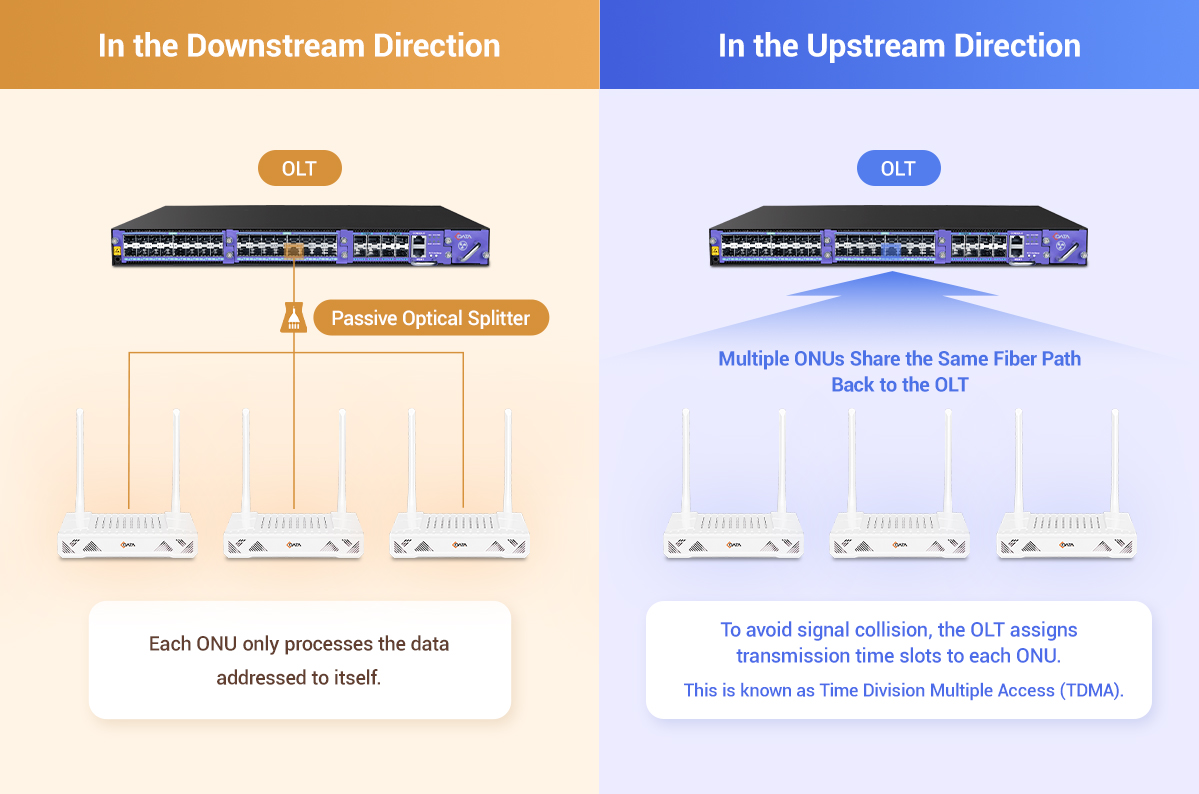
This communication model allows one OLT PON port to serve multiple ONUs through passive optical splitters. It is one of the main reasons PON networks are widely used in FTTH deployment.
According to ITU-T G.984.3, GPON transmission convergence includes upstream TDMA and operates at 2.488 Gbit/s downstream and 1.244 or 2.488 Gbit/s upstream. This provides the technical background for understanding how an OLT coordinates downstream and upstream communication in GPON networks. Source: ITU-T G.984.3
An OLT detects ONUs through a discovery, registration, and activation process. When a new ONU is connected to the PON network, it cannot immediately transmit user traffic. It must first be discovered, registered, authenticated, and activated by the OLT.
The typical ONU detection process includes:
The ONU is physically connected to the optical distribution network.
The OLT sends discovery or registration-related messages.
The ONU responds with identity information, such as serial number or registration data.
The OLT verifies whether the ONU is allowed to join the network.
The OLT measures the distance-related delay between itself and the ONU.
The OLT assigns an ONU-ID and transmission timing.
The ONU enters the operational state after successful activation.
This process is important because ONUs may be located at different distances from the OLT. Without distance measurement and timing adjustment, upstream signals from different ONUs could overlap and cause collision.
In GPON networks, the ONU activation process includes registration and ranging. Ranging helps the OLT calculate timing compensation so that multiple ONUs can share the upstream channel correctly.
An OLT manages multiple ONUs by controlling authentication, bandwidth allocation, service profiles, VLAN configuration, QoS policies, multicast services, alarm monitoring, and remote maintenance.
Because many ONUs share the same PON port, the OLT must make sure each ONU receives the right service and transmits data at the right time. This is why OLT management is not only about forwarding traffic. It is also about controlling user access and service quality.
The OLT usually manages ONUs in several ways:
Assigning ONU-IDs after registration
Binding ONU serial numbers or authentication information
Allocating upstream bandwidth dynamically
Applying service profiles for internet, voice, IPTV, or business services
Managing VLAN and traffic separation
Controlling QoS for different service priorities
Monitoring optical power, online status, and alarms
Supporting remote configuration and firmware maintenance
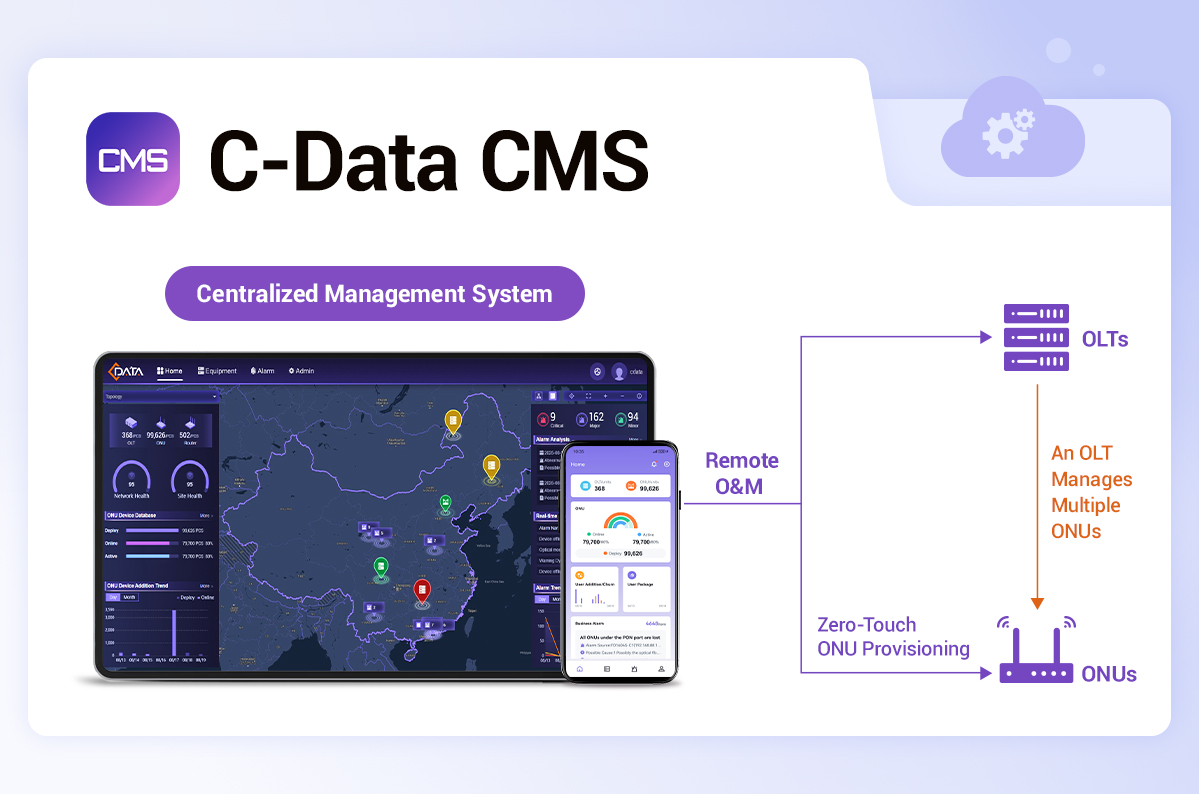
C-Data CMS is a centralized management system that helps operators streamline operations with zero-touch ONU provisioning and remote O&M for OLTs and ONUs, reducing manual operations while accelerating service deployment.
OMCI stands for ONU Management and Control Interface. It is the standardized management protocol used by the OLT to manage ONU in GPON and related optical access networks.
ITU-T G.988 states that it "specifies the optical network unit (ONU) management and control interface (OMCI)" for optical access networks. This means OMCI provides a standardized way for the OLT to configure, manage, and monitor ONU functions. Source: ITU-T G.988
Through OMCI, the OLT can manage ONU-side functions such as:
Ethernet ports
VLAN configuration
T-CONT configuration
GEM port and service mapping
Voice service parameters
Multicast service settings
Performance monitoring
Alarm reporting
Remote configuration
For operators, OMCI is useful because it allows centralized ONU provisioning. Instead of configuring each ONU manually at the user site, the OLT can deliver service profiles and management commands remotely.
Dynamic Bandwidth Allocation, often called DBA, is the mechanism used by the OLT to control upstream bandwidth among multiple ONUs.
In a PON network, upstream bandwidth is shared. Different users may send different amounts of traffic at different times. Some users may be watching video, some may be uploading files, and others may only be browsing websites. The OLT must allocate upstream bandwidth efficiently so that the network remains stable and fair.
The basic logic is:
1. ONUs report or indicate their upstream bandwidth needs.
2. The OLT evaluates the traffic demand and service priority.
3. The OLT assigns upstream transmission opportunities.
4. Each ONU sends data only during its assigned time slot.
5. The OLT continuously adjusts allocation based on traffic changes.
DBA helps improve bandwidth utilization. Instead of giving every ONU a fixed amount of upstream bandwidth at all times, the OLT can adjust allocation based on real-time traffic demand.
This is especially important for FTTH broadband, business access, IPTV, VoIP, cloud applications, and enterprise services where traffic patterns can change quickly.
The OLT keeps ONUs from interfering with each other through ranging, time-slot control, ONU identification, and upstream scheduling.
Since all ONUs connected to the same PON port share the upstream optical path, they cannot transmit at the same time unless the system is designed to separate them properly. The OLT controls this by assigning precise upstream transmission windows.
Several mechanisms help prevent interference:
Each ONU receives a unique ONU-ID after registration.
Ranging measures delay between the OLT and ONU.
Timing compensation adjusts for different fiber distances.
The OLT grants upstream time slots to each ONU.
ONUs only transmit when allowed by the OLT.
Alarms and monitoring help detect abnormal ONU behavior.
This control model is different from a traditional point-to-point Ethernet link. In PON, the OLT must coordinate many user-side devices over a shared optical distribution network.
When an ONU goes offline, the OLT detects the change through loss of signal, OMCI timeout, alarm reporting, or failure to respond to control messages.
Common reasons for ONU offline status include:
Fiber cable disconnection
Power failure at the user side
Low optical power
ONU hardware fault
Incorrect configuration
Authentication failure
Splitter or distribution fiber problem
OLT port issue
After detecting the offline ONU, the OLT or management system may generate alarms, update ONU status, and help engineers locate the problem. In managed networks, the operator can check optical power, registration status, ONU-ID, port information, and service configuration to troubleshoot the issue.
This is why ONU monitoring is important in ISP operations. A good OLT management system can reduce field maintenance time and improve service restoration speed.
OLT-ONU communication directly affects broadband stability, user experience, service provisioning, and network maintenance. If the OLT cannot correctly detect, register, manage, and schedule ONUs, the whole PON network may suffer from unstable connections, service interruptions, or bandwidth problems.
Reliable OLT-ONU communication supports:
Stable FTTH broadband access
Efficient shared bandwidth usage
Remote ONU provisioning
Faster fault diagnosis
Better service quality control
Multi-service delivery over one fiber network
Large-scale subscriber management
For network operators, choosing compatible OLT and ONU equipment is critical. Even when devices follow the same PON standard, interoperability should still be validated because OMCI implementations, firmware behavior, and service profiles may differ between vendors.
An OLT communicates with ONUs through a controlled PON communication process. In the downstream direction, the OLT broadcasts data to ONUs. In the upstream direction, the OLT assigns time slots so that multiple ONUs can share the same fiber path without collision.
The OLT detects ONUs through discovery, registration, authentication, and ranging. It manages multiple ONUs through ONU-IDs, service profiles, VLAN configuration, QoS control, dynamic bandwidth allocation, OMCI, and centralized monitoring.
For FTTH and telecom access networks, the OLT is not only a traffic forwarding device. It is the control center that keeps ONUs online, organized, managed, and properly connected to broadband services.
The OLT communicates with ONUs through a PON network. It sends downstream data to ONUs through broadcast transmission and controls upstream communication by assigning time slots to each ONU.
An OLT detects a new ONU through discovery, registration, and activation. The ONU provides identity information, the OLT verifies it, performs ranging, assigns an ONU-ID, and then allows the ONU to enter service.
The OLT manages multiple ONUs by assigning ONU-IDs, controlling bandwidth, applying service profiles, managing VLANs, monitoring ONU status, and using management protocols such as OMCI.
ONUs may be located at different distances from the OLT. Ranging allows the OLT to measure delay and assign timing compensation so that upstream signals from different ONUs do not collide.
OMCI means ONU Management and Control Interface. It allows the OLT to configure, manage, and monitor ONU functions such as Ethernet ports, VLANs, service mapping, alarms, and performance data.
In principle, OLTs and ONUs that comply with the same ITU-T PON standards may interoperate. However, operators should test compatibility, OMCI behavior, firmware versions, and service profiles before mixing OLT and ONU brands in a live network.
An ONU may go offline because of power failure, fiber disconnection, low optical power, incorrect configuration, authentication failure, ONU hardware fault, or OLT-side port issues.