 Optical Transport Networking Solution
 FTTH Solution
 Home Networking Solution
 POL Solution
 Outdoor OLT Solution
 More
More
 Brand News
 Product News
 Tech Blogs
 CMS
CMS
 Tech Support
 Document Download
 Software Download
 FAQ
FAQ
 Training Center
 About Us
 Careers
 Partners
 Quality Assurance
 Video Center


This website uses cookies to ensure you get the best experience. Some cookies are essential, while others help
us improve your experience by analyzing data or showing personalized content.
For details, please see our
Privacy Policy.

Rural broadband deployment is different from urban FTTH deployment. In cities, users are usually concentrated in apartments, office buildings and residential communities. In rural and remote areas, users may be scattered across villages, farms, mountain regions, islands, roadsides or industrial sites. This makes network planning more difficult because the access distance is longer, user density is lower and equipment maintenance is less convenient.
For these scenarios, the OLT plays a central role in building a reliable fiber access network. A properly selected OLT can help operators extend broadband coverage, connect remote users, reduce field maintenance and support future service upgrades.
This article explains how OLTs are used for rural broadband and remote areas, which deployment models are suitable, and what operators should consider before selecting OLT equipment.
Rural broadband networks face several challenges that are less common in dense urban networks. Users are often far apart, access nodes may be located outdoors, fiber routes may be long and maintenance teams may need more time to reach the site.
According to ITU Facts and Figures 2025, 85% of urban dwellers use the Internet globally, compared with 58% of the rural population. This gap shows why rural broadband infrastructure remains an important network development priority.
Common rural broadband challenges include:
Long distance between subscribers
Lower user density
Limited equipment room availability
Higher construction cost per user
Difficult field maintenance
Power supply limitations in remote sites
Need for outdoor cabinets or pole-mounted equipment
Unstable environmental conditions
Future demand for video, cloud services, surveillance and smart agriculture
Because of these conditions, OLT selection for rural broadband should focus on reliability, flexible deployment, remote management and suitable port capacity rather than only high-density access.
An OLT, or Optical Line Terminal, is the central-side device in a PON network. It connects the aggregation network to user-side ONUs or ONTs through passive optical splitters and optical distribution networks (ODN).
A rural broadband access path may look like this:
Core network → aggregation switch → OLT → optical splitter → ONU / ONT → user devices
In rural broadband networks, the OLT is responsible for:
Connecting rural users to the operator network
Managing ONUs across long-distance access areas
Allocating bandwidth among subscribers
Supporting internet, IPTV, VoIP and monitoring services
Reducing the need for active field equipment along the fiber path
Supporting remote management and alarm monitoring
Extending access coverage through suitable split ratio and optical power budget planning
A C-Data OLT can be used as the access-side control platform for rural FTTH, village broadband, outdoor cabinet deployment and distributed access projects.
PON is useful for rural broadband because it uses passive optical splitters between the OLT and ONUs. This allows operators to reduce the number of powered intermediate devices in the field.
In a PON network, one OLT PON port can connect to multiple ONUs through optical splitters. This can help reduce fiber deployment costs and simplify access network design in remote areas.
According to ITU-T G.984.3, GPON transmission convergence supports downstream and upstream transmission mechanisms such as upstream TDMA and dynamic bandwidth allocation. These mechanisms help the OLT coordinate multiple ONUs sharing the same PON access network.
For rural broadband, PON can provide several advantages:
Fewer active devices between the OLT and users
Lower power requirements in the ODN
Flexible splitter deployment
Long-distance fiber access capability
Centralized management from the OLT side
Easier service expansion as more users are connected
Support for broadband, voice, IPTV and business access
This is why a GPON OLT is commonly considered for rural FTTH, community broadband and small ISP access networks.
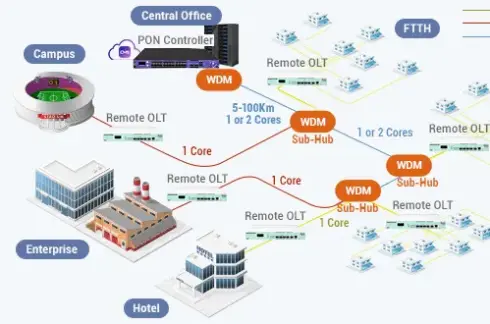
In remote areas, operators usually choose between centralized OLT deployment and distributed OLT deployment.
Centralized OLT deployment means the OLT is installed in a central office, main equipment room or town-level access node. Fiber is then extended to villages or remote user groups through the ODN.
Distributed OLT deployment means the OLT is placed closer to users, such as in an outdoor cabinet, village node, roadside cabinet or remote access point.
Deployment Model | Centralized OLT | Distributed OLT |
OLT location | Central office or main access room | Village, cabinet or remote access node |
Best for | Areas with planned feeder fiber routes | Scattered users or long access distances |
Maintenance | Easier if central site is accessible | Needs strong remote management |
Fiber distance | May require longer distribution fiber | Can shorten last-mile access distance |
Equipment environment | Usually indoor | Often outdoor or cabinet-based |
Expansion | Good for planned regional coverage | Good for flexible remote access growth |
For rural broadband, centralized OLT deployment may work well when villages are connected by planned fiber routes. Distributed OLT deployment may be better when users are scattered, the access distance is long or outdoor access nodes are required.
An outdoor OLT is useful when the access node needs to be installed outside an equipment room. This is common in rural communities, roadside cabinets, industrial parks, mining areas, farms, ports and remote villages.
An outdoor OLT can help operators place the access device closer to users, reduce distribution distance and improve deployment flexibility.
Outdoor OLT deployment is suitable when:
Indoor equipment rooms are not available.
The OLT must be installed near villages or communities.
Fiber access needs to cover scattered users.
The access node is located in a cabinet or roadside site.
Field conditions require stronger environmental protection.
Operators need remote management to reduce on-site visits.
When selecting an outdoor OLT, operators should check:
Operating temperature range
IP protecting rating (such as IP65)
Dust and moisture protection
Power supply options
Surge and lightning protection
Uplink port capacity
PON port count
Cabinet compatibility
Grounding design
Remote monitoring capability
In rural broadband deployments, outdoor OLT reliability is especially important because field maintenance may be slower and more expensive than in urban areas.
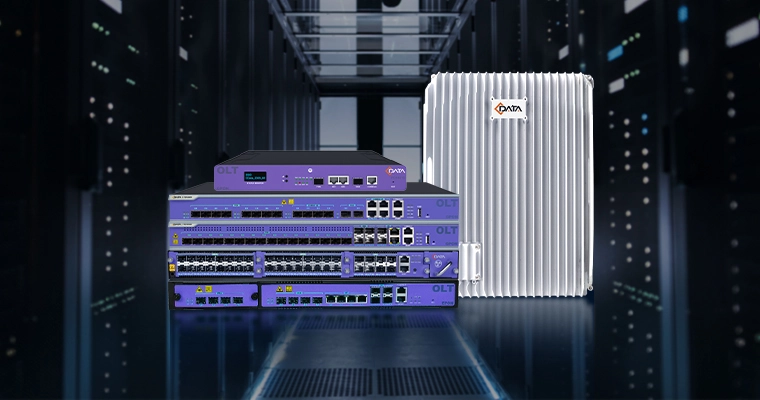
For outdoor deployments, C-Data outdoor OLT solutions combine industrial-grade reliability, wide-temperature operation and centralized remote management, enabling operators to deploy fiber access closer to subscribers while reducing maintenance effort and supporting long-term network expansion.
A mini OLT can be suitable for small rural broadband projects, remote access nodes and phased deployments. It is compact, easier to install and often more cost-effective than a large chassis OLT.
A mini OLT may be suitable for:
Small villages
Rural schools
Farms and agricultural parks
Small ISP access points
Remote monitoring sites
Temporary or pilot broadband projects
Hotels or small communities in remote areas
The advantage of a mini OLT is that operators do not need to deploy a large-capacity platform where user density is low. However, they should still check uplink bandwidth, optical split ratio, optical power budget, supported ONU quantity and future expansion needs.
A mini OLT is not always the best option for large regional rural broadband projects. If the network will eventually cover many villages or thousands of users, C-Data Distributed PON Solution is well suited. By placing OLTs closer to subscribers, it supports transmission distances of up to 120 km, reduces fiber usage, and extends broadband coverage to more remote areas. With centralized management, operators can simplify network operations and maintenance while improving deployment efficiency.
OLT capacity planning for rural broadband should be based on user distribution, not only total user count. A village with 200 homes concentrated in one area may require a different design from 200 users scattered across a wide region.
Important planning factors include:
Number of villages or remote sites
Number of users per village
Distance between users and access nodes
Splitter location
Maximum optical split ratio
Fiber route length
Optical power budget
Uplink capacity
Expected bandwidth package
Future user growth
Service type, such as internet, IPTV, VoIP or surveillance
A practical rural broadband OLT plan should avoid two problems. First, it should not overbuild expensive high-density equipment in areas with limited users. Second, it should not underbuild the uplink, optical power budget or management capacity in areas expected to grow.
The ONU is the user-side device in the PON network. In rural broadband, ONU selection affects installation convenience, service quality and maintenance efficiency.
An optical network unit should be selected according to the user scenario. Residential users may need Wi-Fi ONU or FTTH ONU models. Business users may need more Ethernet ports, bridge mode, VLAN support or higher stability. Remote monitoring sites may need simple Ethernet access with strong reliability.
Common ONU selection factors include:
GPON, EPON or XGS-PON compatibility
Ethernet port type
Wi-Fi support
Voice port requirement
CATV or IPTV support
Optical receive sensitivity
Remote management support
Installation environment
Power stability
OLT interoperability
For rural areas, remote ONU management is important. If engineers can check ONU status, optical power, alarms and configuration remotely, operators can reduce unnecessary field visits.
To meet different rural broadband deployment needs, C-Data offers both wired and Wi-Fi ONUs, supporting high-speed Internet, IPTV, VoIP and enterprise connectivity. With interoperability across major third-party OLT platforms, operators can seamlessly deploy C-Data ONUs in existing multi-vendor networks while maintaining greater flexibility for future network expansion.
Rural broadband is not only for basic internet access. A well-planned OLT network can support multiple services for homes, businesses, public facilities and industry applications.
Common services include:
Service | Typical User | OLT Network Requirement |
Home broadband | Rural households | Stable bandwidth and ONU management |
IPTV | Residential users | Multicast and QoS support |
VoIP | Homes and small offices | Voice VLAN and low-latency service |
Public Wi-Fi backhaul | Villages, schools, public areas | Stable uplink and traffic separation |
Surveillance | Roads, farms, communities | Reliable upstream bandwidth |
Smart agriculture | Farms and rural IoT sites | Wide coverage and stable connectivity |
Enterprise access | Rural factories or parks | VLAN, QoS and business service profiles |
In remote areas, upstream demand may become important because surveillance, cloud backup, video calls, IoT monitoring and smart agriculture applications often require stable upload capacity.
Before deploying OLTs in rural or remote locations, operators should perform a site and network assessment.
Key checks include:
Is there an indoor equipment room or only an outdoor cabinet?
How far are users from the OLT or splitter?
What is the available power supply?
Is lightning or surge protection required?
What is the expected split ratio?
Is the optical power budget enough?
What uplink bandwidth is available?
Can the OLT be managed remotely?
Are spare fibers available for expansion?
What ONU types will be installed?
What maintenance team can access the site?
Remote area deployment should be planned with maintenance in mind. A low-cost device may become expensive if it causes frequent site visits, difficult troubleshooting or unstable service.
The right OLT depends on rural network size, user density, installation environment and upgrade plan.
A practical selection guide is:
Requirement | Recommended C-Data OLT Choice |
Small village broadband | Mini GPON OLT |
Rural FTTH with standard broadband | Pizza-box GPON OLT |
Outdoor cabinet deployment | Outdoor cabinet OLT / Distributed PON solution |
Scattered users across long distances | Distributed PON solution |
Larger regional rural network | Chassis OLT |
Future high-bandwidth upgrade | Combo PON OLT |
Limited maintenance access | Appropriately sized OLT with C-Data CMS |
For most rural broadband projects, the best OLT is not necessarily the largest device. It should match the number of users, fiber distance, power conditions, management capability and long-term service plan.
OLT deployment for rural broadband and remote areas requires a different strategy from dense urban FTTH networks. Rural users are often scattered, access distances are longer, equipment rooms may be limited and maintenance can be more difficult. This makes OLT selection, outdoor protection, optical power budget planning and remote management especially important.
A centralized OLT model may be suitable for planned village coverage. A distributed OLT or outdoor OLT may be better when access nodes need to be closer to users. A mini OLT can be practical for small villages or phased projects, while a scalable GPON, XGS-PON or Combo PON platform may be better for long-term regional broadband development.
For ISPs and integrators, a successful rural broadband project should balance cost, coverage, reliability, management and future upgrade capacity. Choosing the right OLT helps operators achieve that balance.
The OLT connects rural users to the operator network through a PON access system. It manages ONUs, allocates bandwidth, carries internet and other services, and supports remote monitoring.
Yes. GPON OLT is suitable for many rural broadband projects because it provides mature fiber access, supports multiple ONUs through optical splitters and can carry internet, IPTV and voice services.
Operators should use outdoor OLT when there is no indoor equipment room or when the access node needs to be closer to users. Outdoor OLT is useful for roadside cabinets, villages, farms, industrial parks and remote access sites.
A mini OLT can be enough for a small village or phased deployment. However, operators should check user count, split ratio, uplink bandwidth, optical power budget and future expansion needs.
Centralized OLT deployment places the OLT in a main access room or central office. Distributed deployment places OLTs closer to users, such as in cabinets or village nodes. Distributed deployment can reduce access distance but requires stronger remote management.
Operators should check user distribution, fiber distance, optical power budget, split ratio, power supply, cabinet conditions, uplink bandwidth, remote management and ONU compatibility.
Yes. Rural OLT networks can support IPTV and VoIP if the OLT, ONU, service VLANs, QoS policies and service platforms are configured properly.