 Optical Transport Networking Solution
 FTTH Solution
 Home Networking Solution
 POL Solution
 Outdoor OLT Solution
 More
More
 Brand News
 Product News
 Tech Blogs
 CMS
CMS
 Tech Support
 Document Download
 Software Download
 FAQ
FAQ
 Training Center
 About Us
 Careers
 Partners
 Quality Assurance
 Video Center


This website uses cookies to ensure you get the best experience. Some cookies are essential, while others help
us improve your experience by analyzing data or showing personalized content.
For details, please see our
Privacy Policy.

Choosing between a GPON OLT and a Combo PON OLT is not only a technical decision. It affects broadband package design, ONU compatibility, ODN reuse, network upgrade cost, and long-term service competitiveness. For ISPs, telecom operators, smart communities, hotels, campuses, and enterprise fiber access projects, the right choice depends on whether the network only needs stable gigabit-class access today or also needs a smooth path toward 10G broadband in the future.
A GPON OLT is mature, cost-effective, and widely used for standard FTTH deployment. A Combo PON OLT is more suitable when operators need GPON and 10G PON coexistence, especially during GPON-to-XGS-PON upgrade. This article explains how to choose between GPON OLT and Combo PON OLT based on network scale, bandwidth demand, existing ODN, ONU compatibility, upgrade plan, and budget.
A GPON OLT is an Optical Line Terminal based on Gigabit-capable Passive Optical Network technology. It is commonly used in FTTH, FTTB, hotel broadband, campus networks, residential communities, and small to medium ISP access networks.
According to ITU-T G.984.3, GPON transmission convergence supports 2.488 Gbit/s downstream and 1.244 Gbit/s upstream. This makes GPON suitable for common broadband services such as internet access, IPTV, VoIP, public Wi-Fi backhaul, and general enterprise access.
A GPON OLT is often selected because GPON technology is mature, ONUs are widely available, deployment cost is relatively low, and maintenance experience is familiar to most operators.
GPON OLT is suitable when the project needs:
Stable FTTH or FTTB broadband access
Wide availability of GPON ONUs
Lower initial deployment cost
Standard residential or business internet service
IPTV, VoIP, and data service support
Fast deployment without complex migration planning
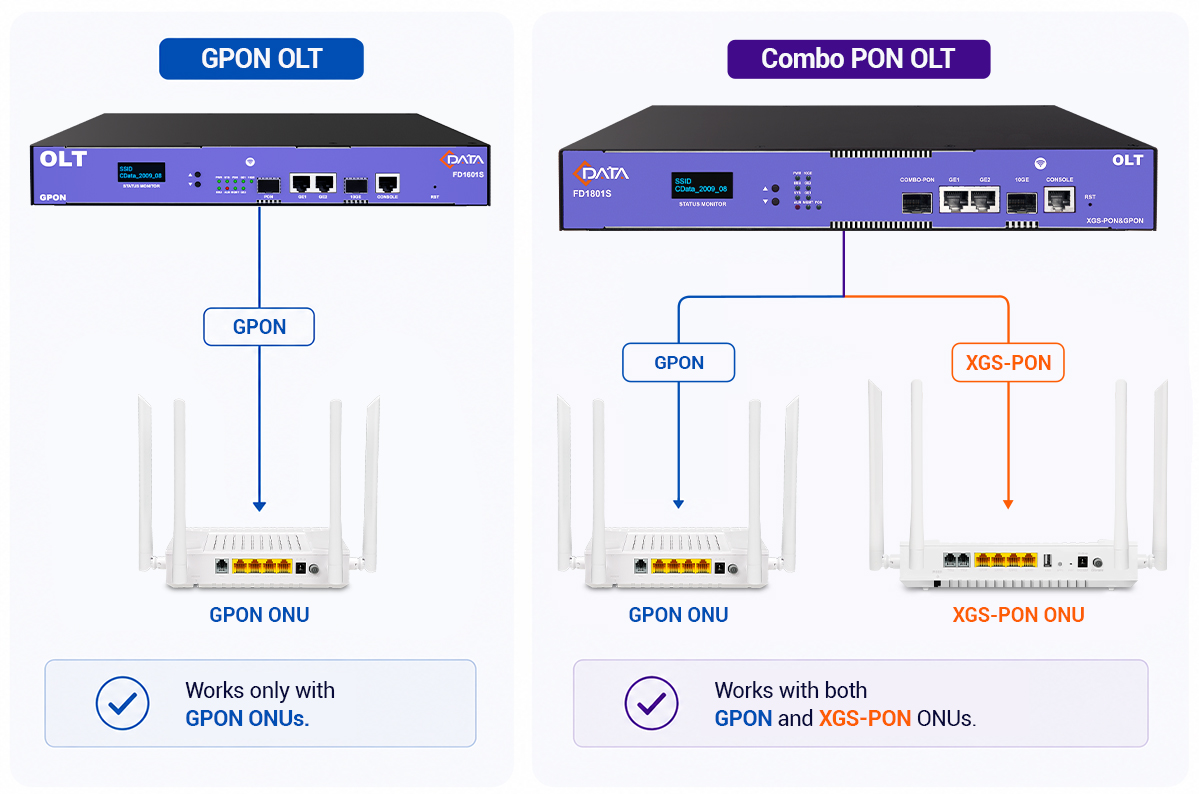
A Combo PON OLT is an OLT designed to support a smoother upgrade from GPON to XGS-PON. Instead of forcing operators to immediately replace all access equipment, Combo PON allows GPON and XG(S)-PON services to coexist during migration.
A Combo PON OLT is useful when existing GPON users must remain online while new or premium users are upgraded to XGS-PON services.
According to ITU-T G.9807.1, XGS-PON is a 10-Gigabit-capable Symmetric Passive Optical Network. This means it is more suitable for users and services that need stronger downstream and upstream capacity, such as premium broadband, enterprise access, cloud applications, video conferencing, and high-density Wi-Fi backhaul.
Combo PON OLT is suitable when the project needs:
GPON and XGS-PON coexistence
Gradual broadband upgrade
Premium 10G-class service packages
ODN reuse where possible
Protection of existing GPON investment
Smooth migration without large-scale service interruption
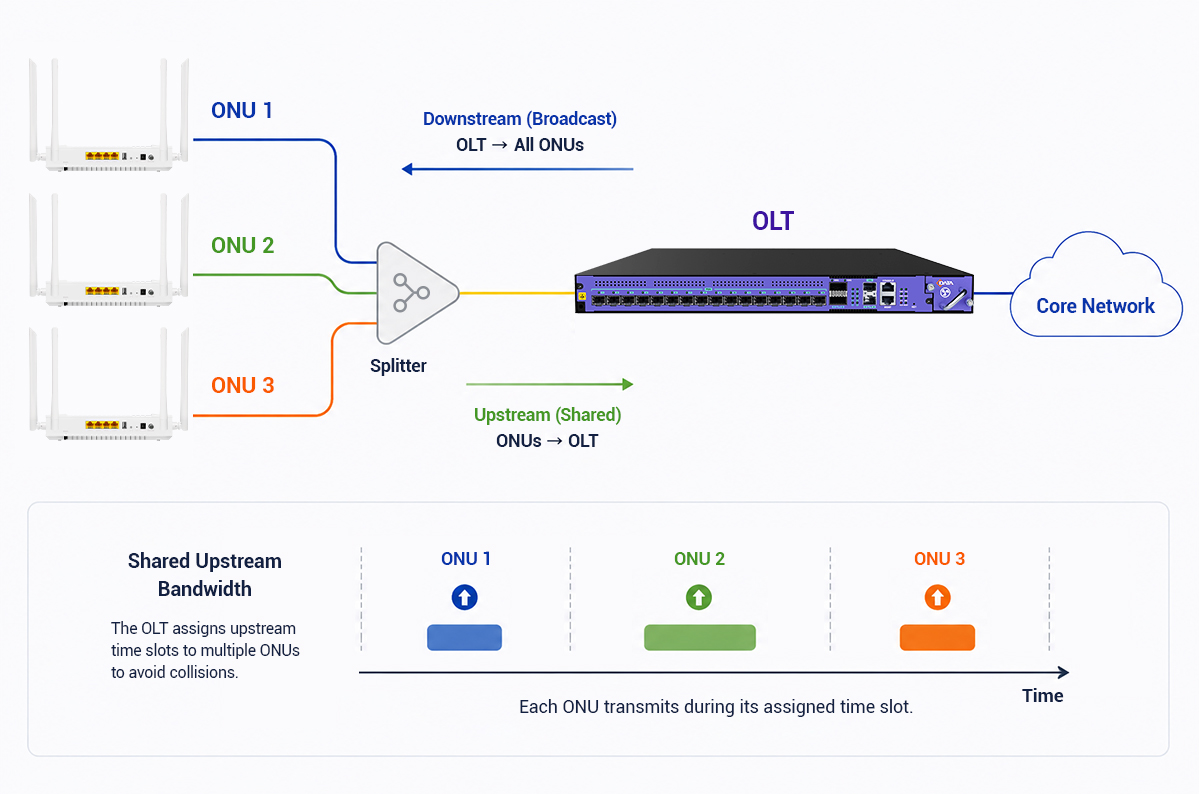
The main difference between GPON OLT and Combo PON OLT is the upgrade path. GPON OLT focuses on stable gigabit-class access, while Combo PON OLT focuses on coexistence and migration toward 10G PON.
Comparison Item | GPON OLT | Combo PON OLT |
Main purpose | Standard FTTH/FTTB broadband access | GPON-to-XGS-PON upgrade and coexistence |
Technology focus | GPON | GPON and XGS-PON coexistence |
Bandwidth direction | Gigabit-class access | Supports 10G-class upgrade path |
Initial cost | Usually lower | Usually higher |
Upgrade flexibility | Limited by GPON platform | Stronger migration flexibility |
ONU ecosystem | Mature and cost-effective | Requires planning for GPON and XGS-PON ONUs |
Best scenario | Stable standard broadband deployment | Premium broadband and phased 10G upgrade |
Long-term value | Good for current access needs | Better for future bandwidth growth |
In simple terms, choose GPON OLT when the current network only needs mature and cost-effective broadband access. Choose Combo PON OLT when the network must support both existing GPON users and future 10G service growth.
You should choose GPON OLT when the project focuses on cost-effective, stable, and mature fiber access rather than immediate 10G upgrade.
GPON OLT is often the better choice for:
Small and medium FTTH projects
Residential communities with standard broadband packages
Hotels, schools, and campuses
Rural broadband access
Small ISP networks
FTTB building access
Projects with strict cost control
Networks without short-term 10G service demand
For example, if most users only need standard broadband, IPTV, VoIP, and Wi-Fi access, GPON OLT is usually enough. It provides a mature access platform and helps operators reduce ONU investment.
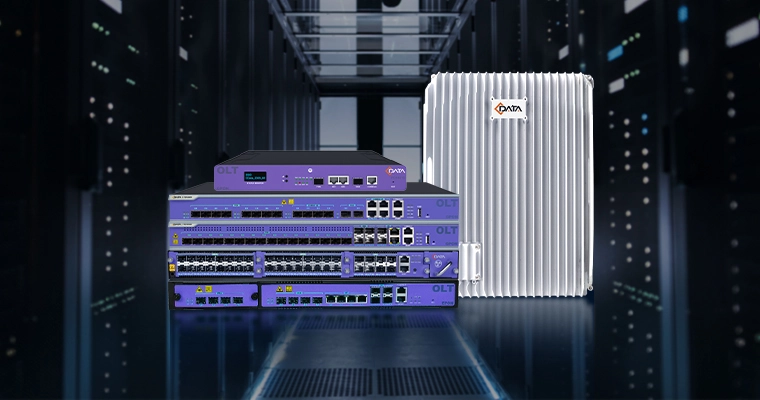
C-Data GPON OLTs provide flexible port configurations for small to medium-sized FTTH, FTTB and campus broadband deployments, delivering a cost-effective access solution for stable Gigabit-class services.
You should choose Combo PON OLT when the network needs to prepare for higher bandwidth demand while keeping existing GPON users online.
Combo PON OLT is often the better choice for:
GPON-to-XGS-PON migration
Premium broadband packages
High-density communities
Enterprise access networks
Smart communities and smart parks
Networks with high upstream traffic demand
Operators planning long-term 10G broadband
Networks where ODN reconstruction should be minimized
The main value of Combo PON OLT is not simply higher speed. It helps operators upgrade in stages. Existing GPON users can remain on current services, while new users or high-value customers can move to XGS-PON-based services.
The Broadband Forum notes that standards can support coexistence, including allowing GPON and XGS-PON to share the same ODN. Building on this capability, C-Data Combo PON OLTs enable phased GPON-to-XGS-PON migration while keeping existing GPON users online, maximizing ODN reuse, protecting previous investments, and reducing overall upgrade costs.
In most cases, a traditional GPON OLT cannot simply become a Combo PON OLT through software alone. Whether an upgrade is possible depends on the OLT platform design, service board support, optical modules, chassis capacity, and vendor roadmap.
There are usually three upgrade paths:
Upgrade Path | Description | Suitable Scenario |
Replace GPON OLT | Remove old GPON OLT and deploy new Combo PON OLT | Small networks or full upgrade projects |
Add Combo PON platform | Keep existing GPON system and add Combo PON for new users | Phased migration |
Use modular OLT expansion | Add compatible service boards if the platform supports it | Scalable chassis or modular OLT systems |
Before planning the upgrade, operators should confirm whether the existing OLT supports modular expansion, 10G PON service boards, enough uplink bandwidth, and unified management.
For networks with long-term upgrade requirements, a scalable or modular OLT platform may be more practical than a fixed low-capacity device.
ONU compatibility is one of the most important factors when choosing between GPON and Combo PON OLT.
A GPON ONU should connect to a compatible GPON OLT. An XGS-PON ONU should connect to an XGS-PON OLT or Combo PON OLT. In a Combo PON upgrade, operators may need to manage both GPON ONUs and XGS-PON ONUs in the same access network.
Before choosing Combo PON OLT, operators should check:
Whether existing GPON ONUs can remain in service
Whether XGS-PON ONUs are available for premium users
Whether the management system supports both ONU types
Whether service profiles can be migrated smoothly
Whether OMCI behavior and vendor interoperability are tested
Whether field engineers can identify ONU types during installation
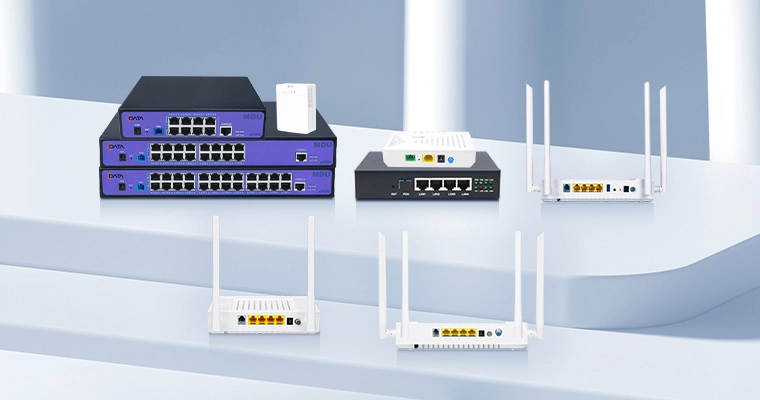
For user-side deployment, C-Data offers xPON and XGS-PON ONUs with flexible service interface configurations, including Ethernet, Wi-Fi, POTS and CATV, enabling operators to match different PON standards and service requirements.
ODN, or Optical Distribution Network, includes feeder fiber, distribution fiber, splitters, connectors, cabinets, and drop cables. In many FTTH projects, ODN construction is a major investment. This is why ODN reuse is an important reason to consider Combo PON OLT.
If the existing ODN can support the required optical power budget, wavelength plan, split ratio, and fiber quality, operators may be able to upgrade part of the network without rebuilding the entire distribution infrastructure.
Before choosing Combo PON OLT, check:
Existing split ratio
Fiber distance
Optical loss
Connector quality
Cabinet space
Available fiber resources
Power budget margin
Wavelength coexistence plan
Current ONU distribution
Future user growth
If the ODN is old, overloaded, poorly documented, or close to the optical budget limit, the upgrade may require additional field work. In that case, the OLT choice should be planned together with ODN testing and improvement.
A common mistake is upgrading the PON side without upgrading the uplink side. If operators choose Combo PON OLT for 10G access but keep insufficient uplink bandwidth, the aggregation network may become the bottleneck.
For GPON OLT deployment, uplink planning should consider the number of PON ports, split ratio, active users, and average bandwidth package. For Combo PON OLT deployment, uplink planning must also consider premium users, enterprise users, high upstream traffic, and future 10G service adoption.
Operators should check:
GE, 10GE, 25GE, 40GE, or 100GE uplink requirements
Number of active users per OLT
Peak-hour bandwidth demand
IPTV and multicast traffic
Business user traffic
Redundant uplink requirements
Aggregation switch capacity
Future broadband package roadmap
A Combo PON OLT without enough uplink capacity may not deliver the expected user experience. The OLT, uplink ports, aggregation switches, and core network must be planned together.
Project Requirement | Better Choice | Reason |
Standard residential FTTH | GPON OLT | Mature and cost-effective |
Small ISP or rural broadband | GPON OLT | Lower initial cost and easier deployment |
Hotel, school, or campus broadband | GPON OLT | Stable multi-service access |
High-density urban community | Combo PON OLT | Better long-term upgrade path |
Premium 10G broadband package | Combo PON OLT | Supports XGS-PON migration |
Existing GPON users must stay online | Combo PON OLT | Supports phased coexistence |
Enterprise users need strong upstream bandwidth | Combo PON OLT | Supports symmetric 10G access |
Budget is the main constraint | GPON OLT | Lower equipment and ONU cost |
Future 10G upgrade is planned | Combo PON OLT | Reduces future replacement pressure |
To choose between GPON OLT and Combo PON OLT, operators should not only compare equipment price. They should evaluate the full network lifecycle.
A practical decision process is:
1. Define current user bandwidth packages.
2. Estimate 3-year and 5-year bandwidth growth.
3. Check whether premium 10G services are planned.
4. Evaluate existing GPON ONU quantity.
5. Test ODN quality and optical power budget.
6. Confirm uplink and aggregation capacity.
7. Compare GPON ONU and XGS-PON ONU cost.
8. Check management platform compatibility.
9. Plan migration by area, user group, or service tier.
10. Choose the OLT platform that matches both current cost and future growth.
If the network is stable, small, and cost-sensitive, GPON OLT is usually the practical choice. If the network is growing, competitive, and preparing for 10G broadband, Combo PON OLT is usually the better long-term choice.
GPON OLT and Combo PON OLT are both valuable, but they serve different network stages. GPON OLT is suitable for mature, stable, and cost-effective broadband access. It is a strong choice for standard FTTH, FTTB, hotels, campuses, rural broadband, and small ISP projects.
Combo PON OLT is better when operators need to protect existing GPON investment while preparing for XGS-PON or 10G-class broadband services. It supports phased migration, coexistence, premium service packages, and better long-term upgrade flexibility.
The best choice depends on user demand, ODN condition, ONU compatibility, uplink capacity, management system, budget, and future broadband strategy. For many operators, the decision is not only about today's deployment cost, but about how smoothly the network can evolve over the next several years.
The main difference is upgrade flexibility. GPON OLT is mainly used for standard GPON broadband access, while Combo PON OLT is designed to support GPON and 10G PON coexistence or migration.
Choose GPON OLT when the project needs mature, stable, and cost-effective FTTH or FTTB access without immediate 10G broadband upgrade requirements.
Choose Combo PON OLT when the network needs to keep existing GPON users online while preparing for XGS-PON, premium broadband, enterprise access, or long-term 10G service growth.
Yes, GPON and XGS-PON can coexist in many upgrade designs if the OLT platform, ONU type, wavelength plan, optical budget, and ODN condition support the deployment.
No. Combo PON OLT is better for upgrade and coexistence scenarios, but GPON OLT may be more cost-effective for standard broadband projects with limited bandwidth growth demand.
For users upgraded to XGS-PON service, XGS-PON ONUs are usually required. Existing GPON users may continue using GPON ONUs if the network is planned for coexistence.
Operators should check existing ODN quality, optical budget, GPON ONU base, XGS-PON ONU availability, uplink capacity, management platform, service migration plan, and future broadband package strategy.