 Optical Transport Networking Solution
 FTTH Solution
 Home Networking Solution
 POL Solution
 Outdoor OLT Solution
 More
More
 Brand News
 Product News
 Tech Blogs
 CMS
CMS
 Tech Support
 Document Download
 Software Download
 FAQ
FAQ
 Training Center
 About Us
 Careers
 Partners
 Quality Assurance
 Video Center


This website uses cookies to ensure you get the best experience. Some cookies are essential, while others help
us improve your experience by analyzing data or showing personalized content.
For details, please see our
Privacy Policy.

Smart cities and smart communities depend on stable digital infrastructure. Cameras, public Wi-Fi, smart lighting, access control, community broadband, IoT sensors, emergency systems, property management platforms and public service networks all need reliable connectivity. In many projects, fiber access provides the foundation because it can support high bandwidth, long-distance transmission and centralized management.
An OLT, or Optical Line Terminal, is a key device in PON-based fiber access networks. It connects the aggregation network to user-side ONUs or ONTs through passive optical splitters and fiber cables. For smart city and smart community applications, the OLT helps connect homes, buildings, public facilities, outdoor nodes and intelligent terminals into one manageable access network.
This article explains how OLTs are used in smart cities and smart communities, what services they can support, and how to choose the right OLT deployment model.
A smart city uses digital technologies to improve urban services, infrastructure efficiency, safety, sustainability and quality of life. The ITU smart sustainable city definition describes a smart sustainable city as an innovative city that uses ICTs and other means to improve quality of life, urban operation, services and competitiveness while meeting the needs of present and future generations.
This definition is important because smart city infrastructure is not only about one application. It is a integrated digital system of many digital services, including:
Public safety cameras
Traffic monitoring
Smart lighting
Environmental monitoring
Public Wi-Fi
Smart parking
Emergency communication
Utility monitoring
Government service networks
Community broadband
Building access control
IoT data collection
These services need a stable access network. Wireless networks are useful for mobility, but many fixed smart city devices need fiber backhaul for stable bandwidth and long-term reliability. This is where OLT-based PON networks can play an important role.
In a smart city network, the OLT works as the central access device for fiber-connected terminals, buildings, communities and remote nodes. It connects the aggregation network to multiple ONUs through the optical distribution network.
A simplified smart city PON structure may look like this:
City data center / aggregation network → OLT → optical splitter → ONU → smart terminals, buildings or community users
The OLT supports smart city networks by:
Providing fiber access for distributed city devices
Aggregating traffic from many ONUs
Supporting VLAN separation for different services
Managing bandwidth for cameras, Wi-Fi, IoT and broadband
Supporting remote ONU monitoring
Reducing active equipment in the distribution network
Supporting long-reach fiber access
Helping operators build scalable city-level access networks
For example, a C-Data OLT can be used as the central access platform for community broadband, public security networks, smart parks, campuses, municipal facilities and distributed outdoor access nodes.
A smart community is usually a residential or mixed-use area that uses digital systems to improve security, property management, resident services and broadband access. Compared with a city-level network, a smart community is smaller, but the service density can be high.
A smart community may include:
Residential broadband
Public area Wi-Fi
IP surveillance cameras
Access control systems
Smart parking systems
Elevator monitoring
Property management platforms
Smart lighting
Intercom systems
Community service terminals
IoT sensors for water, electricity or environment
In this scenario, the OLT can connect multiple buildings, cabinets, floors or user terminals through one PON access network. A GPON OLT is commonly suitable for smart community broadband and multi-service access when the project needs mature, stable and cost-effective fiber connectivity.
One of the main advantage is that the community can use fiber infrastructure to carry different services while keeping them logically separated through VLANs, QoS and service profiles.
An OLT-based PON network can carry many fixed-access smart city and smart community services. The exact design depends on the OLT model, ONU type, service platform, VLAN plan and uplink capacity.
Application | Typical Terminal | Network Requirement |
Public surveillance | IP camera, NVR, monitoring platform | Stable upstream bandwidth and low packet loss |
Public Wi-Fi backhaul | Outdoor AP, community AP | High bandwidth and user isolation |
Smart lighting | Lighting controller, IoT gateway | Wide coverage and reliable control channel |
Smart parking | Camera, sensor, payment terminal | Stable access and service separation |
Access control | Door controller, face terminal, intercom | Low-latency and secure service VLAN |
Environmental monitoring | Sensor gateway | Reliable low-bandwidth data access |
Residential broadband | Home ONU, Wi-Fi router | Bandwidth control and user management |
Property management | Office terminals, management system | Secure business network connection |
Emergency communication | Alarm terminal, command system | High priority and reliable connectivity |
For smart city deployments, the key is not only connecting devices. The network must separate services, protect critical traffic and support remote troubleshooting.
PON is suitable for smart city and smart community networks because it uses passive optical splitters between the OLT and ONU. This reduces the need for powered devices in the middle of the network.
According to ITU-T G.984.3, GPON transmission convergence includes upstream TDMA and dynamic bandwidth allocation (DBA) mechanisms. These mechanisms help the OLT coordinate multiple ONUs sharing the same PON network, which is useful for multi-point access scenarios.
PON can support smart city access because it offers:
Long-distance fiber transmission
Passive distribution network design
Centralized OLT management
Flexible ONU deployment
Support for multiple service types
Reduced dependence on field power in the distribution section
Better scalability for buildings, cabinets and communities
Suitable access for cameras, Wi-Fi APs, IoT gateways and broadband users
For smart communities, PON can reduce cable complexity by connecting multiple buildings or areas through optical splitters and ONUs. For smart cities, it can help extend fiber access to distributed public facilities and outdoor nodes.
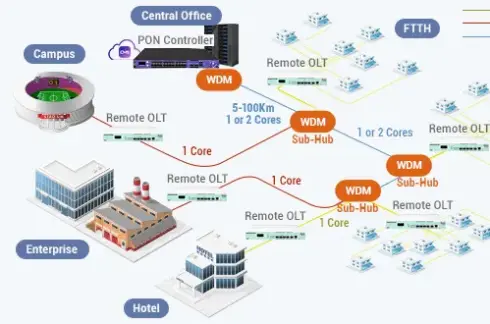
Smart city OLT deployment can use centralized, distributed or hybrid architecture.
A centralized model places the OLT in a main equipment room, data center or telecom access node. Fiber is then distributed to different communities, buildings or service points.
A distributed model places OLTs closer to service areas, such as in outdoor cabinets, street cabinets, smart poles, industrial parks, public facilities or community access rooms.
A hybrid model uses centralized OLTs for dense areas and distributed OLTs for remote or scattered nodes.
Deployment Model | Best Use Case | Main Advantage |
Centralized OLT | Dense communities, campus, planned city zones | Easier centralized maintenance |
Distributed OLT | Remote city nodes, outdoor cabinets, scattered facilities | Shorter access distance and flexible coverage |
Hybrid OLT | Large smart city projects with mixed density | Balanced scalability and deployment flexibility |
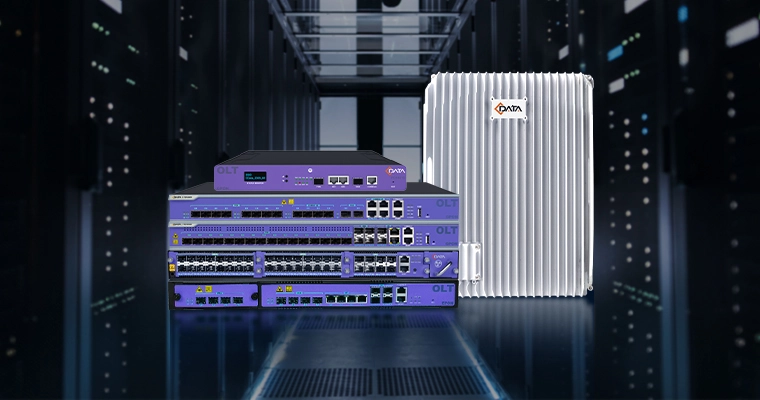
For outdoor deployment scenarios, C-Data outdoor OLT is a better choice. Featuring a rugged cabinet-based design and flexible installation options, it can be deployed closer to smart city terminals while ensuring reliable operation in harsh outdoor environments.
Public security and surveillance are common smart city applications. Cameras may be installed in streets, communities, parking lots, entrances, schools, industrial parks and public facilities. These cameras often generate continuous upstream video traffic, so the access network must provide stable upload capacity.
An OLT supports surveillance networks by:
Connecting camera-side ONUs to the monitoring center
Carrying upstream video traffic through PON
Using VLANs to isolate video traffic
Applying QoS to prioritize important streams
Supporting remote ONU monitoring
Helping reduce powered intermediate devices in outdoor areas
In a smart community, cameras may connect to ONUs in buildings or cabinets. In a smart city, cameras may connect through outdoor ONUs or access nodes. The OLT aggregates these video streams and forwards them to the monitoring platform through uplinks and aggregation switches.
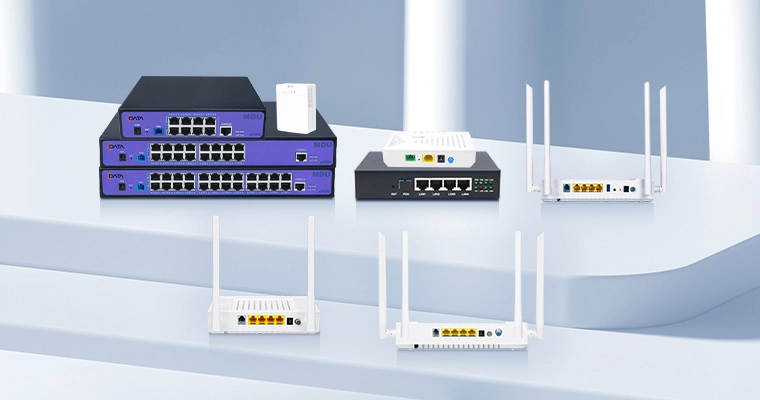
For IP surveillance networks, C-Data MDU series supports integrated PoE for IP cameras, reducing separate power cabling and simplifying installation. Available in 4-, 8-, 16- and 24-port Gigabit Ethernet models with both xPON and XGS-PON options, it provides flexible deployment for communities, campuses, industrial parks and other smart city applications.
Public Wi-Fi and community broadband are bandwidth-intensive services. They need enough access capacity, user isolation and stable uplink design.
A typical structure may be:
OLT → optical splitter → ONU → Wi-Fi AP / router / user terminal
For community broadband, the ONU may be installed in homes, buildings or floor distribution boxes. For public Wi-Fi, the ONU may connect to outdoor APs or indoor APs in public areas.
The OLT helps support these services through:
Bandwidth profiles
VLAN separation
QoS policies
ONU authentication
User service profiles
Remote monitoring
Uplink traffic aggregation
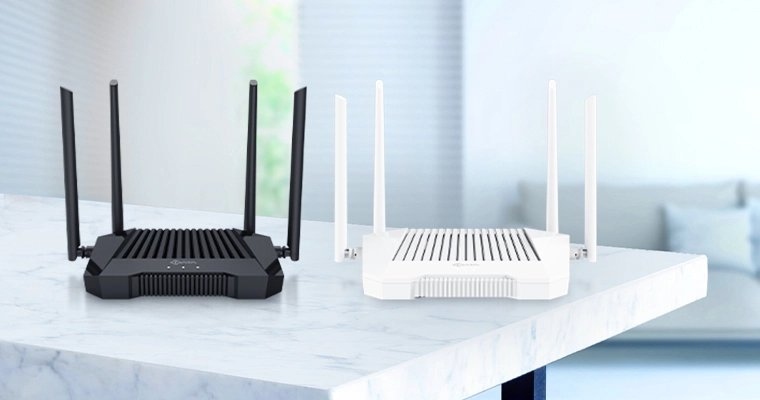
For user-side access, C-Data offers a comprehensive portfolio of wired and Wi-Fi ONUs with Gigabit Ethernet connectivity and supporting broadband, public Wi-Fi, IPTV, VoIP and IoT services. With interoperability across third-party OLTs, operators can deploy C-Data ONUs flexibly in existing multi-vendor networks.
Smart lighting, IoT sensors and utility monitoring often require wide coverage rather than extremely high bandwidth. These services may generate smaller data flows, but they need stable and continuous connectivity.
An OLT network can connect IoT gateways or controllers through ONUs. These ONUs may be installed in cabinets, buildings, poles or equipment rooms. The OLT then forwards data to municipal platforms, property systems or cloud-based management platforms.
Applications may include:
Smart street lighting control
Environmental sensors
Water meter data collection
Electricity monitoring
Parking sensors
Public facility monitoring
Equipment status reporting
Smart pole connectivity
For these services, the OLT network should focus on reliability, service isolation and easy maintenance. Even if each IoT device uses little bandwidth, the total number of nodes can be large, so centralized monitoring is important.
Smart city networks often carry many services at the same time. Without proper VLAN and QoS planning, traffic from cameras, Wi-Fi, broadband users and IoT systems may interfere with each other.
A practical service separation model may include:
Service Type | Suggested Network Design Focus |
Surveillance video | Dedicated VLAN, stable upstream bandwidth, monitoring priority |
Public Wi-Fi | User isolation, bandwidth control, security policy |
Residential broadband | Subscriber VLAN, bandwidth profile, service authentication |
IoT and sensors | Separate management or IoT VLAN |
Access control | Secure VLAN and low-latency forwarding |
Emergency systems | Higher QoS priority and redundant path planning |
Network management | Separate management VLAN for OLT and ONU monitoring |
The ITU-T Y.4903 smart sustainable city KPI recommendation provides key performance indicators for smart sustainable cities and general principles for selecting KPIs. For network planners, this reinforces the idea that smart city infrastructure should be measurable, manageable and aligned with service performance goals.
In OLT deployment, VLAN and QoS planning should reflect real service priorities. Public safety and emergency services should not be treated the same as normal browsing traffic.
Before selecting an OLT for a smart city or smart community project, planners should evaluate the service types, number of access points, deployment environment and management requirements.
Important checks include:
Number of communities, buildings or service points
Number of cameras, APs, ONUs and IoT gateways
Indoor or outdoor deployment environment
Required PON standard, such as GPON or XGS-PON
Uplink bandwidth to aggregation network
VLAN and QoS requirements
Optical power budget and fiber distance
Remote management capability
ONU compatibility
Cabinet and power conditions
Future expansion plan
Service redundancy requirements
A smart city project may start with surveillance or broadband, but later expand to smart lighting, public Wi-Fi, access control, IoT and emergency systems. The OLT should leave enough room for service growth.
For smart communities, the right OLT should match user density, service mix and installation environment. A small community may only need a compact GPON OLT. A large residential area may need higher port density, stronger uplinks and better centralized management.
A practical selection guide is:
Requirement | Recommended C-Data OLT Choice |
Standard community broadband | Pizza-box GPON OLT |
High-density residential community | Expandable OLT / chassis OLT |
Outdoor cabinet deployment | Outdoor OLT |
Multiple smart community services | Combo PON OLT |
Public Wi-Fi and surveillance | GPON / Combo PON OLT |
Future 10G upgrade | Combo PON OLT |
Many distributed nodes | Distributed PON solution |
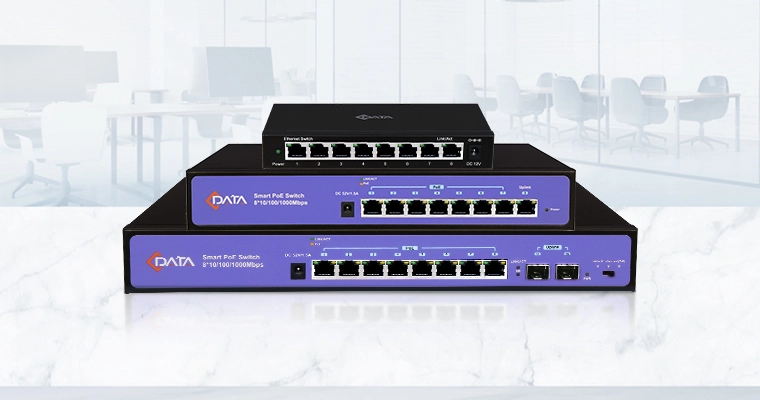
In many smart community projects, the OLT should be planned together with ONUs, switches, cameras, APs, routers and property management systems. A network switch may also be used to aggregate OLT uplinks or connect upper-layer systems in the community network.
OLT plays an important role in smart cities and smart communities because it provides a scalable fiber access layer for many connected services. It can support public surveillance, community broadband, public Wi-Fi, smart lighting, access control, IoT gateways, utility monitoring and property management systems.
For smart cities, OLT deployment may use centralized, distributed or hybrid architecture depending on user density and access node location. For smart communities, a GPON OLT or outdoor OLT can help connect buildings, public areas and intelligent terminals through one manageable PON network.
The best OLT solution should match the service mix, fiber distance, ONU type, uplink capacity, VLAN plan, QoS strategy, deployment environment and future expansion needs. A well-planned OLT network can provide the fiber access foundation for smarter, safer and more connected communities.
The OLT provides fiber access for smart city terminals, buildings, communities and outdoor nodes. It connects ONUs to the aggregation network and supports services such as cameras, public Wi-Fi, IoT gateways, smart lighting and broadband.
In smart communities, the OLT connects homes, buildings, cameras, access control systems, Wi-Fi APs and management platforms through a PON access network. It helps separate and manage different services with VLANs, QoS and ONU profiles.
Yes, GPON OLT is enough for many standard smart community projects. If the project requires very high bandwidth, dense video access or future 10G services, XGS-PON or Combo PON options may be considered.
Outdoor OLT should be used when the access node must be installed in outdoor cabinets, roadside locations, remote facilities or areas without indoor equipment rooms.
Yes. OLTs can connect camera-side ONUs and carry video traffic to monitoring platforms. VLAN and QoS planning are important for stable surveillance transmission.
VLANs help separate surveillance, broadband, public Wi-Fi, IoT, access control and management traffic. This improves security, service stability and troubleshooting efficiency.
Planners should consider user density, service types, PON port count, uplink bandwidth, ONU compatibility, VLAN design, QoS, deployment environment, remote management and future upgrade needs.
This is the first one.