 Optical Transport Networking Solution
 FTTH Solution
 Home Networking Solution
 POL Solution
 Outdoor OLT Solution
 More
More
 Brand News
 Product News
 Tech Blogs
 CMS
CMS
 Tech Support
 Document Download
 Software Download
 FAQ
FAQ
 Training Center
 About Us
 Careers
 Partners
 Quality Assurance
 Video Center


This website uses cookies to ensure you get the best experience. Some cookies are essential, while others help
us improve your experience by analyzing data or showing personalized content.
For details, please see our
Privacy Policy.

With the widespread adoption of fiber-optic networks, the ONU - an essential component in fiber-to-the-home deployments, directly affects the user's network experience. Wi-Fi 6 technology enhances the connection efficiency and concurrent performance of ONU Wi-Fi, especially in multi-terminal scenarios. But what exactly is a Wi-Fi 6 ONU? And how does it improve connection quality and support for concurrent devices? This article explores these questions and compares the performance differences between AX1500 and AX3000 models.
Wi-Fi 6 (802.11ax) is the latest generation of wireless network standards. It supports more simultaneous device connections, with MU-MIMO enabling efficienct communication between the router and multiple devices at once. Compared to previous Wi-Fi generations, Wi-Fi 6 offers advantages including:
Higher transmission rates: Supports higher modulation methods (such as 1024-QAM) and broader channels (some high-end devices support 160MHz bandwidth), with theoretical speeds up to 9.6Gbps.
Lower latency: Wi-Fi 6 leverages OFDMA (Orthogonal Frequency Division Multiple Access) technology to improve bandwidth allocation efficiency, reducing latency caused by device contention in multi-user environments.
Stronger multi-device support: MU-MIMO (multi-user multiple input multiple output) technology allows the router to communicate with multiple devices simultaneously, significantly enhancing concurrency.
As the terminal device in fiber-optic networks, an ONU with integrated Wi-Fi 6 delivers a faster and more stable wireless experience for users. The advantages of Wi-Fi 6 ONU include:
Higher connection efficiency: With OFDMA and MU-MIMO technologies, a Wi-Fi 6 ONU can efficiently manage simultaneous connections from multiple devices, reducing network congestion.
Stronger signal coverage: Wi-Fi 6 utilizes beamforming technology to enhance signal strength in specific directions, improving both coverage range and signal penetration.
Lower power consumption: TWT (Target Wake Time) technology optimizes the wake-up mechanism of terminal devices, reducing power consumption and extending battery life.
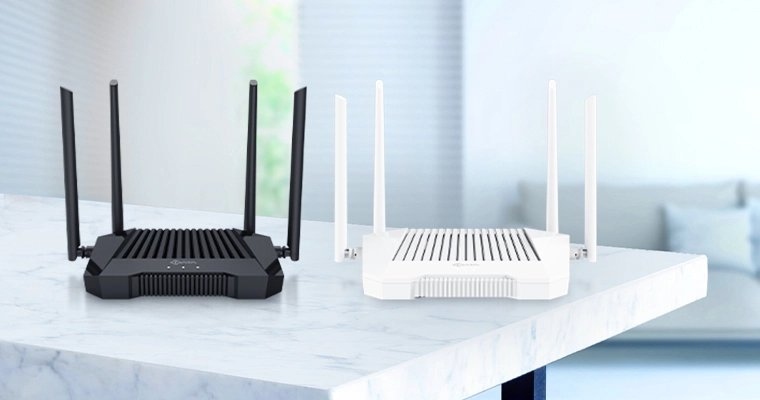
The AX1500 and AX3000 are Wi-Fi 6 ONU models with distinct specifications, each optimized for specific performance needs to suit diverse network demands.
AX1500
Theoretical speed: Dual-band concurrent speed up to 1501Mbps (2.4GHz 300Mbps, 5GHz 1201Mbps).
Terminal support: Suitable for typical households or small offices, supporting about 20-30 simultaneous device connections but may encounter performance bottlenecks under heavy load conditions.
Application scenarios: Suitable for users with basic network needs, such as everyday browsing and video streaming.
AX3000
Theoretical speed: Dual-band concurrent speed up to 3000Mbps (2.4GHz 574Mbps, 5GHz 2402Mbps).
Terminal support: Supports more simultaneous device connections, theoretically supporting about 50-100 devices, suitable for high-density environments such as 4K video collaboration, SMEs, or high-density smart homes.
Application scenarios: Suitable for users with high network requirements, such as 4K streaming, online gaming, and multi-device smart homes.
By integrating technologies such as OFDMA and MU-MIMO, Wi-Fi 6 ONUs significantly improve connection efficiency and the ability to support concurrent devices. The AX1500 is suitable for typical home users, while the AX3000 is better suited for high-density scenarios with greater performance requirements. With the widespread adoption of Wi-Fi 6 technology, ONU Wi-Fi will offer even stronger multi-device support in the future, enhancing the overall user network experience.