 Optical Transport Networking Solution
 FTTH Solution
 Home Networking Solution
 POL Solution
 Outdoor OLT Solution
 More
More
 Brand News
 Product News
 Tech Blogs
 CMS
CMS
 Tech Support
 Document Download
 Software Download
 FAQ
FAQ
 Training Center
 About Us
 Careers
 Partners
 Quality Assurance
 Video Center


This website uses cookies to ensure you get the best experience. Some cookies are essential, while others help
us improve your experience by analyzing data or showing personalized content.
For details, please see our
Privacy Policy.

In fiber access networks, OLTs and switches are often deployed together, but they serve different purposes. An OLT is used in PON access networks to connect ONUs or ONTs through passive optical splitters, while a switch is used to forward Ethernet traffic between network devices.
For ISPs, telecom operators, campus networks, hotels, apartments, and enterprise projects, understanding the difference between OLT and switch is important. It helps network planners decide whether they need a PON access system, an Ethernet switching system, or a combined architecture that uses both.
This article compares the key differences between OLT and switch, how they work together, and how to choose between centralized OLT, distributed OLT, carrier-grade OLT, and enterprise OLT deployment models.
An OLT, or Optical Line Terminal, is the operator-side device in a Passive Optical Network. It connects the operator's aggregation or core network to multiple user-side ONUs or ONTs through optical splitters and fiber cables.
A typical PON access path looks like this:
Core network → OLT → optical splitter → ONU / ONT → user device
The OLT is responsible for PON access control, ONU registration, dynamic bandwidth allocation (DBA), service profile delivery, VLAN mapping, multicast control, and network management. In FTTH networks, a GPON OLT can be used to deliver broadband Internet, IPTV, VoIP, and enterprise access services over fiber.
According to Broadband Forum TR-156, the OLT is described as the first aggregation point in GPON access scenarios. This explains why the OLT is not only a fiber interface device, but also an access aggregation and service control platform.
A network switch is an Ethernet device used to connect multiple devices within a local area network, campus network, data center, enterprise network, or aggregation layer. It forwards traffic based on MAC addresses and may also provide Layer 3 routing functions.
A switch is commonly used to connect:
Routers
Servers
Computers
Wireless access points
IP cameras
OLT uplink ports
Firewalls
Other switches
Many OLT uplink ports connect to aggregation switches before traffic reaches the router, BNG, BRAS, firewall, or core network. The IEEE 802.3 Ethernet standard defines the Ethernet specifications for LAN, MAN, and Ethernet-based access networks, which is why switch uplinks are widely used in telecom and enterprise network design.
For projects that require Ethernet aggregation, a network switch can work with OLTs to carry subscriber traffic toward the core network.
The main difference between an OLT and a switch is their network role. An OLT is designed for PON fiber access, while a switch is designed for Ethernet traffic forwarding and aggregation.
Item | OLT | Switch |
Full name | Optical Line Terminal | Network switch |
Main role | Controls PON access network | Forwards Ethernet traffic |
Network position | Fiber access layer | LAN, aggregation, distribution, or core layer |
Downstream connection | ONU / ONT through optical splitters | PCs, APs, routers, servers, OLTs, cameras |
User access method | PON fiber access | Ethernet access |
Network interface | PON ports, uplink ports, management ports | Ethernet RJ45, SFP, SFP+, QSFP ports |
Management focus | ONU management, bandwidth allocation, PON service profiles | VLAN, switching, aggregation, routing, port control |
Typical scenario | FTTH, FTTB, ISP access, PON campus network | Enterprise LAN, data center, aggregation network |
In simple terms, an OLT connects fiber subscribers through PON technology. A switch connects Ethernet devices and forwards traffic inside or between networks.
In most real carrier or enterprise fiber access networks, OLTs and switches are not competitors. They are used together.
A common structure is:
ONU / ONT → OLT → aggregation switch → router / BNG / core network
The OLT collects traffic from multiple ONUs through PON ports. Then it forwards that traffic through uplink ports to the aggregation switch. The switch aggregates traffic from one or more OLTs and forwards it to the core network.
This design is common in:
ISP FTTH networks
Campus fiber access
Hotel broadband systems
Smart community networks
Enterprise park networks
Apartment broadband projects
Rural broadband access
For example, an operator may deploy a C-Data OLT in the access room and connect its uplink ports to a switch. The switch then connects to routers, firewalls, or the service provider backbone.
You should use an OLT when the project requires PON-based fiber access. This is usually the case when many users need to be connected through optical splitters and optical distribution network (ODN).
An OLT is suitable when:
The network uses GPON, EPON, XGS-PON, or Combo PON.
One fiber feeder needs to serve many users.
ONUs or ONTs are installed at the user side.
The project needs FTTH, FTTB, or FTTx access.
The operator needs centralized ONU management.
Long-distance fiber access is required.
Passive optical splitters are part of the design.
A switch alone cannot replace an OLT in a PON network because it does not control ONU registration, ranging, upstream time-slot allocation, or PON service profiles.
You should use a switch when the network is based on Ethernet access rather than PON access. A switch is suitable for connecting devices directly through Ethernet cables or optical Ethernet links.
A switch is suitable when:
Devices connect through Ethernet instead of PON.
The network is inside a building, office, campus, or data center.
The project needs Layer 2 or Layer 3 traffic aggregation.
OLT uplinks need to be collected and forwarded.
VLAN, trunk, routing, or aggregation is required.
The network does not use optical splitters or ONUs.
For example, if a building already has Ethernet cabling to each room, a switch may be enough. But if the network uses optical splitters and ONU terminals, an OLT is required.
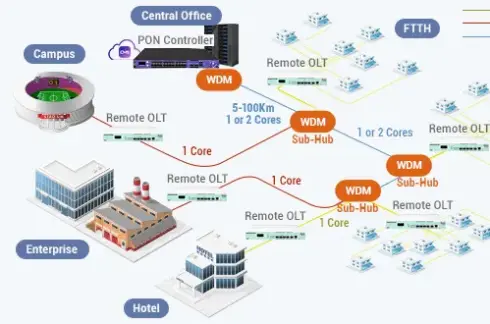
Centralized OLT deployment means the OLT is installed in a central office, main equipment room, or central access node. Fiber is then distributed to users through optical splitters and ODN infrastructure.
Distributed OLT deployment means OLTs are placed closer to users, such as in outdoor cabinets, remote nodes, communities, buildings, or edge access points.
Deployment Model | Centralized OLT | Distributed OLT |
OLT location | Central office or main equipment room | Closer to users |
Fiber distribution | Longer feeder and distribution network | Shorter access distance |
Management | Easier central maintenance | Requires stronger remote management |
Expansion | Good for large planned networks | Good for remote or scattered users |
Typical use | Urban FTTH, ISP access room, campus core | Rural broadband, outdoor cabinet, community access |
Centralized OLT is suitable when user density is high and fiber resources are well planned. Distributed OLT is suitable when users are scattered or when access nodes need to be closer to the service area.
A distributed model may also use an outdoor OLT when indoor equipment rooms are unavailable.
Carrier-grade OLTs are designed for telecom operators and ISPs. They usually require higher reliability, larger capacity, redundancy, advanced management, and long-term service stability.
Enterprise OLTs are often used in campuses, hotels, industrial parks, schools, hospitals, office buildings, or private fiber access networks. They may focus more on simplified deployment, cost control, and service flexibility.
Item | Carrier-Grade OLT | Enterprise OLT |
Target user | ISP, telecom operator | Campus, hotel, enterprise, building network |
Capacity | Higher user capacity | Small to medium user capacity |
Reliability | Higher redundancy requirement | Depends on project scale |
Management | EMS, NMS, SNMP, C-Data CMS, remote operation | Web, CLI, EMS, C-Data CMS, simplified operation |
Service type | Broadband, IPTV, VoIP, enterprise leased access | Internet, Wi-Fi backhaul, IP cameras, office access |
Deployment cycle | Long-term network planning | Project-based deployment |
Carrier-grade OLTs are better for large subscriber networks. Enterprise OLTs are better for private fiber networks where the project owner wants fiber access benefits without building a full telecom-grade access system.
The right choice depends on access technology, user distribution, cable infrastructure, management needs, and future expansion.
Choose an OLT when the project requires:
FTTH or FTTB access
ONU or ONT terminals
Optical splitters
Long-distance PON access
Centralized subscriber management
GPON, EPON, or XGS-PON service delivery
Choose a switch when the project requires:
Ethernet device connection
LAN or campus aggregation
OLT uplink aggregation
VLAN trunking
Layer 2 or Layer 3 forwarding
Direct connection to routers, servers, APs, or cameras
In many projects, the best answer is not OLT or switch. It is OLT plus switch. The OLT handles PON access, and the switch handles aggregation and forwarding toward the core network.
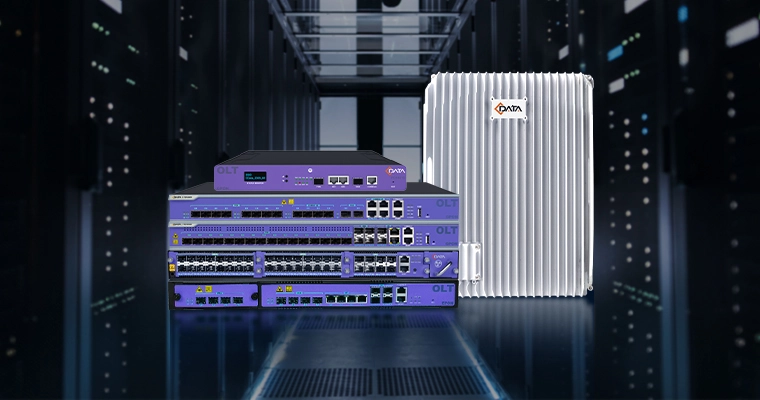
Whether deploying a PON access network or an Ethernet network, C-Data provides a complete portfolio of OLTs and Ethernet switches. From mini, pizza-box, expandable, chassis, and outdoor OLTs to unmanaged and Layer 2 managed Gigabit switches, the portfolio supports flexible network design from the access layer to traffic aggregation.
OLT and switch are both important network devices, but they serve different purposes. An OLT is used for PON fiber access and ONU management. A switch is used for Ethernet forwarding, device connection, and traffic aggregation.
In FTTH and carrier networks, the OLT connects subscribers through optical splitters, while switches aggregate OLT uplinks and forward traffic toward routers, BNG systems, or the core network. Centralized OLT deployment works well for dense planned networks, while distributed OLT deployment is useful for remote or scattered access areas. Carrier-grade OLTs are designed for large operator networks, while enterprise OLTs are suitable for private or project-based fiber access.
For most fiber access projects, OLT and switch should be deployed together rather than compared as direct replacements.
No. An OLT is a PON access device used to connect ONUs or ONTs through optical splitters. A switch is an Ethernet forwarding device used to connect and aggregate network devices.
A switch cannot replace an OLT in a PON network because it cannot manage ONUs, optical splitters, PON registration, ranging, or upstream bandwidth allocation.
Yes. In most networks, the OLT connects to an aggregation switch through uplink ports. The switch then forwards traffic to routers, firewalls, BNG systems, or the core network.
Centralized OLT deployment means the OLT is installed in a central office or main equipment room. It is suitable for dense FTTH networks and centralized operation.
Distributed OLT deployment places OLTs closer to users, such as in cabinets, buildings, communities, or remote access nodes. It is suitable for scattered users or outdoor access networks.
Carrier-grade OLTs are designed for telecom operators and ISPs with higher capacity and redundancy. Enterprise OLTs are usually used in campuses, hotels, buildings, and private fiber access networks.
In many FTTH or PON networks, yes. The OLT manages PON access, while the switch aggregates uplink traffic and connects the OLT to the core network.