 Optical Transport Networking Solution
 FTTH Solution
 Home Networking Solution
 POL Solution
 Outdoor OLT Solution
 More
More
 Brand News
 Product News
 Tech Blogs
 CMS
CMS
 Tech Support
 Document Download
 Software Download
 FAQ
FAQ
 Training Center
 About Us
 Careers
 Partners
 Quality Assurance
 Video Center


This website uses cookies to ensure you get the best experience. Some cookies are essential, while others help
us improve your experience by analyzing data or showing personalized content.
For details, please see our
Privacy Policy.

Choosing the right OLT is not only about port counts. Operators and integrators also need to compare PON standards, device structure, installation environment, upgrade path, and management requirements. Therefore, questions such as Combo PON OLT vs GPON OLT, Mini OLT vs Chassis OLT, and Indoor OLT vs Outdoor OLT often appear together during network planning.
For ISPs, hotels, communities, campuses, rural broadband projects, and enterprise fiber networks, the right OLT type should match both current deployment needs and future bandwidth growth. This article explains the main differences between common OLT types and provides a practical selection guide.
A GPON OLT is an Optical Line Terminal based on Gigabit-capable Passive Optical Network technology. It is widely used in FTTH, FTTB, campus broadband, hotel networks, and ISP access networks.
A GPON OLT connects to multiple ONUs through passive optical splitters and provides broadband access from the central side of the network. It supports downstream and upstream communication, ONU management, VLAN configuration, service profiles, and bandwidth control.
According to ITU-T G.984.3, GPON commonly operates at 2.488 Gbit/s downstream and 1.244 Gbit/s upstream, making it suitable for standard FTTH broadband, IPTV, VoIP, and general multi-service access.
GPON OLT is often selected when the network needs mature technology, stable ONU compatibility, controlled deployment cost, and enough capacity for common residential or enterprise access.
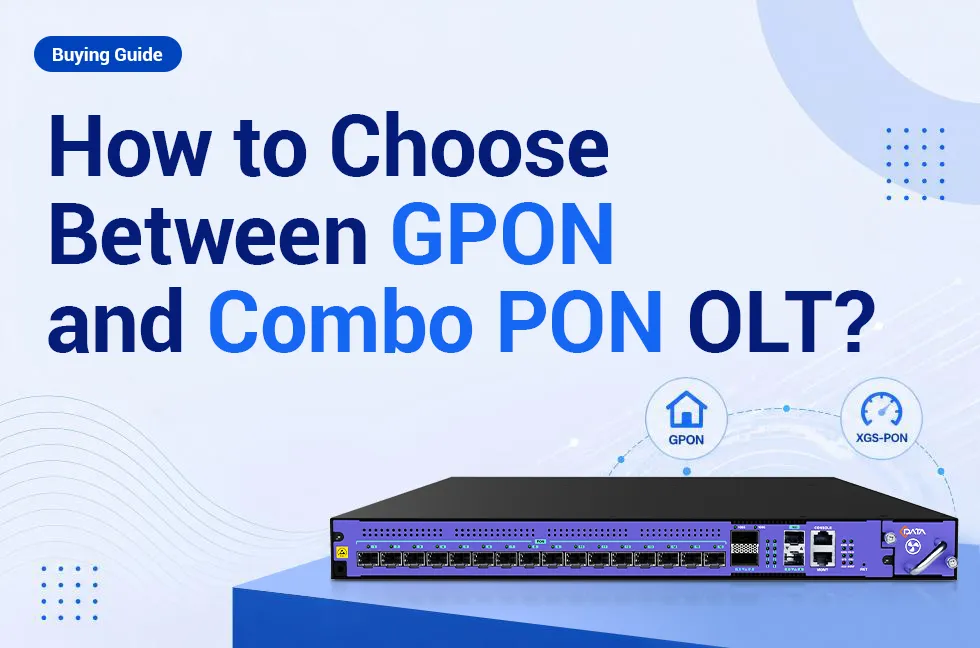
A Combo PON OLT is an OLT designed to support smoother migration from GPON to XG(S)-PON on the same ODN. It helps operators serve existing GPON users while preparing the network for higher-bandwidth services.
A Combo PON OLT is useful when an operator wants to protect the existing GPON investment but also offer premium 10G-class broadband services to selected users.
Combo PON OLT is commonly used when:
Existing GPON users must remain online.
New users require higher bandwidth.
The operator wants a phased upgrade plan.
The existing ODN should be reused as much as possible.
GPON and XGS-PON services need to coexist during migration.
One of the primary advantages of Combo PON OLT is upgrade flexibility. It reduces the need for disruptive network reconstruction and allows operators to move users to higher-speed services gradually.
The main difference between Combo PON OLT and GPON OLT is the upgrade path. A GPON OLT focuses on mature gigabit-class access, while a Combo PON OLT is designed for coexistence and migration toward 10G PON.
Item | GPON OLT | Combo PON OLT |
Main purpose | Standard FTTH broadband access | GPON and 10G PON migration |
Technology focus | GPON | GPON and XG(S)-PON coexistence |
Upgrade flexibility | Limited to GPON platform capability | Better upgrade flexibility |
Typical user | Residential broadband, hotel, campus, small ISP | ISP upgrade, higher-bandwidth services, high-density access |
Cost structure | Usually lower initial cost | Higher initial cost but better migration value |
Best fit | Stable standard broadband network | Network upgrading from GPON to 10G PON |
Choose GPON OLT when the project needs a stable and cost-effective access network. Choose Combo PON OLT when the project needs GPON continuity and future 10G broadband readiness.
A mini OLT is a compact OLT used for small and medium-scale PON deployment. Compared with large chassis systems, a mini OLT usually has fewer PON ports, smaller size, simpler installation, and lower initial deployment cost.
A mini OLT is suitable for:
Small FTTH projects
Hotels and apartments
Schools and campuses
Rural broadband access
Small ISP access nodes
Enterprise fiber access
Pilot projects or phased deployment
The advantage of a mini OLT is flexibility. It can be deployed in small equipment rooms, structured wiring cabinets, cabinets, desktops, or distributed access points. It is often easier to install and maintain than a large chassis OLT.
However, mini OLTs may have limited expansion capability. If the user base will grow quickly, planners should check port capacity, uplink speed, management functions, and future scalability before selecting a mini model.
A chassis OLT is a modular OLT system with slots for service boards, control boards, uplink boards, power modules, and fan modules. It is designed for higher capacity, better expansion, and stronger redundancy.
A chassis OLT is suitable for:
Large ISP access networks
High-density FTTH deployment
Central office access nodes
Smart community broadband
City-level or regional broadband networks
Projects requiring service board expansion
Networks requiring redundancy and hot-swappable modules
The main advantage of a chassis OLT is scalability. Operators can add service boards as subscribers increase. They can also support different PON technologies or uplink modules depending on the platform design.
Mini OLTs and chassis OLTs are designed for different network scales. A mini OLT is compact and cost-effective. A chassis OLT is scalable and suitable for larger networks.
Item | Mini OLT | Chassis OLT |
Size | Compact | Larger modular frame |
Capacity | Small to medium | Medium to large |
Expansion | Limited | Stronger expansion |
Installation | Easier | Requires equipment room planning |
Cost | Lower initial cost | Higher initial cost |
Redundancy | Limited by model | Better support for redundancy |
Best fit | Small projects, hotels, rural nodes | ISP, central office, high-density FTTH |
Choose a mini OLT when the project is small, budget-sensitive, or distributed. Choose a chassis OLT when the project needs high port density, long-term expansion, and stronger reliability.
An indoor OLT is designed for installation in equipment rooms, data rooms, offices, buildings, or controlled environments. It usually does not need the same environmental protection as an outdoor OLT.
Indoor OLTs are commonly used in:
Telecommunication rooms
Office buildings
Hotels
Campuses
Residential communities
Data rooms
Enterprise access networks
Indoor deployment is usually easier to manage because power supply, grounding, cooling, and maintenance access are more controlled.
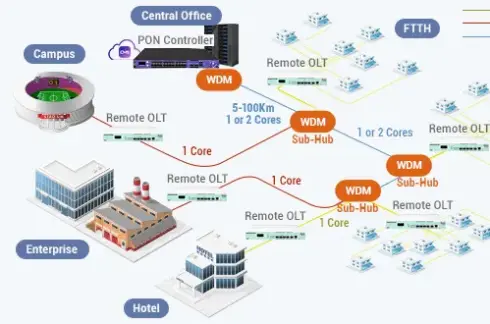
An outdoor OLT is designed for deployment in outdoor cabinets, remote access nodes, roadside cabinets, industrial areas, rural broadband networks, or other environments without a traditional indoor equipment room.
An outdoor OLT usually needs stronger environmental adaptability, such as temperature resistance, dust protection, power protection, cabinet compatibility, surge protection, and remote management support.
Outdoor OLTs are useful when:
Users are far from the central office.
The network needs distributed access nodes.
Indoor equipment rooms are unavailable.
Fiber feeder distance needs to be reduced.
Rural or remote broadband deployment is required.
The OLT must be closer to users.
Outdoor deployment can reduce access distance and improve deployment flexibility, but it also requires better protection and remote maintenance planning.
The main difference between indoor and outdoor OLT is the installation environment. Indoor OLTs are used in controlled rooms. Outdoor OLTs are used in harsher field conditions.
Item | Indoor OLT | Outdoor OLT |
Installation location | Equipment room or indoor cabinet | Outdoor cabinet or remote site |
Environmental requirement | Controlled environment | Temperature, dust, power and surge protection |
Maintenance | Easier on-site access | Requires remote monitoring and field service |
Typical use | Buildings, campuses, hotels, central rooms | Rural broadband, remote communities, roadside cabinets |
Deployment flexibility | Depends on room availability | Better for distributed access |
Protection design | Standard indoor protection | Stronger on-site protection |
Choose indoor OLT when the project has a stable equipment room. Choose outdoor OLT when access nodes must be closer to users or when indoor sites are not available.
OLT selection should start with deployment goals, not product names. A good selection process should consider network scale, bandwidth demand, user location, ODN condition, and upgrade strategy.
A practical selection table is:
Requirement | Recommended C-Data OLT Type |
Standard FTTH broadband | Pizza-box GPON OLT |
GPON-to-XGS-PON migration | Combo PON OLT |
Small hotel, apartment, or school project | Mini GPON OLT / Combo PON OLT |
Large ISP or high-density FTTH network | Expandable OLT / chassis OLT |
Equipment room deployment | Pizza-box OLT |
Remote or cabinet deployment | Outdoor OLT / Distributed PON solution |
Long-term capacity expansion | Expandable OLT / chassis OLT |
Cost-sensitive small project | EPON OLT / Mini GPON OLT |
For buyers comparing C-Data OLT options, the final choice should match the number of users, PON port demand, uplink bandwidth, ONU compatibility, management platform, installation environment, and future upgrade plan.
C-Data provides a complete OLT portfolio including Mini, Pizza-Box, Expandable, Chassis, and Outdoor solutions with 1 to 112 PON ports. Supporting GPON, XGS-PON, Combo PON and broad multi-vendor ONU compatibility, C-Data OLTs help operators build flexible, scalable, and future-ready FTTH networks.
Different OLT types solve different deployment problems. A GPON OLT is mature and cost-effective for standard FTTH broadband. A Combo PON OLT is better for networks that need GPON continuity and future 10G PON migration. A mini OLT is compact and suitable for small or distributed projects. A chassis OLT is better for large networks that need expansion and redundancy. An indoor OLT is suitable for controlled equipment rooms, while an outdoor OLT is designed for remote or harsh deployment environments.
For ISPs, integrators, and enterprise network planners, the best OLT is not always the highest-capacity model. The best choice is the one that fits the current network while leaving enough space for future growth.
A GPON OLT is mainly used for standard GPON access. A Combo PON OLT is designed to support GPON and 10G PON coexistence or migration, making it more suitable for network upgrades.
Yes, a mini OLT can be suitable for small ISP networks, rural access nodes, hotels, apartments, and phased deployment. For large-scale ISP networks, a chassis OLT may be better.
A chassis OLT provides higher capacity, modular service boards, better expansion, and stronger redundancy. It is suitable for central offices and high-density FTTH networks.
Choose an outdoor OLT when the access node must be installed outside, closer to users, or in locations without indoor equipment rooms. It is useful for rural broadband, remote communities, and outdoor cabinets.
Indoor OLTs should not be used outdoors unless they are installed in a properly protected cabinet with suitable temperature control, power protection, grounding, and environmental protection.
Not always. Combo PON OLT is better for upgrade and coexistence scenarios. GPON OLT may still be more cost-effective for standard broadband projects without near-term 10G PON demand.
You should check PON standard, PON port count, uplink speed, multi-vendor ONU compatibility, maximum optical split ratio, optical power budget, management system, installation environment, redundancy, and future upgrade requirements.