 Optical Transport Networking Solution
 FTTH Solution
 Home Networking Solution
 POL Solution
 Outdoor OLT Solution
 More
More
 Brand News
 Product News
 Tech Blogs
 CMS
CMS
 Tech Support
 Document Download
 Software Download
 FAQ
FAQ
 Training Center
 About Us
 Careers
 Partners
 Quality Assurance
 Video Center


This website uses cookies to ensure you get the best experience. Some cookies are essential, while others help
us improve your experience by analyzing data or showing personalized content.
For details, please see our
Privacy Policy.

Different network scenarios require different OLT selection strategies. A rural broadband project does not have the same requirements as a telecom operator network. A small startup ISP may not need the same OLT platform as a large carrier. An outdoor access node needs stronger environmental protection than an indoor equipment room deployment.
For network planners, choosing the right OLT means matching the device to the deployment environment, service model, user density, service requirements and maintenance capability. This article explains how to choose an OLT for rural networks, outdoor deployment, small-scale deployment, enterprise projects, startups, ISPs and telecom operators.
The best OLT for rural networks is usually the one that balances coverage, cost, reliability and remote management. Rural users are often scattered, access distance is longer, and on-site maintenance is more expensive than in urban areas.
According to ITU Facts and Figures 2025, 85% of urban dwellers use the Internet globally, compared with 58% of the rural population. This digital gap explains why rural broadband infrastructure still needs practical, scalable and cost-effective access solutions.
For rural networks, the OLT should support:
Long-distance fiber access planning
Split ratio planning
Sufficient optical power budget
Remote ONU monitoring
Outdoor or cabinet deployment where required
Lower field maintenance pressure
Sufficient but not excessive port capacity
Future expansion as more users join the network
A GPON OLT is often suitable for rural FTTH and village broadband because it provides mature fiber access and supports multiple ONUs through passive optical splitters.
An outdoor OLT is designed for deployment outside a traditional equipment room. It may be installed in a cabinet, roadside access node, village site, industrial park, smart community or remote facility.
An outdoor OLT is suitable when:
There is no indoor equipment room.
The access node must be closer to users.
Users are scattered across a wide area.
Fiber distribution distance needs to be reduced.
The OLT must work in cabinet or outdoor conditions.
Remote maintenance is required.
When choosing an outdoor OLT, check:
Factor | Why It Matters |
Operating temperature | Outdoor sites may face heat or cold |
Dust and moisture protection | Cabinet environments are less controlled |
Surge protection | Outdoor fiber and power routes may be exposed |
Power supply design | Remote sites may have unstable power |
Remote management | Reduces field visits |
Uplink capacity | Prevents access bottlenecks |
PON port count | Must match user distribution |
Cabinet compatibility | Ensures proper installation and heat dissipation |
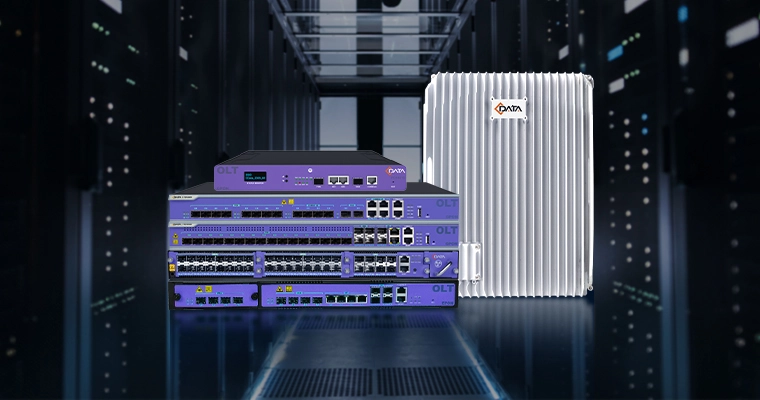
Outdoor OLT selection should focus on reliability and maintainability. C-Data outdoor cabinet OLT combines a rugged cabinet-based design, environmental monitoring capabilities, and flexible installation options, helping operators minimize on-site maintenance while ensuring reliable operation in harsh environments.
A mini OLT is a compact OLT designed for small or medium access networks. It is often used where high-density chassis deployment is unnecessary.
A mini OLT is suitable for:
Small ISP access nodes
Hotels and apartments
Rural villages
Schools and campuses
Office buildings
Pilot FTTH projects
Startup ISP deployment
Distributed access points
The main advantages of mini OLTs include compact size, lower initial cost, easier installation and flexible deployment. However, the limitation is usually scalability.
Before choosing a mini OLT, check:
PON port count
Maximum ONU support
Uplink speed
Supported PON standard
Management interface
Power supply reliability
Rack, wall-mount or cabinet installation
Future expansion requirement
For small-scale or phased network deployments, the C-Data Mini OLT series are practical. Available in GPON and Combo PON models with 1- or 2-port configurations and 10GE uplinks, the OLTs are flexible and cost-effective for hotels, campuses, startup ISPs and phased FTTH deployment.
For enterprise networks, OLTs are usually used in campuses, hotels, hospitals, office parks, schools, factories, smart buildings and private fiber networks. The goal is not always public broadband service. It may be internal fiber access, Wi-Fi backhaul, IP camera aggregation, office network access or building connectivity.
For enterprise networks, OLT selection should focus on:
Simple management
VLAN separation
Broad ONU interoperability
Integration with switches and routers
Support for IP cameras, APs and office devices
Cost-effective port capacity
Easy maintenance by IT teams
Reliable access for different departments or buildings
An optical network unit should also be selected carefully because user-side interfaces matter. Some enterprise users need Ethernet ports, some need Wi-Fi, some need bridge mode, and some need PoE or special service configurations.
C-Data provides a comprehensive OLT portfolio of EPON, GPON, and Combo PON OLTs with flexible 1- to 32-port configurations, enabling enterprise networks to deploy right-sized fiber access solutions without the cost and complexity of large carrier-grade platforms.
An ISP-grade OLT must support more users, stronger management and higher reliability than a small enterprise OLT. For ISPs, the OLT becomes part of the revenue-generating broadband infrastructure, so stability and scalability are critical.
ISP-grade OLT selection should consider:
Higher PON port density
Higher uplink capacity
ONU batch provisioning
EMS, NMS, SNMP or centralized management
VLAN, QinQ and subscriber separation
QoS and bandwidth profiles
IPTV and multicast support
Redundant power or uplinks
Firmware upgrade support
Stable long-term operation
Support for multi-vendor ONU interoperability
For ISPs comparing C-Data OLT options, the best model should match current subscriber scale and future growth. A startup ISP may begin with a mini OLT, while a growing ISP planning long-term network growth, the C-Data Combo PON chassis OLT FD6700S provides up to 112 Combo PON ports and dual 100GE uplinks, supporting large-scale subscriber access and smooth GPON-to-XGS-PON evolution.
Startup ISPs and new broadband projects often need to control initial investment. However, choosing the cheapest OLT without planning future growth can create problems later.
For startups, the OLT should be:
Affordable enough for initial deployment
Easy to configure and maintain
Compatible with cost-effective ONUs
Scalable for the next stage of user growth
Capable of remote management
Suitable for the local deployment environment
Supported by clear documentation and technical support
A startup ISP should avoid overbuilding a large chassis system too early, but it should also avoid buying an OLT that cannot handle future users, uplink bandwidth or management needs.
A practical approach is to start with a mini or fixed-port GPON OLT for the first service area, then move to higher-capacity platforms as the subscriber base grows.
Telecom operators usually need carrier-grade OLT systems because their networks serve larger user bases and require long-term reliability.
A telecom operator should evaluate:
High-density PON capacity
Modular expansion
GPON, XGS-PON or Combo PON migration
Large-scale ONU management
Redundant uplink and power
Advanced QoS and multicast
Integration with OSS/BSS or management platforms
Multi-service support
Service-level reliability
Long-term vendor roadmap
According to Broadband Forum TR-156, GPON access architectures include OLT and ONU/ONT functions in broadband access deployment. For telecom operators, this means the OLT should be considered as part of the whole access architecture, not only as an isolated piece of hardware.
Telecom operators should also plan migration from GPON to XGS-PON or Combo PON when user bandwidth demand grows.
Although both use OLTs as the fiber access platform, enterprise and ISP deployments have different design priorities.
Item | OLT for Enterprise | ISP-Grade OLT |
Main user | Campus, hotel, building, company | ISP or telecom operator |
Network purpose | Private access network | Public broadband service |
User scale | Small to medium | Medium to large |
Management | Simple IT management | Centralized operator-grade management |
Service complexity | Office, Wi-Fi, cameras, building access | Internet, IPTV, VoIP, subscriber packages |
Redundancy | Project-dependent | More important |
Expansion | Moderate | Stronger long-term scalability |
Best fit | Private fiber network | Revenue-generating broadband network |
For enterprise networks, choose an OLT that matches the scale and requirements of private, project-based deployments. For ISP networks, select an OLT designed to support large-scale subscriber management, service provisioning, high availability, and long-term scalability.
The best OLT type depends on real deployment conditions.
Scenario | Recommended C-Data OLT Type |
Small rural village | Mini GPON OLT or outdoor OLT |
Remote outdoor access node | Outdoor OLT |
Hotel or apartment broadband | Mini or pizza-box GPON OLT |
Campus or enterprise park | Pizza-box or expandable GPON / Combo PON OLT |
Startup ISP first service area | Mini or pizza-box GPON OLT |
Growing ISP network | Pizza-box or expandable GPON OLT |
Telecom operator upgrade | Combo PON chassis OLT |
Future 10G broadband | Combo PON OLT |
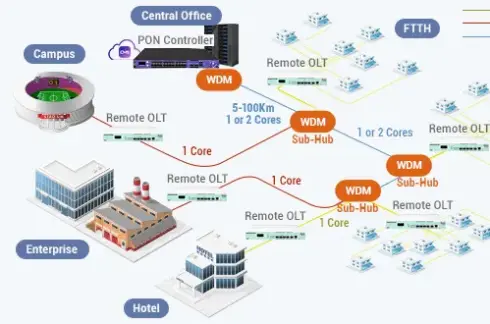
Scattered users | Distributed PON solution / outdoor OLT |
Dense urban FTTH | Distributed PON solution / Combo PON chassis OLT |
This table should be treated as a starting point. Final selection should also include optical power budget, splitter plan, uplink design, ONU model, service type and maintenance capacity.
Common mistakes include choosing only by price, ignoring uplink bandwidth, overusing high split ratios, forgetting outdoor conditions, selecting incompatible ONUs and failing to plan future upgrades.
Avoid these problems by checking:
Is the OLT standard compatible with the ONU?
Is the uplink enough for peak traffic?
Does the split ratio match optical power budget?
Is the device suitable for the installation environment?
Can the OLT be managed remotely?
Is the port count enough for future growth?
Does the OLT support required services such as IPTV or VoIP?
Is there a clear firmware and technical support path?
OLT selection should be treated as network planning, not only hardware purchasing.
Different OLT scenarios require different selection logic. For rural networks, the best OLT should balance coverage, cost and remote maintenance. For outdoor deployment, environmental reliability is critical. For mini OLT projects, compact size and affordability matter, but expansion should not be ignored. For enterprise networks, easy management and service separation are important. For ISPs and telecom operators, scalability, redundancy, centralized management and future upgrade capability become more important.
The right OLT should match the business model, user density, installation environment, service demand and long-term growth plan. By evaluating these factors clearly, operators and integrators can avoid overbuilding, underbuilding and early equipment replacement.
The best OLT for rural networks is usually a GPON OLT, mini OLT or outdoor OLT depending on user density, fiber distance, cabinet conditions and maintenance requirements.
Choose an outdoor OLT based on operating temperature, power supply, surge protection, cabinet compatibility, uplink capacity, PON port count and remote management capability.
Choose a mini OLT for small villages, hotels, apartments, campuses, startup ISPs, pilot projects and distributed access nodes where compact size and lower initial cost are important.
Enterprise networks typically deploy compact or fixed-port OLTs to provide fiber access for campuses, hotels, hospitals, factories, office parks, and other private networks. enterprise networks generally require moderate capacity, simplified management, and flexible service isolation rather than large-scale subscriber management.
An ISP-grade OLT is designed for broadband operators. It usually requires higher capacity, centralized management, subscriber control, QoS, multicast, redundancy and long-term scalability.
A startup ISP may choose a mini or fixed-port GPON OLT for the first service area, but it should still check uplink capacity, ONU compatibility, management functions and future expansion.
Telecom operators should choose scalable, reliable and centrally manageable OLT platforms, often with GPON, XGS-PON or Combo PON migration capability, depending on network strategy.