 Optical Transport Networking Solution
 FTTH Solution
 Home Networking Solution
 POL Solution
 Outdoor OLT Solution
 More
More
 Brand News
 Product News
 Tech Blogs
 CMS
CMS
 Tech Support
 Document Download
 Software Download
 FAQ
FAQ
 Training Center
 About Us
 Careers
 Partners
 Quality Assurance
 Video Center


This website uses cookies to ensure you get the best experience. Some cookies are essential, while others help
us improve your experience by analyzing data or showing personalized content.
For details, please see our
Privacy Policy.

For many broadband operators, choosing an OLT starts as a specification exercise: port density, uplink capacity, supported ONUs and price.
But the more important question is strategic:
What will the access network need to support three to five years from now?
That changes the GPON-versus-Combo-PON discussion.
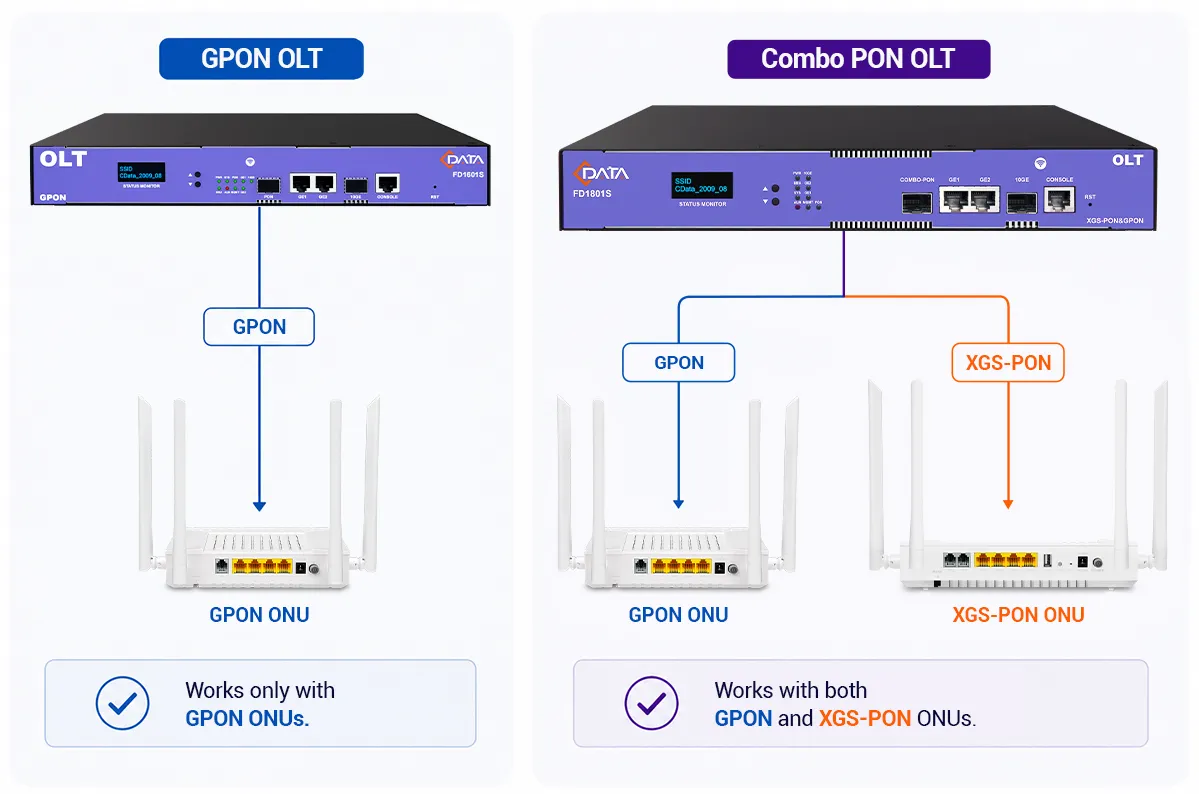
GPON remains a mature and cost-effective choice for many FTTH, FTTB, campus and enterprise deployments. Combo PON, meanwhile, becomes increasingly relevant when an operator needs to keep existing GPON subscribers online while creating a practical path toward XGS-PON services.
The right answer is not “newer is always better.”
It depends on the network you have today, the services you plan to sell tomorrow and how much disruption you can accept during migration.
GPON has a large installed base, a mature ONU ecosystem and a cost structure that works well for standard broadband access.
For a new ISP serving residential users, a hotel or campus network, a rural broadband project or an enterprise deployment without near-term 10G requirements, a GPON OLT can still be the more rational investment.
The key is to distinguish between future-ready and overbuilt.
If subscribers mainly need mainstream internet access, IPTV, VoIP and Wi-Fi backhaul, deploying a more complex platform before the business model requires it may increase initial CAPEX without creating an immediate service advantage.
In these cases, GPON allows operators to concentrate investment where it may create more immediate value: coverage, reliable ODN construction, ONU deployment, customer acquisition and day-to-day operations.
The question is therefore not whether GPON is the newest technology. It is whether GPON can support the commercial requirements of the network for the foreseeable planning cycle.
The strongest case for Combo PON is not simply higher speed.
It is migration flexibility.
Operators with an established GPON network face a difficult question when demand for higher upstream and downstream capacity begins to grow:
How can selected customers move toward XGS-PON without forcing an immediate replacement of the entire installed base?
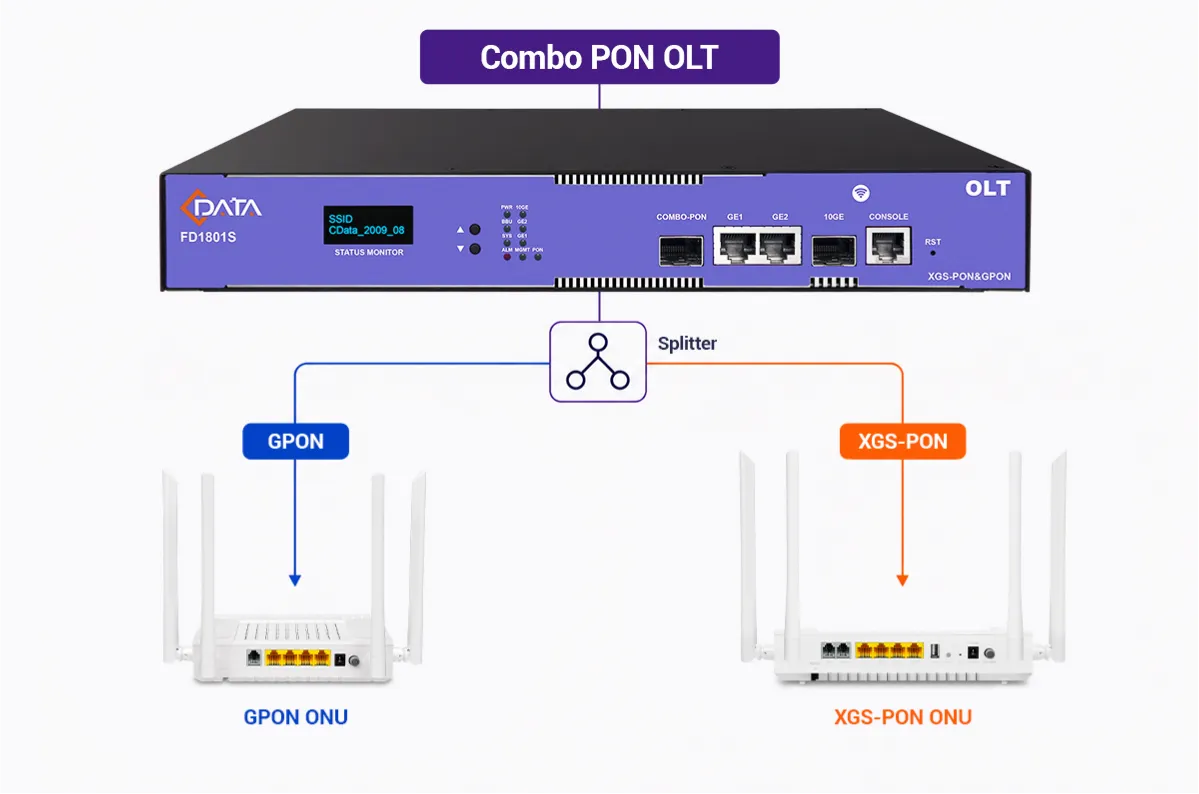
Combo PON OLT Solutions address this transition by allowing GPON and 10G-class PON services to coexist as part of the same migration strategy.
Existing GPON subscribers can remain on their current services, while new users, enterprise customers or premium broadband subscribers can gradually move to XGS-PON.
This staged approach can be especially valuable for operators that want to protect previous network investment while opening new, higher-value service tiers.
Instead of treating network evolution as a one-time replacement project, operators can treat it as a phased commercial transition.
One of the most important considerations in an FTTH upgrade is often not the OLT itself.
It is the Optical Distribution Network.
Feeder fiber, distribution fiber, splitters, cabinets, connectors and drop cables represent a substantial part of the physical network investment. They are also costly and disruptive to rebuild.
That means an upgrade decision should never be based only on comparing OLT purchase prices.
If an existing ODN can support the required optical budget, split ratio, fiber quality and wavelength coexistence plan, a phased migration may allow the operator to continue using much of the passive infrastructure already deployed in the field.
This changes the economics of the decision.
A Combo PON platform may require higher initial equipment investment, but it can provide stronger long-term value when the alternative is widespread ODN reconstruction or a disruptive forklift upgrade.
Before choosing the migration path, operators should therefore validate the existing ODN rather than simply assume that it is ready for the next generation.
Migration planning also has to include the subscriber side.
An established network may contain hundreds or thousands of GPON ONUs with different service profiles, software versions and vendor implementations.
Introducing XGS-PON means the operator may need to manage two generations of ONUs simultaneously.
That affects much more than engineering.
It affects procurement, provisioning, inventory, field installation, troubleshooting and technical support.
Before moving toward Combo PON, operators should understand whether their existing GPON ONUs can remain in service, which subscribers actually require XGS-PON first, whether the management platform can handle both generations efficiently, and whether interoperability has been properly tested.
The operations team also needs a clear way to identify, install and provision the correct ONU for each service.
These operational details can have as much influence on migration cost as the OLT hardware itself.
A better OLT decision begins with the service roadmap.
First, what services will the network sell over the next three to five years? If the roadmap centers on conventional residential broadband, GPON may remain sufficient. If premium symmetric services, enterprise connectivity or high-capacity backhaul are becoming important, Combo PON deserves stronger consideration.
Second, how much of the existing investment needs to be protected? The larger the GPON installed base, the more valuable coexistence can become.
Third, can the current ODN support migration? Split ratio, optical loss, distance, connector quality and power-budget margin all matter.
Fourth, is the operations team ready to manage two PON generations? Technology migration is also a provisioning and maintenance challenge.
Finally, is there real customer demand behind the upgrade? 10G capability should support a service strategy—not exist only as a specification advantage.
For many networks, GPON remains a practical and proven platform.
For operators preparing for a staged move toward XGS-PON, Combo PON can reduce migration friction and create a more flexible evolution path.
The best decision is therefore not about choosing the fastest technology available.
It is about matching access architecture to subscriber demand, existing infrastructure, operational capability and the commercial roadmap.
At C-Data, our OLT portfolio is designed around this broader network-evolution strategy: deploy what the network needs today while leaving a technically and economically realistic path for what comes next.
Further Reading: How to Choose Between GPON and Combo PON OLT