 Optical Transport Networking Solution
 FTTH Solution
 Home Networking Solution
 POL Solution
 Outdoor OLT Solution
 More
More
 Brand News
 Product News
 Tech Blogs
 CMS
CMS
 Tech Support
 Document Download
 Software Download
 FAQ
FAQ
 Training Center
 About Us
 Careers
 Partners
 Quality Assurance
 Video Center


This website uses cookies to ensure you get the best experience. Some cookies are essential, while others help
us improve your experience by analyzing data or showing personalized content.
For details, please see our
Privacy Policy.

In a Passive Optical Network (PON), the Optical Network Unit (ONU) is the user-side device that converts optical signals into electrical signals and delivers broadband services to end users. Whether the project is residential FTTH, multi-dwelling FTTB, hotel access or enterprise fiber deployment, the choice of ONU directly affects service quality, management efficiency and long-term network performance.
An ONU sits at the end of the optical distribution network. It receives downstream data from the OLT through passive optical splitters and sends upstream traffic back according to the access and bandwidth-allocation mechanisms defined by the active PON standard. Modern fiber optic ONU models support data only, data + voice, data + CATV, Triple Play, Wi-Fi routing and even 10G-class XGS-PON access.
For ISPs, system integrators, hotels, campuses and enterprise network planners, understanding the different types of ONU device — including voice ONU, Panel-Type xPON ONU for FTTH and ONU box form factors — is essential before selecting equipment. This guide explains what an ONU is, how it works, the main product categories, key selection criteria, and how C-Data solutions fit real-world deployment needs.
An ONU, or Optical Network Unit, is the subscriber-side termination device in a PON access network. In many FTTH deployments it is also called an ONT (Optical Network Terminal). The device connects to the optical distribution network via a single-mode fiber and provides Ethernet, Wi-Fi, voice (POTS), CATV or other user interfaces.
A typical access path is:
Core network → OLT → optical splitter → ONU / ONT → user devices (router, PC, IPTV, phone)
According to ITU-T recommendations, the ONU operates under the control of the OLT. In GPON, downstream traffic is transmitted toward the ONUs on a shared PON, while upstream transmissions are coordinated in assigned time slots so multiple ONUs can share the upstream channel.
The Broadband Forum TR-156 describes the ONU as the device that provides the user-facing interfaces and maps traffic between those interfaces and the GEM ports toward the OLT. This architecture makes the ONU the critical last-mile element for service delivery and quality of experience.
C-Data’s optical network unit portfolio is designed for exactly this role, offering C-Data xPON ONU adaptive models that automatically switch between GPON and EPON modes, strong third-party OLT compatibility, and support for TR-069-based remote management of applicable CPE functions.
ONU devices are classified by service capability, form factor and PON standard. The most common categories include:
Type | Key Features of C-Data Models | Typical Use Cases |
Data ONU | Ethernet ports only | Basic broadband access |
Voice ONU | Ethernet + POTS ports | Voice + data services |
ONU with router / Wi-Fi ONU | Built-in Wi-Fi (Wi-Fi 4/5/6), routing functions | Home and SOHO networks |
CATV ONU | Ethernet + RF CATV output | Triple Play (data + video) |
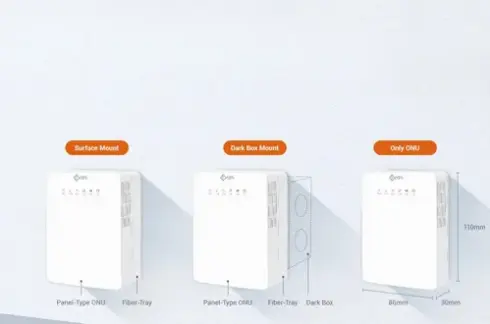
Panel-Type xPON ONU for FTTH | Compact wall-mount / 86-box form factor | Indoor residential installation |
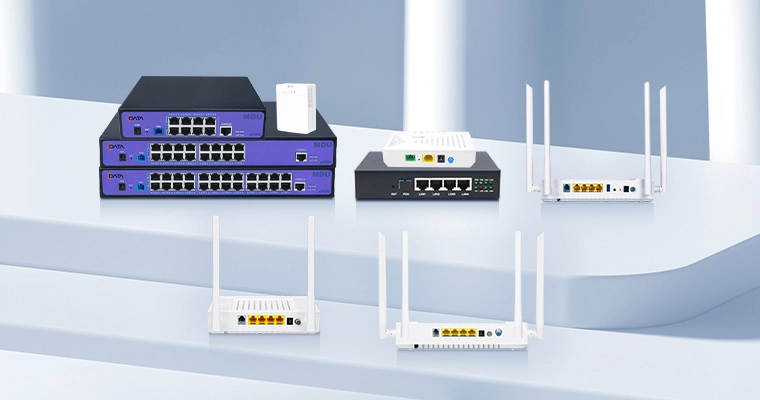
MDU / Multi-port ONU | 8/16/24 GE ports, optional PoE | FTTB, apartments, hotels |
ONU Stick / SFP ONU | SFP form factor with MAC | Flexible switches, routers or other host devices |
Voice ONU models provide one or more RJ11 POTS ports so operators can deliver traditional telephone service over the same fiber that carries internet. ONU with router integrates Wi-Fi access point and routing functions, reducing the need for a separate home gateway. Panel-Type xPON ONU for FTTH is designed for flush mounting in standard electrical boxes, combining fiber splicing protection and a clean indoor appearance.
Many C-Data models support SC/APC connectors, which provide higher return-loss performance than UPC connectors, helping minimize optical back-reflection in PON links. The compact ONU box design is also widely used for desktop or wall-mount installations.
Communication follows a well-defined process, although the specific mechanisms vary by PON standard:
1. The ONU is powered and connected to the ODN.
2. The OLT discovers and registers the ONU using the mechanisms defined by the active PON standard.
3. The OLT coordinates upstream transmission to allow multiple ONUs to share the same PON.
4. Bandwidth is allocated according to traffic demand and configured service policies.
5. Service parameters such as VLAN, QoS and multicast are provisioned and managed.
The specific mechanisms differ across PON technologies. GPON and XGS-PON use OMCI, defined by ITU-T G.988, for OLT-to-ONU management and configuration. EPON relies primarily on IEEE 802.3 OAM together with implementation-specific management mechanisms. Dual-mode xPON ONUs operate according to the management mechanisms of the active GPON or EPON mode.
Depending on the model and active PON mode, C-Data ONUs support applicable management mechanisms such as OMCI and TR-069, enabling centralized provisioning through the C-Data CMS platform or third-party ACS systems. This is particularly valuable for large-scale FTTH roll-outs where thousands of ONU devices must be managed remotely.
An ONU with routing combines the optical termination function with a full home gateway. Depending on the model, features may include:
Single-box installation reduces cost and complexity
Dual-band Wi-Fi
EasyMesh support for whole-home coverage
USB ports for storage or 4G/5G backup
Built-in firewall, parental control and QoS
Market data shows strong demand for integrated devices. Industry reports indicate that the global ONU & ONT market reached approximately USD 8.65 billion in 2025 and is projected to grow at a CAGR of around 6.6 % through 2032, driven largely by FTTH expansion and the shift to multi-service gateways. By September 2025, FTTH/FTTB networks in Europe had passed approximately 295 million homes, with subscriber take-up continuing to rise.
For operators, an integrated ONU router simplifies logistics and reduces truck rolls. For end users it delivers a cleaner installation experience. When evaluating ONU router price, total cost of ownership (installation labor, management platform and upgrade path) is usually more important than the initial hardware cost.
Panel-Type xPON ONU for FTTH models are gaining traction across hotels, high-density residential buildings, and office environments.. C-Data panel-type ONU models are designed to fit 86-type electrical boxes. Key benefits include:
Integrated fiber splicing tray and bend-radius protection
SC/APC or SC/UPC optical interface
1GE or multi-GE user ports, optional CATV or POTS
Clean aesthetic appearance for living rooms or corridors
C-Data offers several panel-type models such as the FD511G-FA10 and FD711G-FA10 series, supporting GPON/EPON adaptive access and AGC for CATV variants. These fiber ONU devices are especially suitable for new apartment construction and hotel guest-room fiber projects.
When evaluating ONU suppliers or an ONU manufacturer, planners should examine the following checklist:
Selection Factor | Why It Matters |
PON standard (GPON / EPON / XGS-PON) | Determines compatibility with existing OLT |
Number and type of user ports | Matches service package (data, voice, CATV, Wi-Fi) |
Wi-Fi generation and Mesh support | Affects home coverage quality |
Optical connector (SC/APC vs SC/UPC) | Impacts optical budget and reflection performance |
PON-side and CPE management support (such as OMCI, OAM or TR-069) | Enables remote provisioning and troubleshooting |
Third-party OLT compatibility | Avoids vendor lock-in |
Power consumption and operating temperature | Critical for outdoor or high-density deployments |
Form factor (desktop, panel, MDU, SFP stick) | Matches installation environment |
ONU fiber performance, ODN optical budget and connector type (especially SC/APC) should always be verified against the planned ODN design.
As an established ONU manufacturer, C-Data provides a complete range of fiber ONU devices covering:
Basic 1GE data ONUs
Voice ONU models with POTS
CATV ONU models with RF interfaces
Triple-Play ONU models with full service capabilities
Full Wi-Fi 6 ONU with router functions (AX1500 / AX2700 / AX3000)
Panel-Type xPON ONU for FTTH
High-density MDU units with PoE
XGS-PON ONU
Compact ONU stick modules and ONU box designs
All models emphasize third-party OLT compatibility, TR-069 support and integration with the C-Data CMS management system. Operators can mix C-Data ONUs with different OLT brands while maintaining centralized visibility and control. C-Data xPON ONU products are widely deployed in FTTH, FTTB and enterprise fiber projects worldwide.
For operators already running C-Data OLT platforms, pairing them with compatible ONUs delivers the most seamless registration, provisioning and remote management experience. You can explore the complete range of C-Data OLT solutions, while the full selection of fiber ONU device models is available for detailed comparison and selection.
An ONU is far more than a simple fiber-to-Ethernet converter. It is the service delivery point that determines bandwidth experience, voice quality, video performance and Wi-Fi coverage for every subscriber. Whether the requirement is a basic fiber optic ONU, a voice or Wi-Fi ONU, or a high-capacity XGS-PON ONU, careful selection based on service needs, management capabilities and future upgrade path is essential.
C-Data continues to expand its ONU portfolio to meet evolving FTTH, FTTB and enterprise fiber demands, offering reliable hardware, strong interoperability and professional remote management tools. By matching the right ONU device to the network architecture, operators can deliver stable multi-service access while keeping operational costs under control.
1. What is an ONU?
An ONU (Optical Network Unit) is the user-side device in a PON network that terminates the optical fiber and provides Ethernet, Wi-Fi, voice or CATV interfaces to end users.
2. What is the difference between a voice ONU and a regular data ONU?
A voice ONU includes one or more POTS (RJ11) ports so traditional telephone service can be delivered over the same fiber. A basic data ONU typically provides Ethernet ports without POTS voice service.
3. What is an ONU with router?
An ONU with router integrates optical termination, Ethernet switching, Wi-Fi access point and routing functions into a single device, eliminating the need for a separate home gateway in many residential deployments.
4. What is a Panel-Type xPON ONU for FTTH?
It is a compact, wall-mountable ONU designed to fit standard electrical boxes. It combines fiber splicing protection with user ports and is ideal for clean indoor residential installations.
5. Why do some ONUs use SC/APC connectors?
SC/APC connectors provide lower reflectance and higher return loss than SC/UPC connectors, helping reduce back-reflection in PON links..
6. Can C-Data ONUs work with third-party OLTs?
Yes. Many C-Data ONUs are designed for interoperability with third-party OLTs. Compatibility depends on the PON standard, OLT implementation, ONU model and required service features, so interoperability testing is recommended before large-scale deployment.
7. How should I choose between different ONU manufacturers or suppliers?
Evaluate PON standard support, management features, third-party interoperability, form-factor options, Wi-Fi performance, power consumption and long-term firmware support rather than ONU router price alone. Choosing a reliable ONU manufacturer helps ensure stable long-term network performance.
This is the first one.