 Optical Transport Networking Solution
 FTTH Solution
 Home Networking Solution
 POL Solution
 Outdoor OLT Solution
 More
More
 Brand News
 Product News
 Tech Blogs
 CMS
CMS
 Tech Support
 Document Download
 Software Download
 FAQ
FAQ
 Training Center
 About Us
 Careers
 Partners
 Quality Assurance
 Video Center


This website uses cookies to ensure you get the best experience. Some cookies are essential, while others help
us improve your experience by analyzing data or showing personalized content.
For details, please see our
Privacy Policy.

Deploying fiber broadband in rural and distributed areas is different from building FTTH networks in dense cities. Users may be scattered across villages, farms, roadsides, industrial parks, transportation corridors, or remote facilities, while dedicated telecommunications rooms may be unavailable.
For these locations, an outdoor OLT can bring PON access closer to subscribers without requiring a conventional indoor headend. A remote outdoor OLT, housed in a weatherproof cabinet that can be pole-mounted, wall-mounted, or ground-installed, can shorten the local access path and provide a practical way to expand FTTH into areas with low or uneven subscriber density.
The need for this type of deployment remains significant. According to the ITU Facts and Figures 2025, 85% of urban residents used the Internet globally in 2025, compared with 58% of rural residents. The ITU also reports that approximately 2.2 billion people remained offline worldwide.
This article examines how remote outdoor OLT and compact GPON OLT platforms can be applied to rural broadband, roadside networks, outdoor surveillance, industrial sites, and other distributed fiber access scenarios.
Urban networks usually benefit from high subscriber density. An OLT can be installed in a central office and serve many nearby users through the optical distribution network.
Rural and remote networks are different. Users may be separated by long distances, fiber routes may follow roads or utility corridors, and an equipment room may not exist at the point where broadband demand is concentrated.
Common challenges include:
Long distance between subscriber groups
Low or uneven user density
Limited equipment-room availability
Higher construction cost per subscriber
Outdoor installation requirements
Difficult field maintenance
Limited or unstable power supply
Harsh environmental conditions
Need for future broadband expansion
The Fiber Optic Association (FOA) specifically identifies remote OLT architecture as an option for low-density rural networks. Its FTTH design guidance states:
“The remote OLT option allows creating a ‘headend’ periodically along a rural road where users are grouped.”
This is important because a rural network does not always need a large centralized OLT. The FOA explains that rural areas may have only a small number of subscribers distributed over a large geographic area, making a smaller OLT deployed closer to users a practical alternative.
For operators, the question is therefore not simply how many PON ports are required, but where those ports should be located.
An OLT connects the operator's aggregation network with ONUs or ONTs through a passive optical network.
A distributed outdoor architecture can be represented as:
Core Network → Aggregation Network → Remote Outdoor OLT → Optical Splitter → ONU/ONT → End User
The key difference from conventional deployment is the location of the OLT. Instead of keeping all OLT equipment inside a central office, the operator places an access node closer to a village, roadside subscriber cluster, industrial site, or surveillance location.
A remote outdoor OLT can therefore help operators:
Bring PON access closer to users
Reduce dependence on centralized equipment rooms
Simplify access to scattered subscriber groups
Reuse existing outdoor infrastructure
Support localized FTTH expansion
Reduce the amount of feeder fiber required in some architectures
Manage remote nodes through centralized O&M systems
C-Data describes its Outdoor OLT Solution as a PON deployment approach specifically designed for networks that do not have a standard headend room. The company identifies quicker setup and lower total cost as key advantages.
PON allows multiple ONUs to share a PON port through passive optical splitters. This reduces the number of active devices that need to be installed along the distribution network.
For a rural or distributed network, the architecture may include:
An aggregation uplink
An outdoor OLT
Optical splitters
Distribution fiber
Residential or business ONUs
Centralized management
This approach can simplify field infrastructure because active PON network equipment remains concentrated at selected access nodes.
However, operators still need to calculate the optical power budget, fiber distance, split ratio, uplink capacity, and expected subscriber bandwidth. An outdoor OLT is part of the complete FTTH design rather than a standalone solution.
Operators generally have two deployment models.
Factor | Centralized OLT | Remote Outdoor OLT |
Location | Central office / headend | Village, roadside or outdoor nodes that are close to subscribers. |
Best suited for | Concentrated or efficienctly reachable | Scattered users |
Equipment environment | Usually indoor | Outdoor/cabinet |
OLT to subscriber distance | Potentially longer | Shorter in many deployments |
Active-node distribution | More centralized | More distributed |
Maintenance | Centralized | Requires strong remote management |
Expansion | Centralized | Localized |
Typical applications | Urban FTTH | Rural, roadside, surveillance, remote access |
Centralized OLT deployment can remain appropriate when several communities are connected through a planned fiber backbone. Distributed deployment becomes more attractive when users are scattered and the access node needs to be closer to them.
The FOA notes that rural FTTH has a fundamental distance challenge: longer cables increase both cable and installation costs, while some networks may exceed the practical reach of GPON before reaching the maximum number of subscribers. Remote OLT architecture can address this by placing OLTs at points where multiple users are grouped.
Rural village FTTH is one of the clearest applications for an 8 PON ports GPON OLT.
A village may have hundreds of potential households, but the homes can be distributed along several roads. Constructing a dedicated equipment room may add unnecessary civil and operating costs.
A compact outdoor OLT can instead be installed near the subscriber cluster.
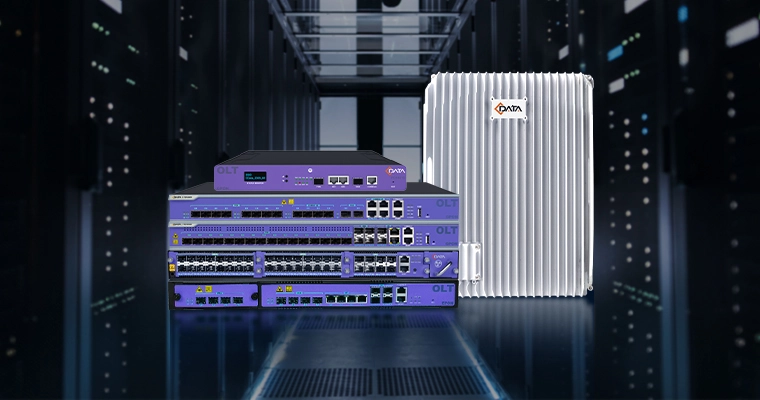
C-Data's FD1608Y is designed for field deployment and provides 8 GPON ports, 4*GE ports, and 2*10GE SFP+ ports.. It supports a maximum 1:128 split ratio and up to 1,024 ONUs under the specified configuration. The product uses an aluminum housing with IP67 protection and supports an operating temperature range of -40°C to 65°C.
For a small rural access node, this provides a combination of:
Compact outdoor installation
8-port GPON access
10GE uplink capability
High environmental protection
Remote management
Flexible mounting options
The result is a distributed FTTH node that can be positioned closer to the users it serves.
Roadside networks create a different type of rural deployment challenge. Users may include homes, small businesses, toll facilities, service areas, maintenance stations, and surveillance systems distributed along a long route.
A remote outdoor OLT can be installed at selected locations along the fiber route.
The architecture can be:
Aggregation Network → Roadside Fiber → Remote OLT → Optical Splitter → Nearby Users
This allows the access network to follow the geography of the route.
The FOA specifically discusses remote OLT deployment along rural roads and explains that small OLTs can create local “headends” where users are grouped. It also notes that remote OLTs can be placed in small outdoor enclosures and mounted on poles or other existing infrastructure.
This makes remote OLT architecture particularly relevant to long linear deployment environments.
Outdoor surveillance is another application identified by C-Data's Outdoor OLT Solution.
Examples include:
Highway surveillance
Traffic monitoring
Industrial perimeter cameras
Rural security systems
Agricultural monitoring
Remote public facilities
These sites may not have an indoor telecom room, but they still require reliable fiber connectivity.
An outdoor intelligent comprehensive cabinet OLT can combine the OLT with power, fiber management, environmental monitoring, and other field components.
C-Data's FDC600Y is designed as an intelligent field communication box. Its current specifications include an IP54 cold-rolled steel enclosure, environmental monitoring, built-in 6 kV lightning protection, fan and heater control, water and smoke sensing, and optional battery and 4G+GPS functions.
This means the cabinet can provide both equipment protection and field monitoring.
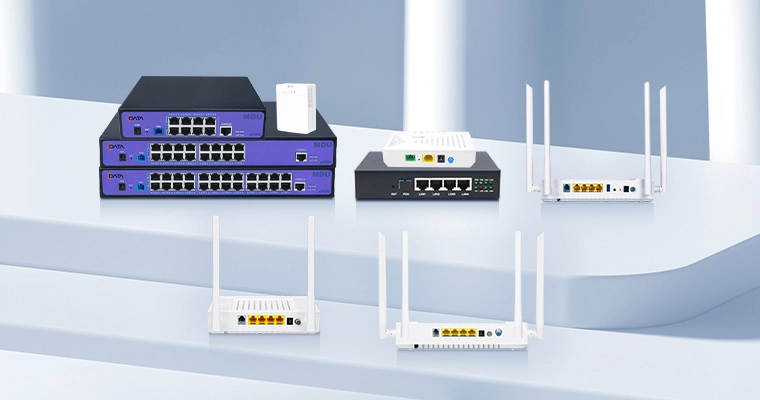
At the camera side, compatible ONUs or PoE-capable MDU devices can convert the PON connection into Ethernet access for IP cameras and other edge devices.
Industrial parks often contain factories, warehouses, offices, security systems, and other facilities spread across a relatively large area.
Installing all active access equipment inside one building may create long fiber routes to other facilities.
An intelligent OLT cabinet can create a local fiber access point within the park.
Potential services include:
Enterprise Internet
Office connectivity
Video surveillance
Building networking
Access-control systems
IP-based industrial applications
The OLT can provide centralized PON access and service management while the cabinet protects the active equipment from outdoor environmental conditions.
For enterprise networks, operators should also consider VLAN, QoS, uplink capacity, and service separation when designing the PON architecture.
Outdoor OLT solutions can also be used where broadband infrastructure needs to be deployed quickly.
Typical examples include:
Construction sites
Temporary residential areas
Emergency-response locations
Temporary offices
Pilot broadband projects
Seasonal facilities
C-Data explicitly lists Temporary Deployments as an Outdoor OLT application scenario.
An outdoor OLT can provide an initial access node without requiring a permanent central equipment room. If subscriber numbers increase, operators can add capacity or deploy additional nodes according to the project plan.
This phased approach can help avoid overbuilding the initial network.
An outdoor intelligent comprehensive cabinet OLT is more than a weather-resistant box. It can integrate network equipment, power systems, fiber management, environmental monitoring, and security functions into one field platform.
For example, the C-Data FDC600Y supports flexible combinations of GPON OLT and EYDFA modules. The current product page states that it can support up to 4 × 8-port GPON OLT modules, with up to 4,096 ONU connections under the stated configuration. It also supports pole or wall mounting and centralized OLT Web and CMS management.
The cabinet's functions can include:
OLT installation
Optical splitter installation
Fiber distribution
Power supply
Battery backup
Fan control
Heater control
Water detection
Smoke detection
Door alarms
Lightning protection
Remote monitoring
This integrated design is useful when an outdoor node must operate for long periods with limited physical maintenance.
A remote site may be far from an operator's maintenance team. This makes OLT management software an important considerations.
C-Data's outdoor OLT solution uses OLT Web and CMS platforms for remote operation and maintenance. The FD1608Y supports CLI, SNMP, TELNET, SSH, and WEB management, as well as device monitoring, configuration management, upgrades, alarms, VLAN, QoS, and PON configuration.
Remote management can help operators:
Check OLT status
Monitor ONUs
Review alarms
Modify configurations
Upgrade equipment
Diagnose faults
Monitor network conditions
Reduce unnecessary site visits
For a distributed network, management capability can therefore have as much operational importance as the PON port count.
Capacity planning should consider subscriber distribution, not only total users.
Factor | Question |
Subscriber count | How many users need service initially? |
User distribution | Are users concentrated or scattered? |
PON ports | How many PON ports are required? |
Split ratio | What split ratio fits the optical budget? |
Fiber distance | What is the ODN distance from the OLT to the farthest ONU? |
Uplink | What bandwidth is required now and later? |
Environment | What protection level is required? |
Power | What power source is available at the site? |
Management | Can the node be monitored remotely? |
Expansion | Will subscriber numbers increase? |
C-Data's FD1608Y provides 8 GPON ports and 10GE uplinks, making it suitable for compact field nodes. FDC600Y provides a modular cabinet architecture when a site requires more equipment or future expansion.
Requirement | FD1608Y | FDC600Y |
Compact outdoor node | ✓ | ✓ |
8-port GPON | ✓ | Modular |
10GE uplink | ✓ | ✓ |
Pole/wall deployment | ✓ | ✓ |
Modular cabinet | ✓ | ✓ |
Environmental monitoring | — | ✓ |
Battery option | — | ✓ |
Water/smoke detection | — | ✓ |
Multiple OLT modules | — | ✓ |
Rural FTTH | ✓ | ✓ |
Outdoor surveillance | ✓ | ✓ |
Larger remote node | — | ✓ |
The FD1608Y is a strong fit when the project needs a compact 8 PON ports GPON OLT.
FDC600Y is better suited to projects that need an intelligent OLT cabinet with integrated environmental monitoring, power, fiber management, and modular expansion.
Before installation, operators should check:
Subscriber distribution
Fiber route length
Optical power budget
Split ratio
Uplink bandwidth
Available power
Battery requirements
Cabinet installation location
Temperature range
Moisture and dust protection
Lightning protection
Grounding
ONU compatibility
Remote management
Future expansion requirements
The cheapest OLT is not necessarily the lowest-cost solution if the network later requires frequent field maintenance or expensive reconstruction.
A practical selection guide is:
Requirement | Recommended Approach |
Small rural node | Compact outdoor OLT |
Rural FTTH | GPON OLT |
Small distributed access | 8-port GPON OLT |
Roadside network | Remote outdoor OLT |
Outdoor surveillance | Outdoor OLT + protected cabinet |
Industrial park | Intelligent cabinet-based OLT |
Larger remote node | FDC600Y modular cabinet |
Harsh environment | Outdoor OLT with an appropriate IP rating |
Limited maintenance access | Strong remote management |
Future expansion | Modular OLT/cabinet |
C-Data's broader OLT portfolio includes GPON, EPON, modular OLT, distributed PON, and outdoor OLT products.
Operators can also review the C-Data OLT product portfolio, the C-Data Outdoor OLT Solution, and the FDC600Y product page when comparing deployment options.
Outdoor OLT deployment provides a practical architecture for extending fiber access beyond conventional equipment rooms.
Rural villages, roadside communities, industrial parks, outdoor surveillance sites, temporary networks, and other distributed locations can benefit from placing PON equipment closer to subscribers.
The FOA's rural FTTH guidance demonstrates why this approach is relevant: rural users are often scattered across large areas, and a remote OLT can create local access points where subscribers are grouped.
The ITU's 2025 statistics further show why rural connectivity remains important. While 85% of urban residents were online globally, the rural figure was only 58%.
For compact deployments, C-Data's FD1608Y provides an 8 -port GPON OLT with outdoor protection and 10GE uplink capability. For larger or more integrated sites, FDC600Y provides an outdoor intelligent comprehensive cabinet with modular OLT capacity, environmental monitoring, power redundancy options, and remote monitoring and field O&M functions.
The right choice ultimately depends on subscriber distribution, fiber distance, optical budget, environment, power, management requirements, and future expansion.
For distributed FTTH, the goal is not simply to install an OLT outdoors. It is to place the right OLT at the right access point and combine it with appropriate cabinet protection and remote management.
1. What is a remote outdoor OLT?
A remote outdoor OLT is an OLT installed closer to subscribers in an outdoor location instead of a conventional central office. It is suitable for rural, roadside, surveillance, and other distributed fiber access scenarios.
2. When is an 8-port GPON OLT suitable for outdoor deployment?
An 8-port GPON OLT is suitable for smaller rural nodes, roadside access points, remote communities, and phased FTTH deployments. Actual subscriber capacity depends on split ratio and optical design.
3. What is an outdoor intelligent comprehensive cabinet?
An outdoor intelligent comprehensive cabinet integrates OLT equipment with functions such as power supply, fiber management, environmental monitoring, alarms, and physical protection.
4. What is the difference between FD1608Y and FDC600Y?
FD1608Y is a compact outdoor OLT with 8 GPON ports and 10GE uplinks. FDC600Y is a modular outdoor cabinet that can accommodate multiple OLT modules and additional remote monitoring and field O&M functions.
5. Can an outdoor OLT be used along rural roads?
Yes. Rural roads are a suitable use case when users are distributed along long routes. The FOA specifically describes remote OLTs as local head-end points along rural roads.
6. Why is OLT management software important for remote sites?
OLT management software can help operators monitor equipment, manage ONUs, review alarms, configure services, and troubleshoot remote nodes without immediately sending technicians to the site.
7. How should operators choose an OLT manufacturer?
Operators should evaluate PON technology, port capacity, uplink capability, outdoor protection, management functions, scalability, and the availability of integrated cabinet solutions. C-Data provides OLT and outdoor PON solutions for different deployment scenarios.