

 Optical Transport Networking Solution
 FTTH Solution
 Home Networking Solution
 POL Solution
 Outdoor OLT Solution
 More
More
 Brand News
 Product News
 Tech Blogs
 CMS
CMS
 Tech Support
 Document Download
 Software Download
 FAQ
FAQ
 Training Center
 About Us
 Careers
 Partners
 Quality Assurance
 Video Center


This website uses cookies to ensure you get the best experience. Some cookies are essential, while others help
us improve your experience by analyzing data or showing personalized content.
For details, please see our
Privacy Policy.

As broadband networks continue to grow, ISPs face rising challenges in network management, troubleshooting, and cost control. Manual processes and multiple management tools often lead to inefficiency, higher OPEX, and slower customer response times.
That's where C-Data CMS, an unified network management platform, comes in - integrating EMS, TR-069 ACS, real-time monitoring, and automated diagnostics into one system. Designed for modern ISPs, CMS delivers real-time visibility and centralized control across the entire network, helping ISPs simplify operations, reduce maintenance workload, and achieve true excellence.
Today, we're sharing two customer stories that show how CMS simplifies operations, reduces maintenance workload, and ultimately helps ISPs achieve true operational excellence.
Case 1: A Regional ISP Streamlines Multi-Vendor Network Management with CMS
One of our clients, a regional ISP in South Asia, operated a large-scale network with over 100,000 OLTs and ONUs from multiple vendors, serving both residential and business customers, including multi-dwelling unit deployments with MDU ONUs.
Behind the large network deployment, the operator faced three major challenges in day-to-day device management:
Devices from different vendors had to be managed separately, resulting in fragmented data and making it hard to monitor overall network status.
Engineers had to frequently visit sites due to limited remote management capabilities, resulting in heavy workloads and rising labor costs.
Frequent network issues combined with slow response led to increased end user complaints and constrained business growth.
A Unified Management Platform - C-Data CMS Solution:
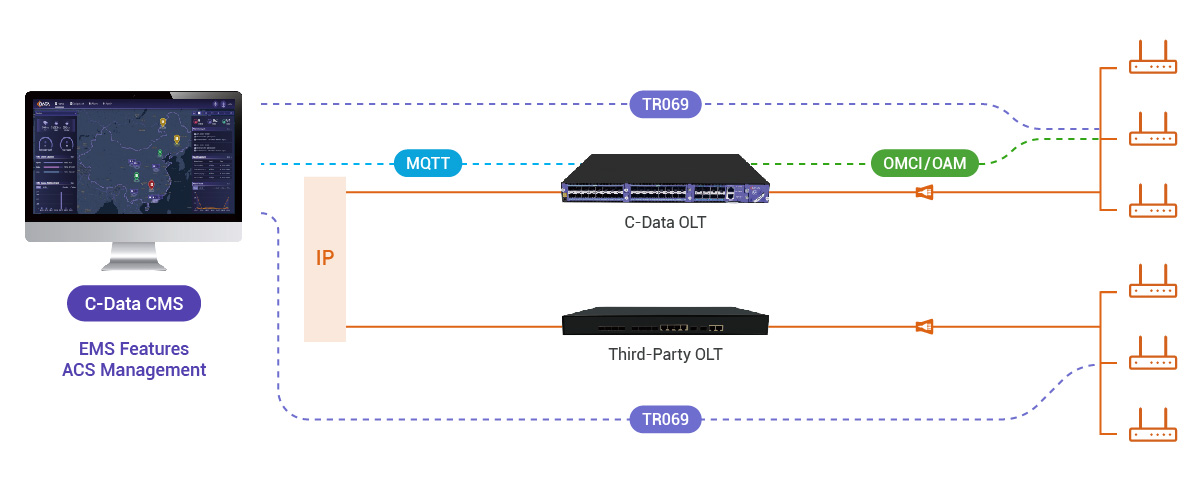
To improve efficiency and service quality, the operator deployed C-Data CMS, a management system that integrates EMS and TR-069 ACS. CMS centrally manages all OLTs and ONUs — OLTs via MQTT and ONUs via OMCI or TR-069 — helping the operator streamline workflows and strengthen remote maintenance. With CMS, the operator was able to perform batch configurations, firmware upgrades, and other routine management tasks. Further more, CMS provided comprehensive functionalities such as automated alerts, remote fault detection and troubleshooting, and intelligent business analysis - empowering the operator with more efficient maintenance.
Within just three months, the operator achieved 45% fewer on-site visits, a 40% improvement in fault response time, and a notable increase in customer satisfaction. With CMS in place, maintenance became easier, network performance more stable, and OPEX reduced.
Building on the success of this project, another client faced a different but equally critical challenge - maintaining consistent Wi-Fi performance across a rapidly growing network.
Case 2: CMS Empowers an ISP to enhance Wi-Fi ONU Management
A rapidly growing ISP aimed to expand service coverage while maintaining a stable wireless experience for end users. However, as the number of connected devices grew, wireless network maintenance became challenging:
Fault detection lacked accuracy and visibility, making it difficult to quickly locate the root cause when issues occurred.
Engineers had to configure each device manually for network optimization, driving up operational costs and workloads.
Frequent Wi-Fi instability and connection drops caused rising dissatisfaction among users.
Intelligent Wi-Fi Management with CMS:
To address the growing difficulty of maintaining stable Wi-Fi performance, the operator deployed CMS. With real-time monitoring of Wi-Fi ONUs and in-depth analysis of key performance metrics, CMS gave the operator clear insights into network health and allowed issues to be identified far more quickly and accurately than before. CMS also enabled one-click Wi-Fi optimization, allowing the operator to resolve problems within minutes and consistently provide a smooth and reliable experience for end users.
After deploying CMS, the operator saw immediate improvement: on-site visit dropped 50%, fault response time improved 45%, and user downtime was significantly reduced. As a result, network stability increased, and customer satisfaction continued to rise.

This is the first one.