 Optical Transport Networking Solution
 FTTH Solution
 Home Networking Solution
 POL Solution
 Outdoor OLT Solution
 More
 Brand News
 Product News
 Tech Blogs
 CMS
 Tech Support
 Document Download
 Software Download
 FAQ
 Training Center
 About Us
 Careers
 Partners
 Quality Assurance
 Video Center


This website uses cookies to ensure you get the best experience. Some cookies are essential, while others help
us improve your experience by analyzing data or showing personalized content.
For details, please see our
Privacy Policy.

Passive Optical LAN (POL) is rapidly becoming the preferred architecture for modern enterprise campuses, hotels, hospitals, universities and large office buildings. Unlike traditional copper-based Ethernet LANs that rely on multiple layers of powered switches in telecommunications closets, a POL solution uses a central OLT, passive optical splitters and endpoint ONU device units to deliver high-bandwidth connectivity over single-mode fiber. This approach dramatically reduces power consumption, floor space and long-term operating costs while providing future-proof bandwidth.
This article focuses exclusively on the enterprise POL use case. It examines how fiber optic ONU models from C-Data company are applied in real campus environments, and why more organizations are choosing POL over conventional active Ethernet.
The global Passive Optical LAN market was valued at approximately $8.6 billion in 2025 and is projected to reach $22.4 billion by 2034, growing at a CAGR of 11.2 %. Industry analyses consistently show that POL can reduce LAN-layer power consumption by 55–70 % and lower 10-year total cost of ownership by 30–40 % compared with traditional copper-switch architectures. According to Dell’Oro Group research summarised in recent industry reporting, “enterprise and data-centre PON deployments are expected to increase dramatically,” (https://techblog.comsoc.org/2026/08/10/delloro-enterprise-pon-deployments-expected-to-increase-844-year-over-year/) with one projection indicating an 844 % year-over-year rise in certain data-centre PON equipment revenues as organizations seek lower-cabling and lower-power solutions.
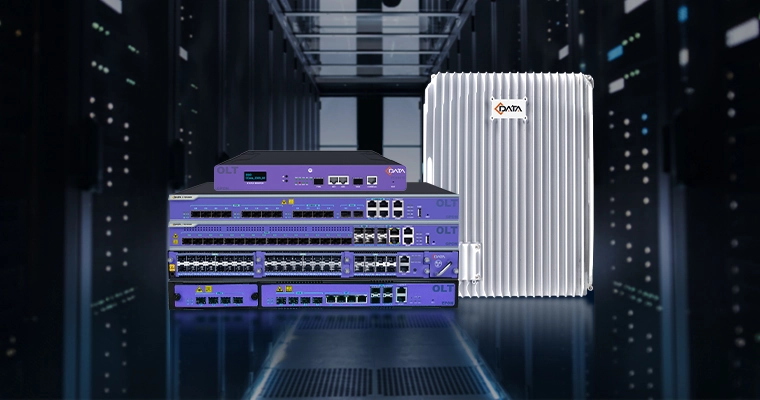
In a typical multi-story office or campus, traditional copper-based LANs require telecommunications rooms and access switches positioned to keep copper cabling within Ethernet distance limits. These switches consume power, generate heat and require cooling, floor space and ongoing maintenance. A POL solution replaces those active intermediate switches with passive optical splitters. PON access functions are centralized at the OLT located in the main equipment room, while compact Panel-Type ONU units serve individual workstations, classrooms, hotel rooms or hospital wards.
The architectural shift brings several measurable advantages. Copper horizontal cabling is largely replaced by lightweight single-mode fiber, reducing pathway congestion and cable tray loading. Because the optical distribution network contains no powered electronics, the need for dedicated telecommunications closets shrinks dramatically. Many projects report the ability to reclaim former IDF rooms for revenue-generating or functional space. At the same time, the centralized OLT model simplifies network management, security policy enforcement and future bandwidth upgrades.

Different areas of a building impose different physical and service requirements, so endpoint selection is critical.
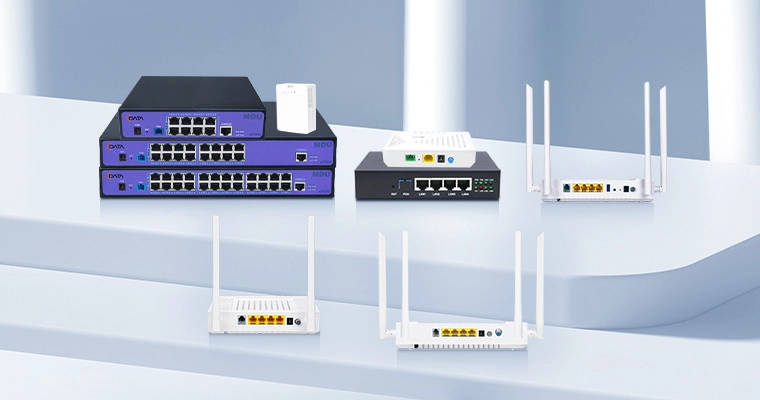
Open-plan offices and cubicle areas typically use compact xPON 1GE ONU or standard ONU box units that provide one or more Gigabit Ethernet ports. These devices sit discreetly under desks or in floor boxes and deliver reliable wired connectivity for workstations and IP phones.
Hotel guest rooms, student dormitories and hospital patient rooms benefit strongly from Panel-Type xPON ONU for FTTH designs. These units fit standard 86-type wall boxes, incorporate fiber splicing and strain-relief features, and present a clean, low-profile faceplate. The compact wall-mounted design keeps the optical termination and cabling neatly integrated into the room environment.
Meeting rooms, classrooms, nurse stations and collaborative zones often require more services. Here triple-play ONU models that combine high-speed data, POTS voice, and IPTV or CATV services. A single fiber drop can therefore support internet access, telephony and video simultaneously.
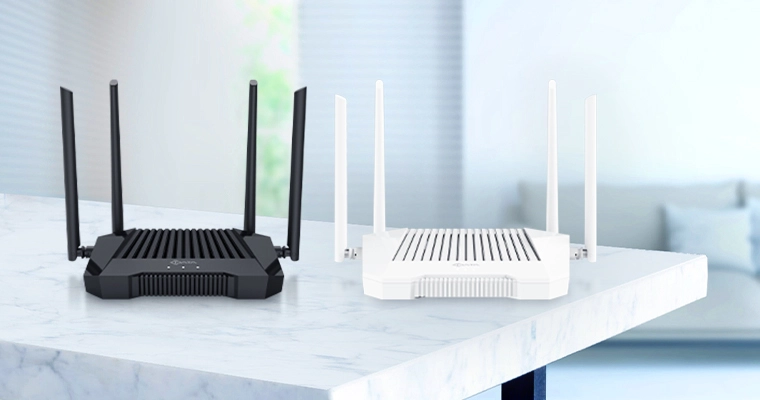
Areas that also need wireless coverage can employ integrated Wi-Fi capable ONUs. In some deployments this reduces the number of separate wireless access points required, further lowering both capital and power costs. When organizations evaluate ONU router price, they increasingly weigh these integrated models against the total cost of separate ONT-plus-access-point combinations.
Connector choice remains important throughout. Many POL designs specify SC/APC optical connectors to minimize optical back-reflection and provide high return loss on the longer indoor fiber runs typical of multi-building campuses.

Once the network is commissioned, a POL infrastructure behaves like a conventional LAN from the end-user perspective. Computers, IP phones, wireless access points, printers and IoT sensors simply connect to the Ethernet ports of the local ONU device. Behind the scenes, the central OLT performs dynamic bandwidth allocation, applies quality-of-service policies and continuously monitors optical and performance parameters.
Network administrators manage the entire campus from a single interface using C-Data CMS. VLAN segmentation isolates guest, staff, clinical or research traffic. Security policies, port authentication and firmware updates can be pushed centrally, eliminating the need for technicians to visit dozens of telecommunications closets. Because the optical distribution network itself is passive, there are fewer active failure points and less equipment that requires regular power or cooling maintenance.
Fault isolation is also simplified. Optical power levels, error counters and dying-gasp alarms from each ONU device are visible at the OLT, allowing rapid identification of fiber cuts, dirty connectors or endpoint failures.
University campus A multi-building university can place one or more high-density OLTs in the central IT facility and extend fiber to every classroom, laboratory, library and dormitory. Panel-Type ONU provides clean wall outlets for students and staff, while higher-port models support specialized laboratory equipment. Centralized management makes semester-start provisioning and security policy changes far faster than in a traditional distributed-switch environment.
Hotel or hospitality property Each guest room receives a Panel-Type xPON ONU. A single fiber drop delivers high-speed internet, IPTV and voice services. The dramatic reduction in copper cabling and intermediate switches frees valuable space in risers and equipment rooms while lowering energy costs — metrics that large hotel chains track closely.
Hospital or healthcare facility POL supports the high reliability, security and regulatory requirements of medical environments. Separate VLANs isolate clinical systems, guest Wi-Fi, administrative traffic and building-management systems. Compact ONU device units can be installed close to nursing stations or inside patient rooms without occupying large equipment closets that would otherwise be needed for Ethernet switches.
Corporate headquarters or government building Long optical reach allows a single OLT to serve distant wings, annex buildings or parking structures that would otherwise require additional switch rooms and copper horizontal runs. As new floors or departments are added, additional splitters and endpoint ONUs are required; the core OLT capacity can be expanded modularly.
Independent studies repeatedly confirm that POL delivers substantial financial and environmental benefits. Power consumption at the LAN layer can drop by more than half because dozens or hundreds of intermediate switches are eliminated. Cooling loads in former telecommunications closets fall correspondingly. Over a 10-year lifecycle, total cost of ownership is frequently 30–40 % lower than an equivalent copper-based design. These savings align directly with corporate sustainability goals and help organizations meet internal or regulatory energy-reduction targets.
The fiber infrastructure itself has a service life measured in decades. Bandwidth upgrades may reuse the existing ODN while OLT and ONU equipment is upgraded, provided the ODN meets the requirements of the target PON technology.
Successful POL projects require careful attention to several practical details:
· Accurate optical power-budget calculation that accounts for splitter loss, fiber attenuation and connector losses
· Selection of appropriate split ratios for the expected user density
· Choice of endpoint form factors that match the physical environment and aesthetic requirements
· Consistent use of SC/APC connectors where return-loss performance is critical
· Early involvement of the facilities and cabling teams so that fiber pathways and zone boxes are properly designed
· Verification that the chosen management platform (such as cdata software) integrates with existing network-management or building-management systems
C-Data designs, manufactures, and supplies both ONU and OLT equipment, providing the full chain of equipment needed for these projects. Organizations can explore the complete POL solution portfolio, matching Panel-Type ONU Specifications, or review complementary access platforms to design a cohesive campus network.
Operators and system integrators can start at the main C-Data site for a complete overview of enterprise-ready platforms, then explore the optical network unit lineup for model-level specifications, or review dedicated POL solution resources for deployment-specific guidance.
Passive Optical LAN represents a practical, high-performance use case for modern ONU device and OLT technology. By replacing layers of powered Ethernet switches with a central OLT, passive splitters and endpoint ONUs, organizations gain lower power consumption, reduced space requirements, simplified management and a future-proof fiber infrastructure. C-Data supports this use case with a coherent portfolio of C-Data xPON ONU and related models, together with C-Data management system CMS for centralized control.
As enterprises continue to prioritize energy efficiency, bandwidth scalability and total cost of ownership, the POL architecture is expected to see accelerating adoption across campuses, hospitality, healthcare and commercial buildings worldwide. The combination of proven optical technology, flexible endpoint options and mature management tools makes POL a compelling long-term foundation for the modern enterprise network.
1. What is the main advantage of a POL solution over traditional Ethernet LAN? POL eliminates most intermediate powered switches, reducing power consumption, cooling needs, floor space and long-term operating costs while providing higher bandwidth over fiber.
2. Which ONU types are most suitable for POL deployments?
The choice depends on the application. Compact desktop ONUs suit standard wired access, panel-type ONUs are useful for rooms where space and aesthetics matter, and multi-port or Wi-Fi-capable ONUs can support areas requiring multiple services or local wireless access.
3. Can existing fiber infrastructure be reused for POL?
In many cases yes. Existing single-mode fiber and passive splitters may be reused when upgrading the PON system, provided the ODN meets the wavelength, optical-budget and other requirements of the target PON technology.
4. How does management work in a POL network?
A central OLT and management platform such as cdata software CMS allow administrators to configure, monitor and upgrade all endpoint ONUs from a single location.
5. Is POL suitable for high-security environments such as hospitals or government buildings?
Yes. POL can support VLAN segmentation, access control and centralized policy management for traffic isolation, but overall security still depends on the complete network design and security architecture.
6. What cost savings can organizations typically expect?
Industry analyses indicate 30–40 % lower 10-year total cost of ownership and 55–70 % reduction in LAN-layer power consumption compared with traditional copper-based designs.
7. Where can I find C-Data equipment for POL projects?
Suitable OLT and ONU models, together with dedicated POL resources, are available through the C-Data product and solution sections.


