 Optical Transport Networking Solution
 FTTH Solution
 Home Networking Solution
 POL Solution
 Outdoor OLT Solution
 More
 Brand News
 Product News
 Tech Blogs
 CMS
 Tech Support
 Document Download
 Software Download
 FAQ
 Training Center
 About Us
 Careers
 Partners
 Quality Assurance
 Video Center


This website uses cookies to ensure you get the best experience. Some cookies are essential, while others help
us improve your experience by analyzing data or showing personalized content.
For details, please see our
Privacy Policy.

Smart communities rely on a stable network to support residential broadband, IP surveillance, access control, public Wi-Fi, smart parking, and IoT devices. Although these services can share the same fiber infrastructure, they have different bandwidth, security, and availability requirements.
An Optical Line Terminal (OLT) serves as the central access node in a PON network, aggregating traffic from ONUs that connect residential users and community service equipment. With appropriate VLAN segmentation, Quality of Service (QoS), ONU management, and fault monitoring, operators can separate services, control traffic, and build a network that is easier to maintain and expand.
The challenge is to keep services properly isolated and reliable as the community grows, without adding unnecessary operational complexity.
Different smart community services place different demands on the network. Residential broadband experiences changing traffic levels throughout the day, surveillance cameras generate continuous video streams, and access control systems exchange operational data. Property management platforms may also carry information that should not be accessible to residents or public Wi-Fi users.
Without proper segmentation, congestion or misconfiguration in one service can affect others. VLANs help separate traffic into distinct Layer 2 domains, while access control policies restrict unnecessary communication between networks. QoS can then prioritize traffic according to service requirements.
A PON architecture provides a practical foundation for this design. The OLT aggregates traffic from multiple Optical Network Units (ONUs), allowing operators to apply service profiles and traffic policies according to the capabilities of the deployed equipment. These requirements should be considered when planning suitable FTTH solutions for smart community networks.
However, VLANs alone do not guarantee complete security or uninterrupted service. Firewall rules, management access controls, sufficient bandwidth, and appropriate upstream network design are also essential.
A typical smart community network connects an OLT to multiple ONUs through passive optical splitters. Each ONU serves a building, floor, residential unit, or equipment location, depending on the deployment.
Operators can assign separate VLANs to residential broadband, surveillance, public Wi-Fi, access control, and property management. For example, camera traffic can be directed to an authorized monitoring platform, while residents access the internet through their own service VLANs. Public Wi-Fi users remain separated from internal administrative systems.
Service | Recommended approach | Main priority |
Residential broadband | Subscriber VLANs and service profiles | Fair bandwidth allocation |
IP surveillance | Dedicated surveillance VLAN | Stable video transmission |
Property management | Restricted business VLAN | Access control and availability |
Public Wi-Fi | Dedicated service VLANs and client isolation | User access isolation |
Access control and IoT | Segmented service VLANs | Reliable, controlled communication |
Network management | Restricted management VLAN | Secure OLT and ONU administration |
This approach allows multiple services to share fiber infrastructure without placing all devices on one unrestricted network. It also makes troubleshooting easier by helping operators identify the affected service segment.
For stronger protection, restrict unnecessary inter-VLAN communication and secure management interfaces with appropriate authentication and access policies. Segmentation should be part of a broader security design, not a substitute for it.
Bandwidth planning should reflect actual service demand. Residential broadband may peak in the evening, while surveillance cameras generate sustained upstream traffic. Public Wi-Fi demand varies with user density, and access control systems generally use little bandwidth but may be operationally important.
In GPON networks, multiple ONUs share the PON’s upstream capacity. Dynamic Bandwidth Allocation (DBA) helps coordinate upstream transmission according to configured policies and reported demand. Depending on equipment capabilities, OLT traffic management and QoS functions can also classify traffic, assign priorities, and enforce rate limits.
Operators should prioritize services according to their real requirements. Surveillance needs sufficient sustained upstream capacity, while residential broadband and public Wi-Fi may require appropriate bandwidth limits. Access control may need dependable forwarding, but its low bandwidth demand does not automatically justify the highest priority.
Effective planning should account for peak traffic, simultaneous camera streams, PON split ratios, uplink utilization, and aggregation capacity. QoS policies should be consistent across the OLT, ONUs, switches, and upstream network wherever supported.
QoS cannot create additional physical bandwidth. If demand exceeds capacity, operators may need to redistribute ONUs across OLT PON ports, increase uplink capacity, or upgrade the access network.
Service isolation can fail when VLANs are misconfigured, management traffic shares insufficiently protected paths with user services, or QoS policies do not reflect the needs of each application. For example, inadequate bandwidth allocation may cause video surveillance streams to lag during peak residential usage, while incorrect VLAN separation can expose management interfaces or allow unwanted traffic between services.
Operators should also review isolation and bandwidth policies whenever new buildings, ONUs, or services are added, as outdated configurations can create bottlenecks and intermittent connectivity. To maintain network stability, validate VLAN assignments end to end, restrict management access, test QoS behavior under peak load, and document configuration changes before deployment. These checks help keep residential broadband, security systems, and property management services operating independently on a shared fiber infrastructure.
Network reliability depends on where a failure occurs and how many services share the affected resources. Although passive optical distribution reduces the need for powered equipment in the access path, it does not eliminate the risk of service interruption.
Failure point | Potential impact | Recommended measure |
Individual ONU | Connected devices lose access | Monitor ONU status and maintain replacement procedures |
Fiber drop or branch | Affected ONUs lose connectivity | Document fiber routes and inspect optical performance |
PON port | All ONUs served by the affected port may lose access | Check port status and available protection mechanisms |
Feeded fiber | Multiple ONUs may lose connectivity | Consider fiber route diversity and supported protection architectures |
OLT | A large group of access services may be interrupted | Evaluate equipment redundancy and recovery procedures |
OLT uplink or aggregation device | Multiple service segments may lose connectivity | Consider redundant links and upstream path diversity |
Operators should distinguish between local faults and shared-resource failures. An individual ONU issue may affect one service point, while a shared PON or uplink failure can disrupt multiple buildings.
Redundancy should reflect service criticality and acceptable recovery time. Options may include redundant uplinks, backup power, spare equipment, and supported protection architectures. Physical diversity matters: two connections that share the same cable route, power source, or aggregation device may still fail together.
The actual protection behavior of the selected OLT network device and connected equipment should be verified rather than assuming that multiple ports provide end-to-end redundancy.
Centralized monitoring helps operators manage large numbers of ONUs, buildings, and service segments without relying entirely on manual investigation. Depending on the platform, an OLT management system can report device availability, ONU registration status, alarms, optical parameters, port utilization, and configuration information.
When a resident reports slow internet or a property manager reports missing camera feeds, troubleshooting should begin by identifying the affected service and determining whether the issue is local or widespread. Operators can then check ONU and PON status, review bandwidth and QoS settings, verify VLAN and uplink configuration, and test the path to the intended destination.
Establishing normal operating baselines also helps identify recurring alarms, changing optical levels, uplink congestion, and repeated service interruptions. These indicators can reveal developing problems before they lead to broader outages.
Remote monitoring cannot replace physical inspection. Fiber damage, contaminated connectors, power issues, and faulty endpoint devices may still require on-site investigation. Combining centralized visibility with documented field procedures helps reduce unnecessary visits and improve fault resolution.
Smart communities often add services in stages. A network initially designed for broadband and surveillance may later need to support smart parking, environmental sensors, public Wi-Fi, and additional property management systems. Planning for expansion early helps avoid costly redesigns and disruptive changes.
Operators should estimate future ONU counts, PON port requirements, uplink capacity, and management needs. Chassis OLTs or expandable OLTs can suit a larger community with phased growth, while a compact Mini OLT may be sufficient for a smaller deployment. Outdoor equipment can be considered where indoor facilities are unavailable, provided that environmental protection, power, and installation requirements are met.
Standardized VLAN assignments, ONU profiles, naming conventions, and configuration documentation make it easier to add buildings consistently. Before introducing major changes, operators should test new configurations, maintain backups, and define rollback procedures.
Capacity planning must also cover the complete service path. An OLT upgrade alone will not resolve congestion caused by overloaded aggregation switches, insufficient uplinks, limited internet connectivity, or constrained video recording systems. Reliable expansion requires coordination across the access, aggregation, and application layers.
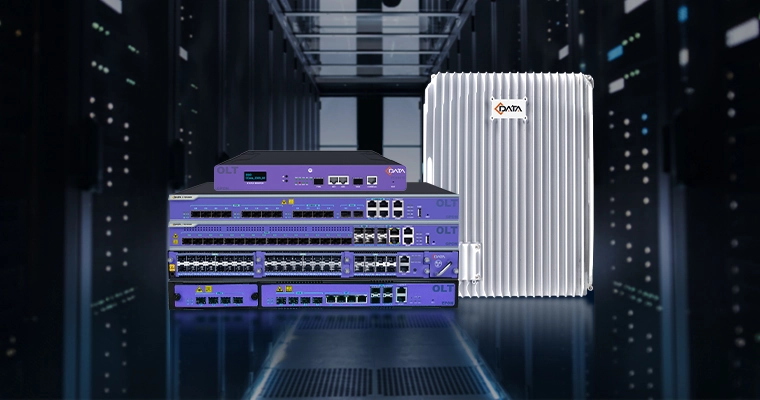
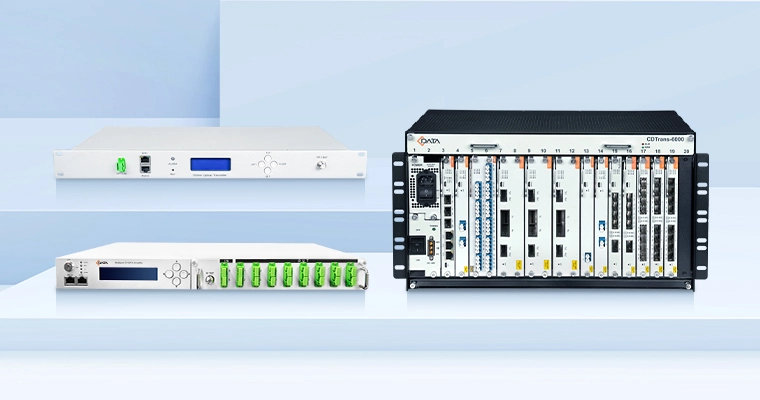
C-Data offers a range of GPON, EPON, and Combo PON OLTs to support different smart community network requirements. Mini OLTs provide compact, space-efficient options for small-scale and edge deployments, while pizza-box OLTs and expandable OLTs are suited to standard access network deployments. For larger networks or phased capacity expansion, Chassis OLTs offer more flexible options to accommodate growing subscriber demand.
Combined with C-Data CMS for centralized monitoring and management, these OLT solutions help operators maintain visibility across multiple access sites, simplify network operations, and support future community expansion.
A PON network can provide a scalable foundation for smart communities, but reliable operation depends on more than connecting buildings and devices through fiber. Operators need to separate services appropriately, allocate bandwidth according to demand, monitor network health, and plan for failures at both the access and upstream layers.
VLANs, QoS, ONU management, capacity planning, and suitable redundancy mechanisms work together to improve network control. The most effective design balances service isolation, operational simplicity, reliability, and future expansion.
Yes. A PON network can support residential broadband, surveillance, public Wi-Fi, and property management when the OLT, ONUs, and connected equipment support the required configurations. VLANs, service profiles, and QoS help manage different traffic types.
Centralized monitoring and alarms can help operators identify faults faster. Depending on equipment capabilities and network design, redundant uplinks, supported protection mechanisms, backup power, and documented recovery procedures can further improve service continuity.
GPON may be sufficient when subscriber demand, surveillance traffic, split ratios, and uplink capacity remain within planned limits. Communities with higher bandwidth requirements or substantial growth forecasts should also evaluate higher-capacity options such as XGS-PON.
Key indicators include ONU availability, PON status, optical alarms and parameters where supported, bandwidth utilization, uplink performance, configuration changes, and recurring service faults. Monitoring should be combined with physical inspections and documented troubleshooting procedures.


